
Attic mold removal in Naperville, IL, typically costs between $1,000 and $6,000 according to published 2026 guides, with small, easy-to-reach patches at the lower end. However, jobs involving wet insulation or structural damage can increase costs to $10,000 to $15,000. The final price for attic mold remediation is primarily driven by the mold's square footage, insulation type, roof access, and the chosen cleanup method. Crucially, addressing the moisture source is essential to prevent recurrence and avoid additional costs.
Most Naperville homeowners should expect attic mold removal to land somewhere between $1,000 and $6,000, with small, easy-to-reach patches at the low end and jobs that involve wet insulation or damaged roof sheathing at the high end. Published ranges vary by source, and the real number depends on how much mold there is, what it has grown on, and whether the moisture that fed it has been fixed. Below, we break down the ranges, the cost drivers, what a written estimate should contain and how to compare quotes without overpaying for work you don’t need.
What is the typical cost of attic mold remediation in Naperville?
- Typical attic mold remediation in Naperville runs about $1,000 to $6,000, according to published 2026 guides. Jobs involving insulation replacement or structural damage can reach $10,000 to $15,000. The price is primarily influenced by square footage, insulation type, roof access, and the cleanup method. The moisture source is crucial, as it determines if you pay once or twice. A good estimate should be written, detail areas and materials, state the containment method, include the moisture fix, and specify how success will be verified. Independent clearance testing is an additional cost, estimated at $300 to $800 in the Chicago area. We offer free estimates, with our attic work beginning with a diagnosis rather than a price guess.
Table of Contents
- What attic mold removal costs in Naperville
- What pushes an attic job up or down
- What a written estimate should include
- How to compare quotes
- Can you do it yourself to save money?
- Does insurance cover attic mold?
- Get an attic estimate in Naperville
- FAQ
- Sources
What attic mold removal costs in Naperville
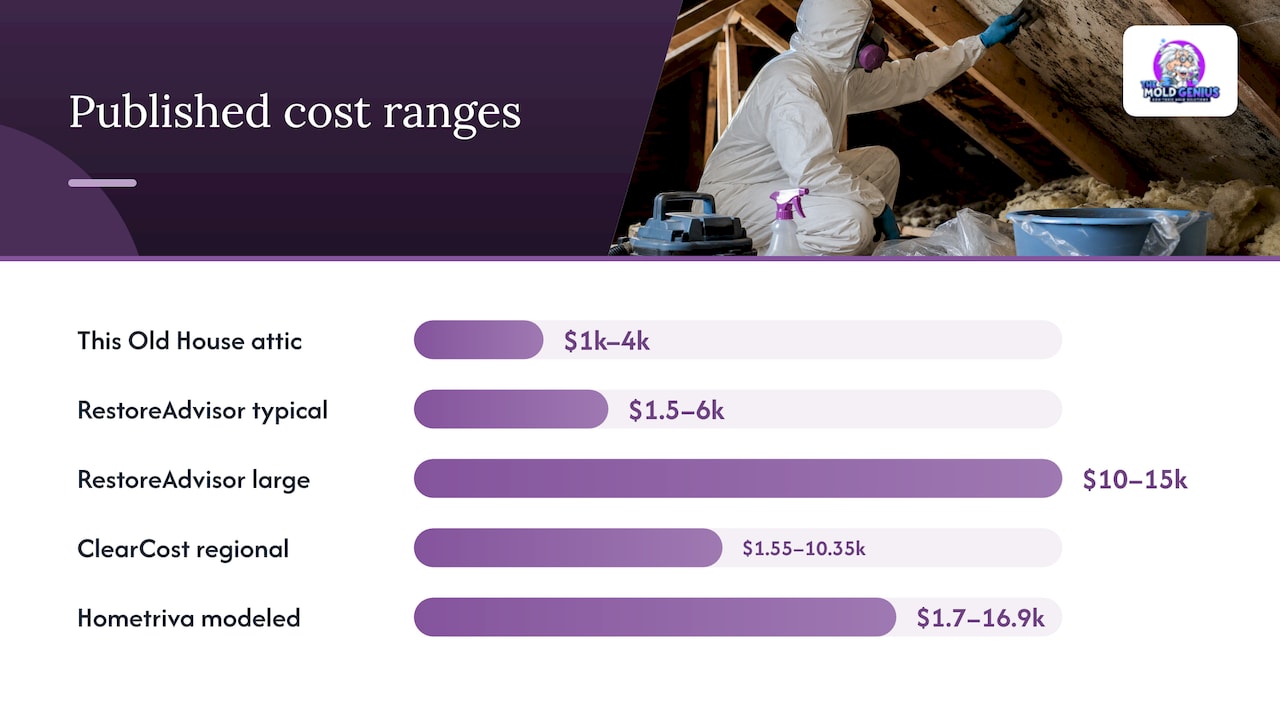
No single page can give you your price without someone looking at the attic. What we can do is lay the published ranges side by side so you know whether a quote is in a believable zone.
| Source | Scope | Range |
|---|---|---|
| This Old House | Attic mold removal | $1,000 to $4,000 |
| RestoreAdvisor | Attic mold remediation, most homes | $1,500 to $6,000 |
| RestoreAdvisor | Large jobs with insulation replacement or structural damage | $10,000 to $15,000 |
| ClearCost | Any mold remediation, Chicago-Naperville-Elgin area (April 2026) | $1,550 to $10,350, average $4,150 |
| Hometriva | General mold remediation in Naperville (August 2026), modeled estimate, not a quote | $1,700 to $16,900, about $13.50 to $39.50 per affected square foot |
Two things stand out. First, the attic-specific figures cluster between roughly $1,500 and $6,000. Second, the wide whole-house ranges include basements, crawlspaces and water-damaged rooms, which are different jobs. If someone quotes you $12,000 for a modest patch of mold on roof sheathing, ask what is in the scope. If someone quotes $300, ask what is left out.
The figures above are published estimates from third-party sites, not our prices. We do not publish a fixed price for attic work because the attic decides it. We give free estimates after an on-site look, so the number you get is tied to your house.
What pushes an attic job up or down
Attics are hard to price from the driveway. Six factors do most of the work.
How much mold, and on what
The EPA draws a rough line at about 10 square feet. Its homeowner guide treats a patch smaller than that as a small problem, and it also notes that porous materials may be difficult or impossible to clean completely and may need to be thrown away. Mold on hard framing is a cleaning job. Mold that has spread across a roof deck, rafters and insulation is a bigger one, and the price follows the surface area.
If you are trying to size up what you saw with a flashlight, our guide to the 10 square foot rule for mold on attic insulation walks through how the threshold plays out by material.
Insulation that has to come out
Insulation is often the line item that surprises people. RestoreAdvisor notes that porous insulation such as fiberglass batting generally cannot be cleaned and must be removed and replaced, which adds cost. The EPA’s worker and employer guide says porous materials such as insulation, drywall and ceiling tiles that have stayed wet for more than 48 hours are generally best removed and replaced.
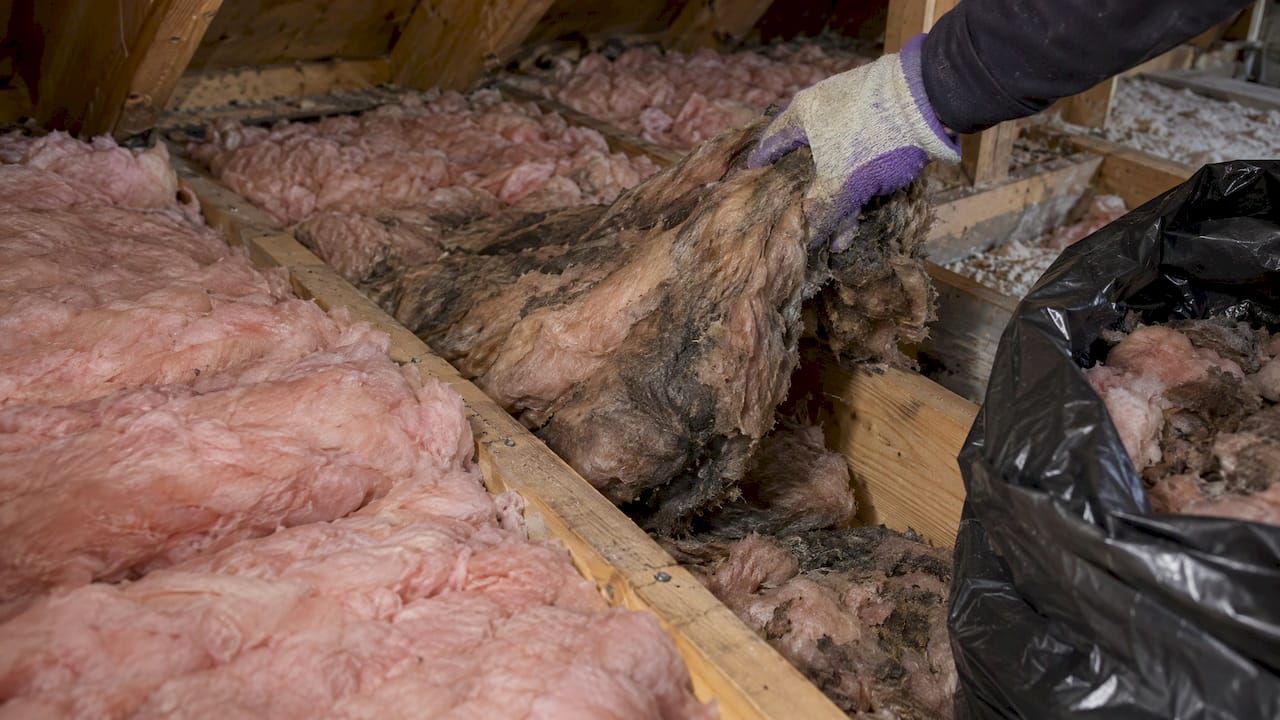
So a moldy attic with wet insulation is two jobs: remediation and re-insulating. Our attic insulation removal cost breakdown covers that side in detail. If the insulation has also been fouled by animals, cleaning contaminated attic insulation is its own step that should be settled before anything is put back.
The cleanup method
Heavy-duty methods cost more. RestoreAdvisor estimates that soda or dry ice blasting, which can work better on structural wood, adds roughly $500 to $1,500 over manual scrubbing. Ask which method a quote assumes and why.
Access and attic layout
A walk-up attic with decking is quicker to work in than a cramped truss attic with a 24-inch hatch. Tight access means more labor hours, more careful containment and, in some cases, specialized equipment. This is also where a method that reaches into corners and behind obstacles earns its keep.
The moisture source
This is the factor that decides whether you pay once. The EPA’s homeowner guide puts it plainly: clean up the mold and fix the water problem, because if you clean the mold without fixing the water, it will most likely come back. The worker guide lists roof and plumbing leaks, condensation and gutters that direct water into a building as common sources.
In Naperville attics, the usual suspects are:
- Roof leaks around flashing, vents and chimneys. See how roof leaks drive attic mold growth and the steps in remediation after a roof leak.
- Condensation from warm indoor air reaching a cold roof deck during Chicago-area winters. Our guide to attic condensation mold causes and solutions explains the mechanics, and the page on recurring sheathing mold covers condensation-first fixes.
- Bathroom or kitchen fans that vent into the attic instead of outside.
- Blocked soffit vents, often from insulation pushed against the eaves.
Fixing a vent duct is cheap. Replacing a section of roof deck is not. A quote that ignores the source is cheaper today and more expensive in two years.
Verification after the work
Clearance testing confirms the job worked. RestoreAdvisor estimates independent clearance testing adds about $300 to $800 in the Chicago area. That is a separate line from the remediation itself, and it is money well spent on a larger job. Our homeowner’s guide to how remediation is verified explains what the process looks like.
What a written estimate should include
A price without a scope is just a number. According to the same Chicago cost guide, the written scope should identify the specific rooms and materials, the containment method, the moisture-source fix and the clearance-testing plan. In practice, ask to see these items on paper:
- Areas and materials. Which rafters, sheathing sections and insulation runs are included, with approximate square footage.
- Method. How the mold will be removed or treated, and whether any material will be replaced rather than cleaned.
- Containment. How the work area is sealed off so spores do not travel into the living space.
- Moisture fix. What will be done about the leak, condensation or ventilation problem, and by whom.
- Insulation. Whether replacement is included or quoted separately.
- Verification. Who does the post-work check and what happens if it fails.
- Warranty. What is guaranteed, for how long and in writing.
If an item is missing, ask for it before you sign. Vague quotes are where change orders come from.
How to compare quotes
Get at least two written estimates and compare scope first, price second. Three checks help.
Certification and insurance. RestoreAdvisor’s Chicago guide advises checking third-party certification and insurance. This is also moving from advice to rule: trade press reports that Illinois passed the Mold Remediation Registration Act, which requires remediation professionals to hold third-party certification and register with the state. Check the state’s current requirements and ask any contractor for proof.
Independent testing. Whoever does the cleanup should not be the one declaring it clean. Using a separate assessor for clearance removes the conflict of interest.
Same scope, same assumptions. One quote may include insulation replacement and another may not. Line them up item by item. For more on that decision, see mold remediation vs. mold removal, because the words contractors use are not always used the same way.
Can you do it yourself to save money?
For a small, dry, accessible spot, the EPA says a homeowner can usually handle an area under about 10 square feet, provided the water problem is fixed and wet materials are dried within 24 to 48 hours. Past that, or when insulation is involved, or when you cannot find where the moisture is coming from, the economics change. Insulation is difficult to clean, hidden mold is easy to miss, and an unfixed source means a second bill. Our page on professional mold removal vs. DIY lays out where that line sits.
If anyone in the home has asthma, allergies, a weakened immune system or a respiratory condition, talk to your doctor before spending time in an attic with visible mold, and have a professional handle larger areas.
Does insurance cover attic mold?
Sometimes. Coverage usually depends on whether the mold came from a sudden, covered event such as a storm-damaged roof, rather than from long-term seepage or poor ventilation. Policies differ, so read yours and call your carrier before work begins. We work with the major carriers, including Allstate, State Farm, USAA, Farmers and Liberty Mutual, and our page on insurance-approved mold remediation covers what a claim typically needs: documentation, photos and a clear scope.
Our perspective
In our experience, the cheapest attic quote is rarely the lowest cost. Mold is the symptom. The roof leak, the condensation or the bathroom fan venting into the rafters is the cause, and a price that skips the cause is only a deposit on the next job.
That is why we start with diagnosis: moisture detection and thermal imaging to find what you cannot see from the hatch. Then we treat the mold with Pure Cloud, our dry fogging system that uses hospital-grade hydrogen peroxide and silver ions. It is designed to reach behind walls, above insulation and into tight corners, so we do not have to gut rooms or tear out more than the situation demands. Most jobs wrap up in a single day, and homeowners can return the same day.
We finish with prevention: assessing ventilation and insulation and fixing the root cause. Our approach is chemical-free and guaranteed, and it is backed by more than 400 Google reviews. We would rather give you a clear, free estimate and a scope you can read than a number that sounds good on the phone.
Alex
Get an attic estimate in Naperville
If you have found dark staining on the roof deck, a musty smell near the hatch or damp insulation, we will look at it, tell you what we find and put the scope in writing. The estimate is free. Start with our attic mold removal service, or see how we work in Naperville attic mold removal.

We also serve nearby communities, including Palatine, Mount Prospect and Schaumburg. If the attic mold started with a leak that also soaked ceilings or walls, our water damage repair and restoration team can handle that too.
FAQ
How much does attic mold removal cost in Naperville?
Published guides put attic mold remediation at roughly $1,000 to $6,000 for most homes, with jobs that involve insulation replacement or structural damage reaching $10,000 to $15,000. Your price depends on the affected area, the materials involved and the moisture source. We give free estimates after looking at the attic.
Is attic mold removal covered by homeowners insurance?
It can be, mostly when the mold results from a sudden covered event such as storm damage to the roof. Mold from slow leaks or poor ventilation is often excluded, so check your policy and contact your carrier before work starts. We can help document the damage for a claim.
Can I clean a small patch of attic mold myself?
The EPA says moldy areas under about 10 square feet can usually be handled by the homeowner, as long as the water problem is fixed and wet materials are dried within 24 to 48 hours. Insulation and other porous materials are often better removed and replaced. If the patch is larger or you cannot find the moisture source, call a professional.
Do I need clearance testing after attic remediation?
It is a good idea on larger jobs, and it is the way to confirm the work succeeded. Estimates for the Chicago area run about $300 to $800, and the test should come from an independent assessor rather than the company that did the cleanup.
Will attic mold come back after removal?
It will most likely return if the water problem is not fixed, according to the EPA. That is why a proper scope includes the roof leak, condensation or ventilation correction, not just the cleaning.
Sources
- How Much Does Mold Remediation Cost? (2026 Guide), This Old House
- Attic Mold: Causes, Removal Process & Costs (2026), RestoreAdvisor
- Mold Remediation Chicago IL: Costs & Sewer Backup Risk, RestoreAdvisor
- Mold Remediation Cost in Chicago-Naperville-Elgin, ClearCost
- Mold Remediation cost in Naperville, IL, Hometriva
- A Brief Guide to Mold, Moisture, and Your Home, EPA
- Mold: Worker and Employer Guide to Hazards and Recommended Controls, EPA
- New Illinois Law Mandates Certification for Mold Remediators, R&R