
Professional mold remediation in Barrington typically costs between $1,500 and $9,000, with an average near $3,500, or roughly $10 to $30 per square foot, according to national figures from sources like This Old House. The Mold Genius provides free estimates for Chicagoland homes, where actual costs depend on the scope of the job, not just the zip code. Price increases with the size of the affected area, how difficult it is to access, and whether porous materials like drywall or insulation need replacement. Angi's 2026 data shows a tighter band of $1,223 to $3,758 for most projects, indicating that typical, contained jobs fall on the lower end of the spectrum.
Most Barrington homeowners should expect professional mold remediation to cost between $1,500 and $9,000, with an average near $3,500, or roughly $10 to $30 per square foot. Where your job lands depends on how much area is affected, how hard it is to reach, and whether drywall, insulation or flooring has to come out. We don’t publish fixed prices because every house is different, and the only number that counts is one written after someone has looked at your space. Below is how to read the ranges, what changes them, and how to judge an estimate.
What is the typical cost of mold remediation in Barrington, IL?
- National averages put professional remediation at $1,500 to $9,000, with about $3,500 as the typical job. Barrington-specific quotes depend on scope, not on the zip code alone.
- Price rises with square footage, hard-to-reach spaces, porous materials that must be replaced, containment and disposal.
- Remediation, testing and rebuilding are separate line items. Make sure your estimate says which it covers.
- Standard homeowners insurance usually treats mold as a maintenance issue, but mold that follows a covered event such as a burst pipe may be covered.
- We offer free estimates for homes across Barrington and the surrounding Chicagoland suburbs.
Table of Contents
- What mold remediation typically costs
- What pushes the price up or down
- Cost by location in the home
- What a fair estimate includes
- Testing, inspection and why they are not the same as remediation
- When you can handle it yourself, and when to call a pro
- Will insurance pay for mold remediation?
- Can mold be fully remediated, and will it come back?
- Perspective: why the method changes the bill
- Get a Barrington estimate
- FAQ
- Sources
What mold remediation typically costs
The widest-cited national figures come from home-improvement cost guides. This Old House reports a range of $1,500 to $9,000, an average of $3,500, and $10 to $30 per square foot. Angi’s 2026 data shows a tighter band of $1,223 to $3,758 for most projects, and a per-square-foot rate of $10 to $25, so a 100-square-foot area runs about $1,000 to $2,500.
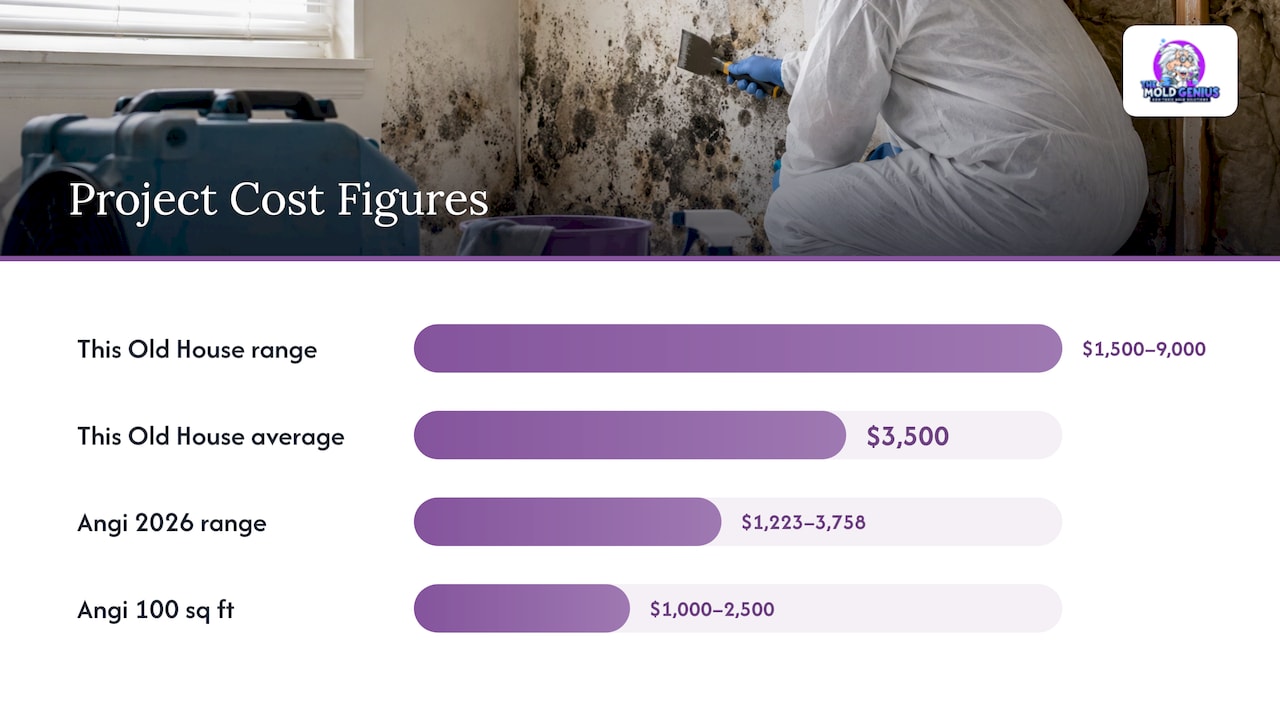
The two ranges differ because they count different things. The lower band reflects typical, contained jobs. The upper end reflects big, hidden or structural problems. Use the numbers as a frame, not a quote.
A rough way to place yourself:
| Situation | What it usually means for price |
|---|---|
| Small patch on a hard, nonporous surface | Low end, and often something you can handle yourself |
| One room or section of a basement, attic or crawlspace | Middle of the range |
| Growth inside walls, across insulation or in several rooms | Upper range, with added containment and disposal |
| Mold plus water damage and rebuilding | Remediation price plus separate repair costs |
What pushes the price up or down
This Old House’s 2026 cost guide lists the same factors we see on every site visit.
Size of the affected area
Square footage is the base of almost every estimate. A few square feet of surface growth is a different job from mold spread across a joist bay or a whole ceiling.
Access and hidden growth
Open, surface-level growth is cheaper to treat. Mold behind walls, above insulation, under flooring or in a tight crawlspace takes more time, more setup and more care. This is also where the method matters, because tools that reach hidden areas without demolition can keep a job smaller.
Porous versus nonporous materials
Porous materials such as drywall, insulation and carpet often have to be removed and replaced, while tile, sealed concrete and metal can usually be cleaned and disinfected. Every material that has to come out adds disposal, labor and a rebuild.
Containment, filtration and disposal
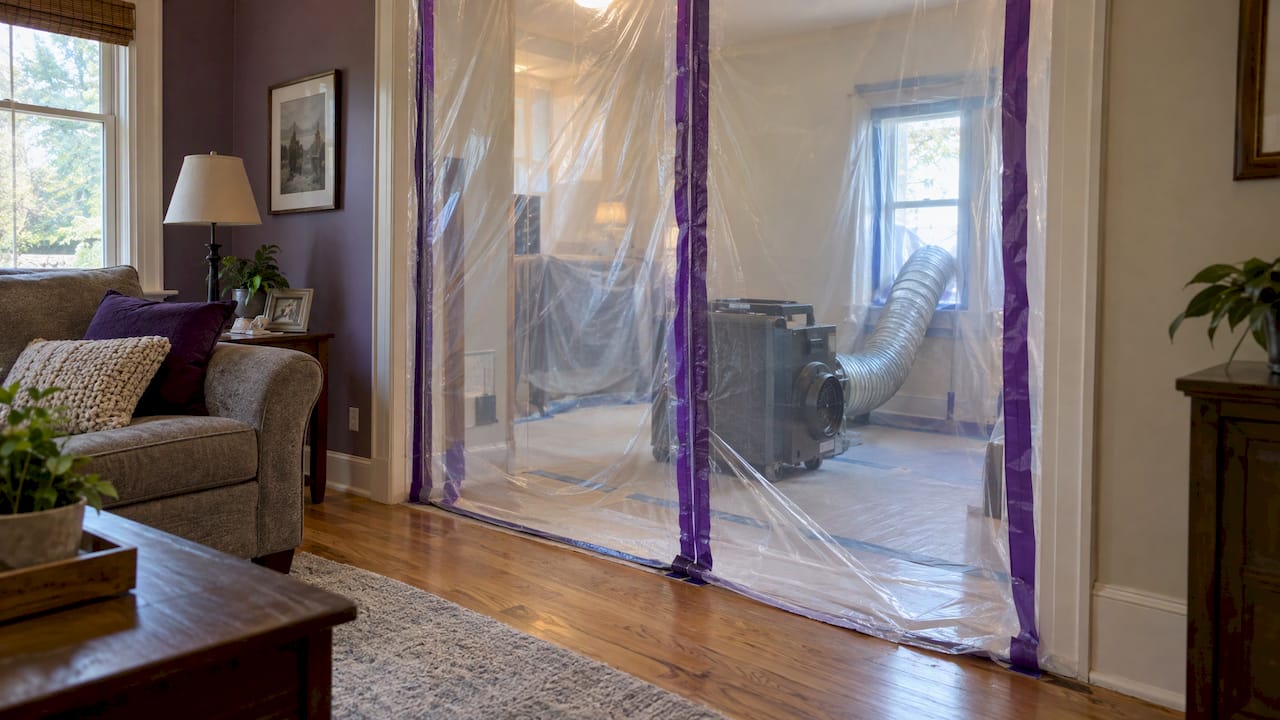
Good remediation keeps spores from traveling to clean parts of the house. That means barriers, negative air and HEPA filtration. If you want to see what that involves, our guide to mold containment walks through it.
HVAC and structural involvement
If ductwork or framing is affected, the scope grows. The EPA notes that a contaminated HVAC system can spread mold through the building, which is why it counts as a reason to call a professional rather than a detail to skip.
Cost by location in the home
Where the mold sits changes the price because tight spaces need more setup and cleanup. According to Angi, attic mold remediation averages $1,000 to $4,000. Basements and crawlspaces often run higher because of size, moisture and repair needs: a 2026 cost guide puts most basement and crawlspace projects at $1,500 to $9,000.
Here is what tends to drive each space:
- Attics. Temperature swings and poor ventilation feed the problem. The cost depends on how much roof sheathing and insulation is affected, and whether ventilation needs correcting. See our attic mold removal service for how we approach it.
- Basements. Size, finished versus unfinished walls, and the water source decide the price. Our basement mold removal page explains the work, and our basement mold remediation process guide breaks it into steps.
- Crawlspaces. Cramped access and damp soil raise labor. Read how crawlspace mold is treated before you compare quotes.
- Bathrooms. Usually the smallest jobs, often limited to ceilings, grout and drywall. Our bathroom mold removal page covers it, and the bathroom mold cost guide goes deeper.
- Garages. Usually moisture from slabs, leaks or stored items. See garage mold remediation.
What a fair estimate includes
A good estimate separates the work into clear pieces. Ask that each one be named.
- Moisture source. Mold returns if the water problem stays. The Illinois Department of Public Health says cleanup means fixing the moisture source, cleaning mold and removing damaged materials.
- Containment and air filtration. Barriers, HEPA filtration and protection of nearby rooms.
- Treatment method. What is cleaned, what is removed, and what product is used.
- Disposal. Bagging and hauling away contaminated material.
- Reconstruction. Remediation controls and removes contamination. Replacing damaged drywall, flooring, framing or cabinetry is usually priced separately.
- Clearance. How the contractor confirms the job is done. The EPA says remediation is not finished until the moisture problem is fixed, mold is removed, and visible mold and odors are gone.
The estimate should say plainly whether repairs are in or out. A low number that leaves out rebuilding is not really lower.
Testing, inspection and why they are not the same as remediation
Testing costs extra, and many homeowners assume they need it. Illinois public health guidance says visible mold generally does not need testing, because results do not change the cleanup steps and there are no standards for judging acceptable indoor mold levels. Angi suggests budgeting $250 to $350 for testing where it is warranted.
What does help is an inspection that finds where moisture is coming from and how far growth has spread, especially when you can’t see all of it. Our mold inspection cost guide for Barrington explains what to expect. Our own process starts with diagnosis using moisture detection and thermal imaging, so you are paying to find the actual extent, not guess at it.
When you can handle it yourself, and when to call a pro
The EPA says homeowners can usually handle moldy areas smaller than about 10 square feet. It points to professional help for larger areas, substantial water damage, suspected HVAC contamination, and sewage or other contaminated water. If anyone in the house has health concerns, talk to a doctor before cleanup starts.
The 10-square-foot line is a guide, not a guarantee. A small visible patch can sit on top of a larger hidden problem, and a leak that keeps feeding it will bring it back. Our comparison of professional mold removal versus DIY helps you decide, and the question of staying in the home during removal deserves its own look.
Will insurance pay for mold remediation?
Usually not on its own. The Insurance Information Institute explains that standard homeowners policies generally treat mold as a maintenance issue, but mold that results directly from a covered peril, such as a burst pipe, may be covered. Flood damage, maintenance damage and typically sewer backup are excluded unless you have separate coverage or an endorsement.
Practical steps:
- Read your policy for mold limits and water-damage wording before you call.
- Report a covered water event quickly and document it with photos.
- Ask your carrier what they require from the contractor.
We work with claims from carriers including Allstate, State Farm, USAA, Farmers and Liberty Mutual, among others. Our insurance coverage checklist lists what to gather. Coverage depends on your policy and the cause of the water, so confirm with your insurer.
Can mold be fully remediated, and will it come back?
Mold can’t be eliminated from indoor air and dust entirely, but it can be remediated. That means removing visible growth and contaminated material, fixing the moisture source, and confirming that growth and odors do not return. The EPA’s prevention guidance is concrete: dry wet materials within 24 to 48 hours, keep indoor humidity below 60%, ideally 30% to 50%, and use ventilation or dehumidification.
That is why prevention belongs inside the price. Money spent on cleanup without a moisture fix is money spent twice. Read how moisture causes mold, then use our post-remediation prevention checklist and the overview of how remediation prevents future mold. The same humidity logic applies to any enclosed space, which is why guides on removing mold from car interiors stress moisture control too.
Perspective: why the method changes the bill
Most of what makes mold jobs expensive is what has to be torn out to reach the problem. When a contractor has to open walls and gut a room, the remediation price is only the start. Demolition, disposal, rebuilding and days of displacement all follow.
That is why we built our work around Pure Cloud Technology, a dry fogging system that uses hospital-grade hydrogen peroxide and silver ions. It is designed to reach mold behind walls, above insulation and in tight corners, so many jobs avoid heavy demolition. Most jobs wrap up in a single day, and homeowners can return the same day.
We also treat the cause, not just the stain. Every job follows three phases: diagnosis with moisture detection and thermal imaging, removal, and prevention that addresses the root cause. A quote that skips any of the three is cheaper only until the mold comes back.
Alex
Get a Barrington estimate
We are a family-owned company with 25+ years of combined experience and more than 400 Google reviews, serving Barrington and the surrounding Chicagoland suburbs. Estimates are free, and we explain in writing what is included so you can compare quotes on equal terms.

Start with our Barrington mold removal services page, or contact us through The Mold Genius to schedule a visit. If you are selling, our realtor network program can help resolve mold issues before closing.
FAQ
How much does mold remediation cost in Barrington, IL?
National ranges run from $1,500 to $9,000, with an average around $3,500. A Barrington job falls somewhere in that band depending on area, access and materials. A free on-site estimate gives you the actual figure for your home.
Is professional mold removal worth it?
For areas larger than about 10 square feet, hidden growth, water damage or HVAC involvement, the EPA points to professional help. A professional also finds and addresses the moisture source, which is what keeps mold from returning. For a small patch on a hard surface, you can often handle it yourself.
Will insurance pay for mold in the attic?
Standard homeowners policies generally do not cover mold from poor ventilation or neglected maintenance. They may cover it when it results directly from a covered event, such as a burst pipe. Check your policy and ask your carrier before work begins.
Can black mold be fully remediated?
Mold can’t be wiped out of indoor air entirely, but visible growth can be removed and the moisture problem fixed so it does not return. Remediation is done when the water source is corrected, the mold and odors are gone, and there is no ongoing water damage.
Sources
- This Old House: What To Know About Household Mold
- This Old House: How Much Does Mold Remediation Cost? (2026 Guide)
- Angi: How Much Does Mold Remediation Cost? [2026 Data]
- The Basement Guide: Mold Remediation Cost Guide 2026
- Illinois Department of Public Health: Common Questions and Answers about Indoor Mold
- US EPA: A Brief Guide to Mold, Moisture and Your Home
- US EPA: A Brief Guide to Mold, Moisture, and Your Home (PDF)
- Triple-I: Protecting your home from mold
- Triple-I: Which disasters are covered by homeowners insurance?
- Diamondbrite: Mold removal from car interiors