
Basement water damage repair requires immediate action, starting with ensuring safety and stopping the water source, then removing water and drying within 24 to 48 hours to prevent mold growth. Forbes Home estimates the typical flooded-basement repair costs between $1,600 and $6,900, though standard homeowners policies often exclude flooding and seepage. The Mold Genius provides basement mold removal and water damage repair services for Chicagoland homeowners, helping address both the damage and its underlying cause.
Basement water damage repair has four jobs: make the space safe, remove the water, dry and clean everything that can be saved, and fix whatever let the water in. Do them in that order, and fast. Mold can start forming within 24 to 48 hours of water exposure, so the first two days decide how big the repair becomes. Below is the sequence we follow with Chicagoland homeowners, what the repair typically costs, and where insurance usually stops.
What are the key takeaways for basement water damage repair?
- Stay out of standing water until electrical, gas and structural hazards are ruled out, then stop the source, photograph everything and call your insurer.
- Aim to remove water and start drying within 24 to 48 hours. Pump out deep water in stages, not all at once.
- Carpet, padding and drywall that stayed wet or touched contaminated water usually have to go. Hard surfaces can be cleaned and disinfected.
- Forbes Home puts the typical flooded-basement repair between $1,600 and $6,900. Standard homeowners policies often exclude flooding and seepage.
- If mold covers more than 10 square feet, or the water keeps coming back, bring in a professional.
What topics are covered in this basement water damage repair guide?
- First, make the basement safe
- Document everything before you touch anything
- Removing the water without hurting the foundation
- What to throw out and what to save
- Cleaning and disinfecting hard surfaces
- Drying: where most repairs succeed or fail
- Mold after water damage: the 10 square foot line
- How much basement water damage repair costs
- Does insurance cover it?
- Fix the source, or it happens again
- Our perspective
- Getting help with your basement
- After the repair: keeping it dry
- FAQ
- Sources
First, make the basement safe
Before you think about repair, think about whether you can walk in. State Farm advises staying out of standing water until electrical, gas and structural hazards have been dealt with. Do not go in if:
- water may be touching outlets or the electrical panel
- the water is deep or moving quickly
- it may contain sewage
- you smell gas
- the structure looks damaged
In any of those cases, call your utility, an electrician or the fire department as the situation requires, and wait. A wet basement is never worth a shock.
If it is safe to enter, stop the source first. That might be a shut-off valve on a failed supply line, a water heater, or a sump pump that has quit. If the water is coming from outside, you can’t stop it yet, but you can stop making it worse.
Document everything before you touch anything
Your claim, if you have one, depends on what you can show. State Farm recommends taking photos and video of the apparent source, the water level, damage to floors, walls and ceilings, damaged appliances and furniture, and any exterior areas where water may have entered. Start an inventory of damaged property and keep receipts for anything you buy during cleanup.
Call your insurer early. Ask what your policy covers before you start throwing things out, and ask whether they need to inspect before cleanup. We work with homeowners filing through Allstate, State Farm, USAA, Farmers, Liberty Mutual and others, so we’re used to the paperwork a good record makes easier.
Removing the water without hurting the foundation
It is tempting to pump everything out at once. Don’t, if the water is deep. MU Extension explains that water in the basement helps brace the walls against pressure from saturated soil outside. Pump too soon and you risk cracking or rupturing the foundation, walls or floor. Pumping in stages lets the soil outside drain as the level inside drops.
Once water is down to puddles, NDSU Extension recommends using pumps and a wet/dry vacuum, and moving furniture to a dry area. Then scrub surfaces with hot water and a heavy-duty cleaner.
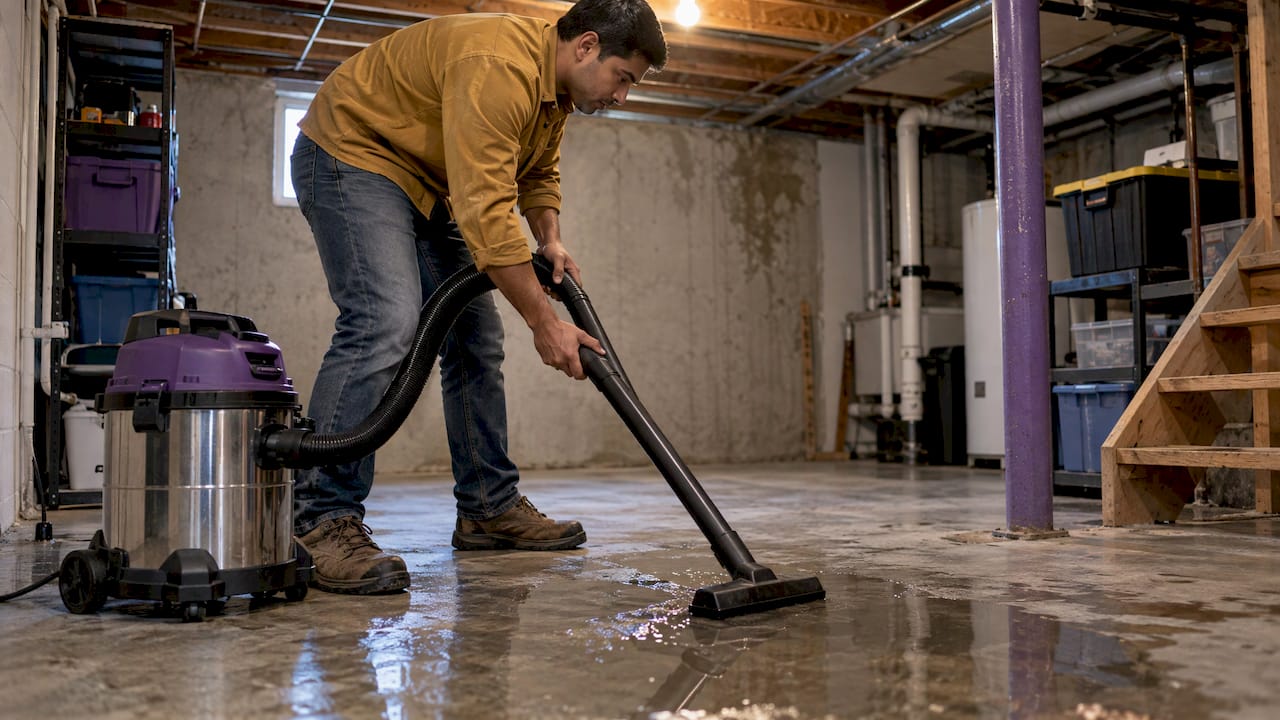
The goal across the board is to remove water and dry the area within 24 to 48 hours if possible. If the water was more than a few inches deep, or you can’t tell how clean it was, that is the point to call a restoration professional rather than push through alone.
What to throw out and what to save
The rule of thumb is simple: if it is porous and you can’t dry it fast, it goes.
| Material | Usually | Why |
|---|---|---|
| Carpet and padding | Remove | NDSU says they are extremely difficult to clean and dry adequately |
| Upholstered furniture | Remove if not dried in 24 to 48 hours, or if sewage or floodwater touched it | Illinois DNR guidance |
| Drywall | Replace if soaked or contaminated | Porous, so moisture moves through it and the inside can mold before the surface dries |
| Concrete floors and walls | Clean and disinfect | Hard, non-porous surfaces |
| Hard furniture and plastics | Clean and disinfect | Can be dried fully |
The Illinois DNR post-flood guide says to remove water-damaged carpets, padding and upholstered items that can’t be thoroughly cleaned and dried within 24 to 48 hours, or that were exposed to sewage or contaminated floodwater. This Old House goes further for contaminated water: porous items such as carpet and upholstery must be thrown away, and porous building materials like drywall must be replaced whatever type of floodwater reached them.
On drywall, there is a middle case. NDSU notes the exposed surface can be cleaned, but the inside may mold before it dries. If clean water touched it briefly and it dries quickly, it may be salvageable. If it sat wet, plan on cutting it out. Cutting more than you need is expensive, which is one reason we focus on finding where moisture actually is first (more on that below).
Cleaning and disinfecting hard surfaces
Clean first, disinfect second. The EPA’s flood cleanup guidance says to clean surfaces gently the first time, using a cloth dampened with clean water and detergent, to remove loose dirt and microorganisms. It also says to wait to start fans or dehumidifiers until visible mold has been gently cleaned at least once, so the fans don’t spread it.
Disinfectant strengths differ by source, and that matters if you read several guides:
- Illinois DNR, following CDC guidance: 1 cup of household bleach per 5 gallons of clean water for hard surfaces.
- NDSU: 1/2 cup of chlorine bleach per gallon of water for sanitizing after scrubbing.
- This Old House: 3/4 cup of bleach per gallon of water for mopping concrete floors and walls.
For anything involving a sewage backup, or if anyone in your house has asthma, a chronic lung condition or a weakened immune system, hand the cleanup to a professional. The CDC advises that these people try to avoid mold-contaminated buildings. Never mix bleach with ammonia or other cleaners, and keep the space ventilated while you work.
Drying: where most repairs succeed or fail
Surface-dry is not dry. NDSU recommends opening windows and running fans with both an inlet and an exhaust, plus a dehumidifier to bring humidity below 60%. The Illinois DNR guide sets a tighter target: keep drying until surfaces feel completely dry and humidity stays below 50 percent for at least three days.
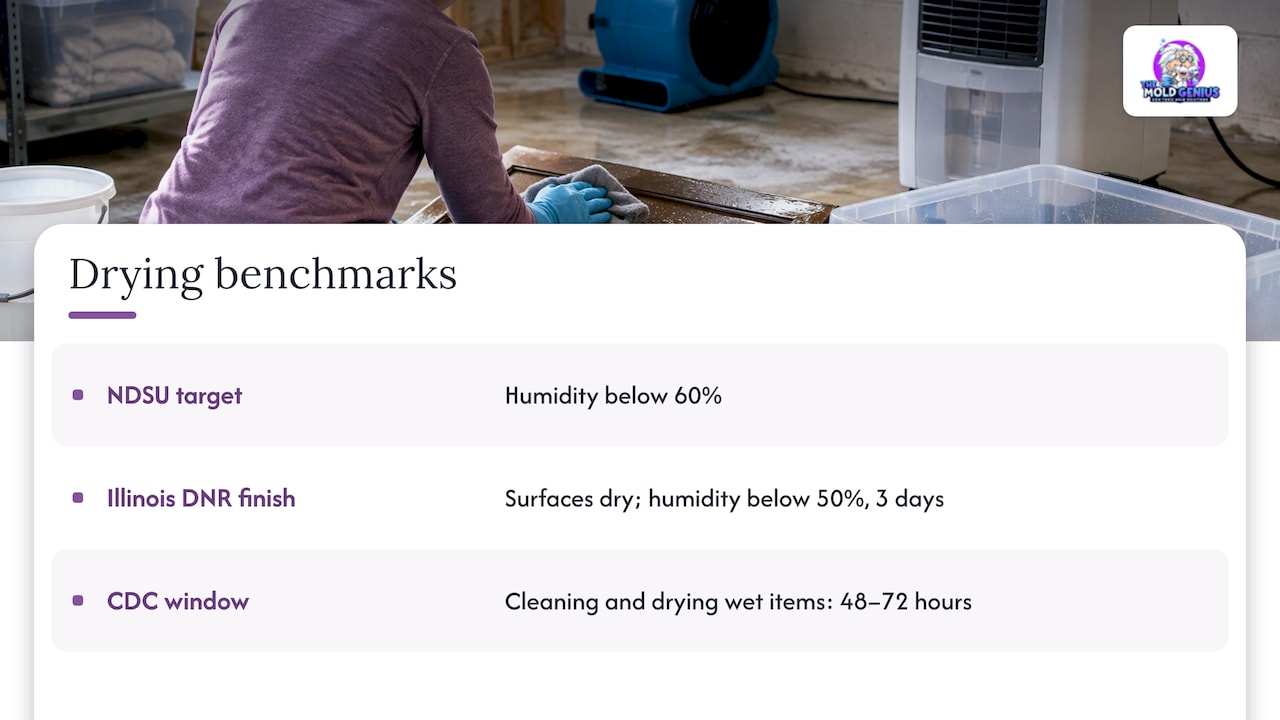
The CDC puts the window for cleaning and drying wet items at 48 to 72 hours, keeping wet areas ventilated and discarding materials that can’t be repaired. In a Chicagoland basement in a humid July, or a cold February when windows stay shut, that window is hard to hit without equipment. We cover the airflow side in more depth in our piece on how ventilation prevents mold growth.
Mold after water damage: the 10 square foot line
The CDC says visible mold can be cleaned with 1 cup of household liquid bleach per gallon of water, and that if it covers more than 10 square feet you should consider a professional. That figure is a starting point, not the whole test. Mold behind a wall, under flooring or above a ceiling may cover far less visible surface and still be a bigger problem. Our guide to flooded basement mold cleanup explains how to judge it, and our article on staying home during mold removal covers why 10 square feet isn’t the only test.
If you want to understand how mold gets going in a basement and what to look for in the first 48 hours, read how to find and stop basement mold.
How much basement water damage repair costs
Forbes Home reports that most homeowners pay around $4,300 on average to repair a flooded basement. Most repairs fall between $1,600 and $6,900. Some spend as little as $500, and extensive jobs can reach $50,000 or more.
What moves your number up or down:
- Water category. Clean supply-line water is cheaper to deal with than groundwater or sewage, which brings more removal and disinfection.
- Depth and duration. Water that sat for days soaks into framing and drywall. Water extracted within a day or two usually does not.
- Finished or unfinished. A finished basement has carpet, drywall, trim and insulation that all need assessing.
- Mold. If growth has started, remediation is added to the job.
- The source. A one-time burst pipe is a repair. A recurring seep means you also have to fix the cause.
We don’t publish fixed prices because every basement is different. We offer free estimates, and an on-site look is the only honest way to scope the work.
Does insurance cover it?
Often less than people expect. NerdWallet explains that standard homeowners insurance generally covers sudden, accidental water damage from inside the home, such as a burst pipe or failed appliance. It generally doesn’t cover flooding, seepage or sewer backups unless you have added water-backup coverage.
University of Georgia risk management professor Marc Ragin, quoted by Insurance.com, puts the general rule this way: water coming from the ground isn’t covered by a standard policy, and flooding needs a separate flood policy. Rain that enters through a storm-damaged roof or window is typically covered.
Practical steps for Illinois homeowners:
- Read your policy for the words “water backup,” “sump pump overflow” and “seepage.”
- Ask your agent whether a water-backup endorsement is available and what the limit is.
- If you are in a flood-prone area, ask about a separate flood policy.
- File promptly, with your photos, video and inventory.
When a claim does apply, we work with the major carriers and can document the damage in terms an adjuster expects.
Fix the source, or it happens again
Repair without a cause fix is a down payment on the next repair. The NAHB and 2-10 Home Buyers Warranty white paper identifies rainfall as the most common source of basement water leaks, followed by irrigation and shallow groundwater. Its prevention checklist includes:
- downspouts that discharge at least 5 feet from the foundation
- ground that slopes downward at least 6 inches in the first 10 feet away from the foundation
Those two checks cost little and are worth doing this week. If water still shows up, the answer may involve sump pumps, crack sealing or drainage, which are work for a waterproofing contractor. Knowing which problem you have matters: our comparison of basement waterproofing and mold remediation explains where one ends and the other begins.
Our perspective
Most basement jobs that go wrong don’t go wrong because of the flood. They go wrong because the water was only dealt with where it could be seen.
A wet wall cavity, damp insulation or a cold corner behind a finished wall will keep feeding mold long after the carpet is gone and the floor looks fine. That’s why we start with diagnosis: moisture detection and thermal imaging to find what you can’t see, then removal, then prevention that fixes the root cause.
For removal, we use Pure Cloud Technology, a dry fogging system built on hospital-grade hydrogen peroxide and silver ions. It is designed to reach mold behind walls, above insulation and in tight corners without gutting rooms. Most jobs wrap up in a single day, and homeowners can usually return the same day.
Our advice is the same whether you hire us or not: move fast in the first 48 hours, document everything, and don’t let a dry-looking surface convince you the job is done.
Alex
Getting help with your basement
If the water has been there more than a day, the basement is finished, or you can see or smell mold, an on-site assessment will save you guesswork. Our water damage repair and restoration service covers diagnosis, drying and repair, and if mold has set in, our basement mold removal uses the Pure Cloud system. We serve Naperville, Wheaton, Palatine, Arlington Heights, Schaumburg-area suburbs and across Chicagoland, and estimates are free.

We also work with insurance carriers and with realtors who need mold resolved before closing. To see how the process runs from start to finish, read our basement mold remediation steps, or book a free estimate.
After the repair: keeping it dry
Once the basement is dry and repaired, keep humidity in check, watch for musty smells, and recheck gutters and grading each fall and spring. Our post-remediation mold prevention checklist lists the routine we recommend. If you are weighing whether to handle cleanup yourself, our comparison of professional mold removal versus DIY lays out the trade-offs.
Frequently Asked Questions about Basement Water Damage Repair
What is the best way to dry out a wet basement?
Remove standing water first, in stages if it is deep, then remove soaked porous materials. Run fans with an inlet and exhaust plus a dehumidifier. NDSU recommends getting humidity below 60%, and the Illinois DNR guide says to keep going until it stays below 50 percent for at least three days.
How much does it cost to fix water damage in a basement?
Forbes Home reports most flooded-basement repairs land between $1,600 and $6,900, with an average around $4,300. Water type, depth, how long it sat, finishes and mold all change the figure. We give free estimates after seeing the space.
What kills mold after a flood?
For visible mold on hard surfaces, the CDC says to use 1 cup of household liquid bleach per gallon of water, never mixed with other cleaners. The bigger factor is drying quickly, since mold can form within 24 to 48 hours. If it covers more than 10 square feet, consider a professional.
Will insurance cover basement flooding?
Usually not under a standard homeowners policy, which generally excludes flooding and seepage. Sudden internal failures like a burst pipe are generally covered, and water-backup coverage can be added in many cases. Check your policy wording and ask your agent before cleanup begins.
What are the sources for this basement water damage repair guide?
- State Farm: What To Do When Your Basement Floods
- MU Extension: Removing water from flooded basements
- NDSU Extension: Safety and efficient drying procedures for basement water damage
- Illinois DNR: Post-flood quick guide
- This Old House: How To Clean, Dry, and Repair a Flooded Basement
- EPA: Flood Cleanup to Protect Indoor Air and Your Health
- CDC: Preventing Mold
- Forbes Home: Average Basement Flooding Repair Costs
- NerdWallet: Does Homeowners Insurance Cover Water Damage?
- Insurance.com: Water damage insurance claims
- NAHB: Ultimate Guide to Stop Basement Water Leaks