
Ceiling water damage repair begins by stopping the water source and thoroughly drying the affected structure, followed by removing unsalvageable materials and checking for mold before any patching or repainting. Prompt action is critical, as mold becomes a significant risk if the area is not dried within 24 to 48 hours. Homeowners should treat spreading stains, sagging ceilings, or visible/smellable mold as signs to call a professional, especially for mold covering more than 30 square feet or suspected hidden mold. The Centers for Disease Control and Prevention (CDC) advises turning off electricity and gas, and documenting damage for insurance before starting cleanup.
Ceiling water damage repair starts with the water, not the paint. Stop the source, dry the structure, remove whatever cannot dry, check for mold, and only then patch and repaint. If the stain is spreading, the ceiling sags, or you can see or smell mold, treat it as a job for a professional and call before you cut anything open.
This guide walks you through the sequence in order. It shows how to judge whether drywall or plaster can stay, when a ceiling leak turns into a mold problem, and how to keep the damage from returning.
What are the key steps for ceiling water damage repair and mold prevention?
- Stop the water and shut off power to the affected area first. Photograph everything and call your insurer before cleanup.
- Wet drywall that is not sagging, swollen or mildewed can sometimes be dried in place. Wet insulation, ceiling tiles and sagging or soft drywall usually have to come out.
- Dry the area within 24 to 48 hours. After that, mold becomes a real risk.
- Mold covering more than 30 square feet, or any mold you suspect is hidden above the ceiling, calls for a professional.
- Patch and paint only after the area is dry and the leak is fixed. Paint over damp or moldy material fails.
Table of Contents
- What to Do in the First Hour
- Should the Ceiling Stay or Go?
- Ceiling Leak Mold: Signs and the Point to Call a Pro
- How to Dry and Repair the Ceiling, Step by Step
- Fix the Source or the Damage Comes Back
- Our Perspective
- Get the Ceiling Looked At by The Mold Genius
- Insurance and Documentation
- Preventing a Repeat
- FAQ
- Sources
What to Do in the First Hour
A ceiling that is dripping, bulging or stained brown is telling you water is trapped above it. Act in this order.
- Make the area safe. The CDC advises making sure electricity and gas are off before you enter a damaged area, and checking for sagging ceilings or floors and other structural problems, per its guide to mold cleanup after water damage. Water near light fixtures is an electrical hazard. Keep people and pets out from under a sagging section.
- Stop or slow the source. Shut off the water supply if a pipe is leaking. If it is a roof leak, place a tarp or call a roofer. Moving a bucket under the drip is only a stopgap.
- Relieve trapped water. If water is pooling in a bulge, a small hole at the lowest point lets it drain in a controlled way instead of letting the whole section fail. Forbes Home Improvement suggests an awl or screwdriver for a single drain hole, and Pennsylvania’s flood recovery guidance says to punch small holes at the low spots of sagging sections. Put a bucket underneath and wear eye protection.
- Document before you clean. The CDC guide says to contact your insurance company and take pictures of the home and belongings before starting cleanup. Photograph the ceiling, the stain edges, the source and any damaged belongings.
- Move belongings out and cover furniture you cannot move.
If the leak came from a bathroom above, a few simple checks can help you find where it starts. This walkthrough of cheap tests to find a bathroom ceiling leak shows how homeowners narrow it down before calling a plumber.
Should the Ceiling Stay or Go?
The most expensive mistake in ceiling repair runs two ways. You can tear out material that would have dried fine, or you can paint over material that is already failing. The federal guidance gives a workable line between the two.
Drywall
The U.S. Department of Energy’s guide to repairing roofs and ceilings says ceiling drywall wet only by clean rainwater can stay if it is not sagging, mildewing or losing its smooth texture. It also says to remove wet insulation so the ceiling can dry. The EPA’s remediation table, which is written for commercial buildings but is widely used as a benchmark, says wallboard may be dried in place when there is no obvious swelling and the seams are intact. Otherwise it should be removed and replaced.
Pennsylvania’s guidance adds that drywall becomes very fragile if it stays wet for a long time and should be discarded.
Plaster
Older Chicagoland homes often have plaster and lath ceilings. The Department of Energy guide says plaster that looks undamaged can stay. If it separates from its wood laths, the entire interior portion has to be removed and replaced. Pennsylvania’s guidance goes further for plaster that stayed wet: it cannot be decontaminated and should be discarded.
Insulation and ceiling tiles
The EPA table says ceiling tiles, cellulose insulation and fiberglass insulation should be discarded and replaced when wet. This matters for attic ceilings, where soaked insulation sits on top of the drywall and keeps it wet long after the leak stops. If the water came through the roof, our page on attic mold after a roof leak covers what happens up there.
What do different ceiling water damage signs mean?
| What you see | What it usually means |
|---|---|
| Light stain, ceiling firm and flat, no smell | May dry in place once the source is fixed |
| Bubble or bulge holding water | Drain it, then plan to cut out the affected section |
| Sagging, soft or crumbling drywall | Remove and replace |
| Musty smell, dark or fuzzy spots | Treat as mold, not just a stain |
| Plaster pulling away from the lath | Remove the loose section |
| Wet insulation above the stain | Remove it so the ceiling can dry |
The stain’s color is not a reliable measure. A brown ring only shows that water has been there. What matters is whether the material is still wet, swollen or growing something.
Ceiling Leak Mold: Signs and the Point to Call a Pro
Water-damaged ceilings are a common place for mold because the space above them is dark, enclosed and slow to dry. Warning signs include a musty odor, dark or fuzzy patches on the surface, stains that keep coming back after being painted, peeling paint and a ceiling that feels damp days after the leak stopped.
The CDC says that if mold has already started to grow, you should not use fans, because they can spread it. It also says people with breathing problems such as asthma, or with weakened immune systems, should stay away from moldy sites. If anyone in your household is in that group, hand the job to a professional.
The 30 square foot line in Illinois
The Illinois Department of Public Health advises consulting a professional when more than 30 square feet are contaminated. Other agencies set a lower bar. A Florida county health department puts the DIY limit at 10 square feet, and recommends professional help when a lot of water damage is involved. In practice, a ceiling stain you can see is only part of the picture. The area above it is often larger.
Hidden mold is the bigger risk
The District of Columbia’s environment agency warns that disturbing materials that hide mold can release a large burst of spores and be hazardous to health. It advises hiring a licensed professional when you suspect hidden mold, in its guidance on mold in residential properties. That is exactly the situation behind a ceiling that has leaked for weeks. Cutting it open yourself can spread the problem into the rest of the house.
The same guidance says ceiling tiles and other porous materials should be thrown away, because crevices often harbor mold that returns.
If the leak came from a bathroom remodel or a bathroom above, this article on what to do when you find mold during a bathroom remodel explains why opening walls and ceilings is a point to bring in a professional. Our own page on bathroom ceiling mold covers removal and prevention. If you want to weigh the decision further, see professional mold removal versus DIY.
How to Dry and Repair the Ceiling, Step by Step
Here is the order a repair follows once the source is stopped. Where mold is involved, the cleanup comes before any of the rebuilding steps.
Step 1: Dry everything within 24 to 48 hours
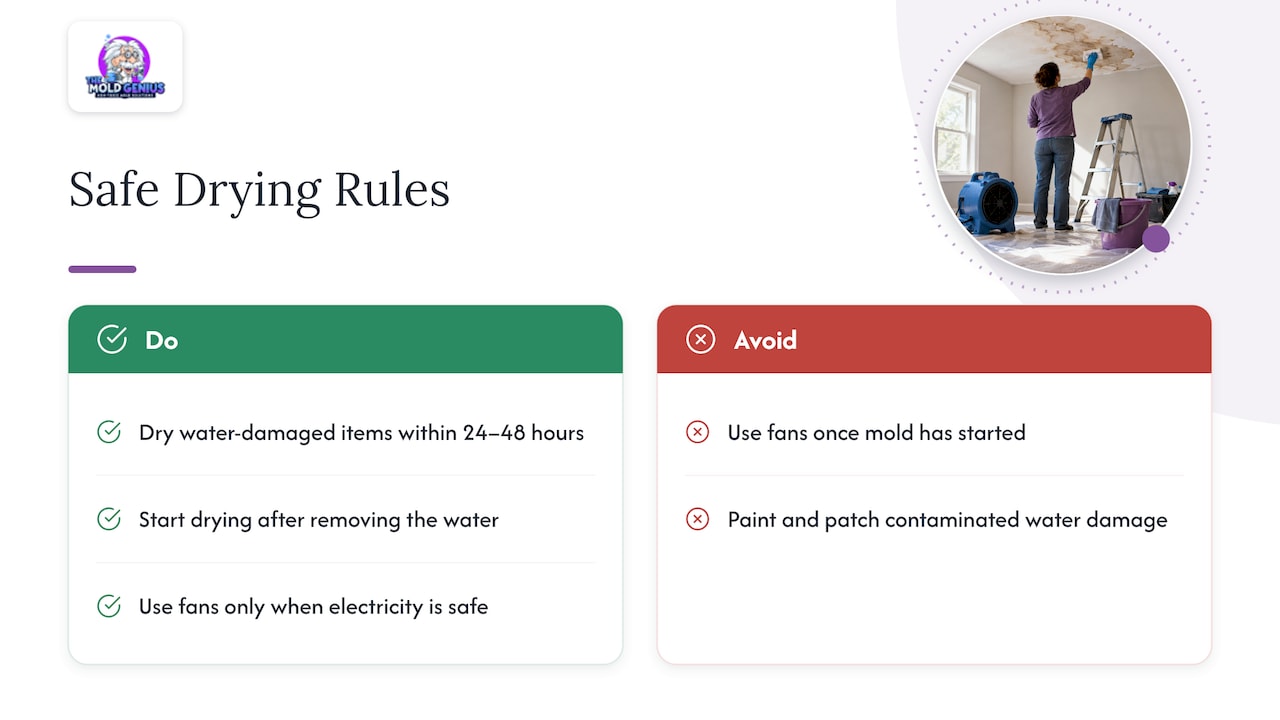
The CDC calls drying the home and removing water-damaged items within 24 to 48 hours the most important step for preventing mold damage. The Massachusetts Department of Public Health gives the same window in its mold cleanup and repair guide, using fans or dehumidifiers. The CDC says to use fans and dehumidifiers only when electricity is safe, and not to use fans once mold has started.
Syracuse University’s guidance on building water intrusion adds that drying should start right after the water is removed. It also says materials affected by contaminated water (Category 2 or 3) need cleaning and sanitizing as well as drying. Water from a supply line or rain is one thing. Water from a toilet overflow or backed-up drain is another, and it is not a job for a paint-and-patch fix.
Step 2: Remove what cannot dry
Cut out sagging, swollen or soft drywall. Forbes advises cutting a few inches beyond the visible damage so no compromised material stays behind. Remove wet insulation above it. The CDC says to throw away items that cannot be cleaned and dried within 24 to 48 hours. Wear protective equipment: gloves, eye protection and a respirator-rated mask.
Step 3: Clean and confirm it is dry
The CDC says to clean with water and detergent. The Massachusetts guide says that once the area is dry, if visible mold and odors are gone, repair can begin. If mold or odor persists, it may mean moisture remains, and the cleaning and drying should be repeated. A ceiling that smells musty a week later still has a moisture source.
Step 4: Patch the drywall
The Department of Energy guide says large water-damaged areas of ceiling drywall can be repaired with a gypsum repair kit or equivalent, using quick-setting joint compound and fiberglass tape. In short:
- Fit a new drywall piece into the cut opening, supported by framing or backing.
- Cover the seams with fiberglass tape.
- Apply joint compound in thin coats and let each coat dry.
- Sand smooth.
- Texture to match the ceiling, if it has one.
Step 5: Prime and paint
Use a stain-blocking primer on the patch and on any old stain edges, then paint the full ceiling plane from wall to wall. Painting only the patch usually shows. Never use paint or caulk to cover mold: the CDC states that painting or caulking over mold will not prevent it from growing.
A warning for homes that have had a lot of dust from demolition: after repair, a thorough cleaning matters. This post-renovation dust protocol explains a 48 to 72 hour approach to dust cleanup that applies after drywall work.
Fix the Source or the Damage Comes Back
The Illinois Department of Public Health says the moisture source must be fixed before mold cleanup, or the mold will grow again. That is the rule behind every repair. Common sources of ceiling water damage in Chicagoland homes:
- Roof leaks from damaged shingles, flashing or ice dams after winter storms. Our guide on how storm damage causes mold explains the chain from roof to ceiling.
- Plumbing leaks from bathrooms, kitchens or laundry rooms above the affected ceiling.
- Attic condensation from poor ventilation and insulation, especially where warm indoor air meets a cold roof deck.
- HVAC problems such as clogged condensate drain lines or leaking ducts.
If the leak was slow and ongoing, the damage can reach the roof framing too. Our article on mold on roof trusses explains why inspecting first matters. For the broader picture, read how water damage leads to mold.
Our Perspective
We see the same pattern again and again: a homeowner patches and paints a stained ceiling, and a few months later the stain is back. The paint was never the problem. The problem is usually moisture trapped above the ceiling, in insulation, framing or the gap behind drywall, where nobody can see it.
That is why we start with diagnosis. Our process has three phases: finding what you cannot see with moisture detection and thermal imaging, removal, and prevention. If you skip the first phase, you are guessing about how far the water went. If you skip the last one, you are likely to be calling someone again next year.
For removal, we use Pure Cloud Technology, a dry fogging system built on hospital-grade hydrogen peroxide and silver ions. It is designed to reach mold behind walls, above insulation and in tight corners, without gutting rooms or displacing a family for days. Most jobs wrap up in a single day, and homeowners can return the same day.
Our advice is simple: if a leak touched your ceiling, get the area looked at before you close it up. A free estimate costs you nothing, and it can tell you whether you have a cosmetic repair or a hidden moisture problem.
Alex
Get the Ceiling Looked At by The Mold Genius
If your ceiling has been wet for more than a day or two, or you can smell mold, our team can find out how far the moisture went and deal with it. Our water damage repair and restoration service covers the drying and repair side, and our mold removal service handles mold using Pure Cloud dry fogging. We are a family-owned company serving the Chicagoland area, with free estimates.

We also work with insurance carriers, including Allstate, State Farm, USAA, Farmers and Liberty Mutual, so you do not have to sort out the paperwork alone. If you are comparing contractors, our guide to getting on-site bids before hiring a mold remediator explains what to look for.
Insurance and Documentation
The CDC advice is to call your insurer before cleanup begins. Coverage often depends on how the water got in. Sudden events, like a burst pipe, are treated differently from long-term seepage, so read your policy or ask your agent. Keep these on hand:
- Photos and video of the damage before you touch it
- A short written timeline: when you first noticed it and what you did
- Receipts for emergency steps such as tarps, fans or plumber visits
- Any contractor reports describing the source and the extent of damage
Because we work with the major carriers, we can supply documentation of what we find and what we do.
Preventing a Repeat
- Respond fast. The 24 to 48 hour window is the line the CDC uses for preventing mold.
- Fix ventilation. Bathroom fans should vent outside, not into the attic. Attic ventilation and insulation should be assessed together, as we do on attic mold jobs.
- Inspect the roof after storms and each fall, before winter ice dams form.
- Watch for early signs: new stains, bubbling paint, a musty smell after rain or a shower.
- Do not repaint over a stain until you know the area is dry.
FAQ
How long does a water-damaged ceiling take to dry?
Guidance from the CDC and the Massachusetts Department of Public Health sets the goal at 24 to 48 hours for drying. Actual time depends on how much water got in and how much insulation is wet. If the area still feels damp or smells musty after that, moisture is still present.
Can I just paint over a ceiling water stain?
Not until the ceiling is dry and the leak is fixed. Paint over damp material peels and the stain bleeds back through. The CDC also says that painting over mold will not stop it from growing.
Is a sagging ceiling an emergency?
Treat it as one. Keep people out from under it, turn off power to the area, and let trapped water drain through a small hole at the lowest point. Then call a professional, because a sagging section can fail.
When does a ceiling leak mean mold remediation?
Call a professional when you see or smell mold, when more than 30 square feet are affected (the Illinois Department of Public Health’s threshold), or when you suspect mold above the ceiling. Anyone with asthma or a weakened immune system should stay out of the area.
Sources
- CDC: Homeowner’s and Renter’s Guide to Mold Cleanup After Disasters
- U.S. Department of Energy: Repairing Roofs and Ceilings
- EPA: Mold Remediation in Schools and Commercial Buildings, Table 1
- Pennsylvania DEP: Flood Recovery, Walls
- Massachusetts DPH: Mold Cleanup, Repairs, and Excess Moisture Control
- Syracuse University: Responding to Building Water Intrusion and Damage
- Forbes Home Improvement: What to Do About Ceiling Water Damage
- Illinois Department of Public Health: Reducing Your Exposure to Mold
- Florida Department of Health in Brevard County: Indoor Mold FAQ
- D.C. DOEE: Mold in Residential Properties