
Most Downers Grove homeowners should plan on roughly $500 to $4,000 for a contained problem in a bathroom, basement, crawl space or attic, and $10,000 or more once mold has spread through walls or the whole house. Those are national planning ranges from Bob Vila’s cost guide, not quotes. The real number for your house depends on how far the mold has spread, what it is growing on, and whether the water source has been fixed. This guide explains each of those factors so you can read an estimate with confidence.
TL;DR
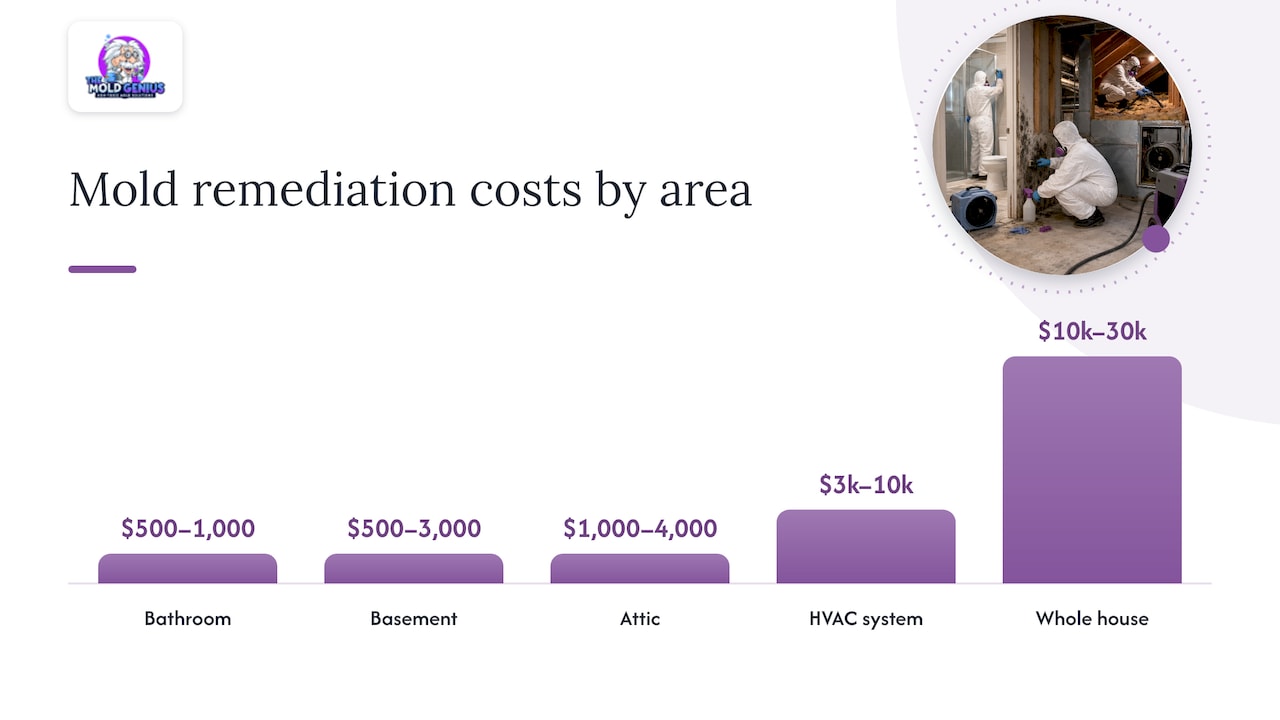
- National ranges by location: bathroom $500 to $1,000, crawl space $500 to $2,000, basement $500 to $3,000, attic $1,000 to $4,000, HVAC $3,000 to $10,000, whole house $10,000 to $30,000 (Bob Vila).
- Cost climbs with hidden growth, porous materials that must be replaced, difficult access, and a moisture source that has not been fixed.
- Homeowners insurance usually pays for mold only when a covered event, such as sudden water damage, caused it, and mold limits are often capped.
- We do not publish flat prices, because the only honest number comes after a moisture and thermal imaging inspection. Estimates from The Mold Genius are free.
Table of Contents
- What mold remediation costs by area of the home
- What raises or lowers your estimate
- Water damage and mold often arrive together
- Will homeowners insurance pay for it?
- How to read and compare mold remediation estimates
- Perspective: what we tell Downers Grove homeowners about cost
- Get a Downers Grove estimate
- Nearby cost guides
- Keeping the bill from coming back
- FAQ
- Sources
What mold remediation costs by area of the home
The location of the mold shapes the price more than almost anything else, because it decides how much access, containment and material removal the job needs. Bob Vila’s 2024 update lists these national ranges:
| Location | Typical national range |
|---|---|
| Bathroom | $500 to $1,000 |
| Crawl space | $500 to $2,000 |
| Basement | $500 to $3,000 |
| Attic | $1,000 to $4,000 |
| Air ducts | $600 to $2,000 |
| HVAC system | $3,000 to $10,000 |
| Drywall | $1,000 to $20,000 |
| Whole house | $10,000 to $30,000 |
Source: Bob Vila, Mold Remediation Cost Guide. Treat the table as a planning range. A small, surface-level patch lands at the low end. Growth inside walls, under flooring or in insulation lands at the high end or above it.
Chicago-area homes add their own pressures. Older bungalows and split-levels in the western suburbs often have finished basements, and a single sump pump failure or a storm that pushes water through a foundation wall can wet carpet, drywall and framing at the same time. That is why a “basement” job can be a $500 cleanup in one house and a five-figure project in the next.
Bathrooms
Bathroom mold is usually the least expensive, because the surfaces are often tile, glass and sealed fixtures that can be cleaned rather than replaced. Costs rise when moisture has gotten behind the tile, into the subfloor, or into a wall shared with another room. A bathroom fan that vents into the attic instead of outdoors is a common cause we look for. Our bathroom mold removal service starts with finding where the moisture is going.
Basements and crawl spaces
Basements vary the most. Mold on bare concrete or block is a different job from mold behind finished drywall, where the wall has to be opened, dried and treated. In crawl spaces, the usual drivers are humidity, uncovered soil and wet insulation. If you want to see how we think about the basement side, our page on Chicagoland basement mold removal costs goes deeper, and our crawlspace mold removal page covers the process.
Attics
Attics are mold-prone because of temperature swings and poor ventilation. Warm indoor air leaks upward in winter, meets cold roof decking and condenses. The job often includes the insulation and the ventilation, not only the mold on the wood. We cover that in our attic mold removal cost guide, and the service itself is on our attic mold removal page.
What raises or lowers your estimate
The factors below explain why two quotes for the same address can differ. This Old House lists most of them, and they match what we see on Chicagoland jobs.
- Size of the affected area. More square footage means more labor, more containment and more disposal.
- Hidden growth. Mold behind walls, under floors or above ceilings takes more labor to reach and more repair afterward.
- Material type. Porous materials such as drywall, insulation and carpet often have to be removed and replaced. Tile, sealed concrete and metal can usually be cleaned without replacement.
- Access. Tight crawl spaces and low attic eaves slow the work.
- An unresolved moisture source. If water keeps coming in, the mold returns, and the quote has to include fixing the cause.
- HVAC involvement. Ductwork and air handlers move spores through the house and push the price up.
- Containment, HEPA filtration and disposal. These are normal parts of a careful job.
- Rebuilding. Replacing drywall, insulation or flooring is often a separate line from the remediation itself.
That last item catches many homeowners off guard. Cleaning mold and rebuilding what was removed are two budgets. If you are planning the repair work as well, it helps to understand how hidden costs emerge in renovations, because the cleanup rarely ends the spending when walls or insulation come out.
Why “per square foot” quotes can mislead
Some national guides quote per-square-foot figures, and they are tempting for a quick mental estimate. The trouble is that square footage is only visible area. A 10-square-foot stain on a ceiling can sit above 80 square feet of wet insulation. A fair estimate comes from an inspection that maps moisture, not from a tape measure on the visible patch.
Water damage and mold often arrive together
In the Chicago suburbs, mold is often a second bill that follows a water event. A flooded basement, a failed sump pump or a slow pipe leak can leave materials damp long enough for growth to start. Local contractor estimates for flood projects commonly list mold treatment as an add-on to drywall removal and drying, so the total for a wet basement can be several times the cost of treating mold alone. Because of that, addressing water fast is the cheapest thing you can do. Our water damage repair and restoration service exists so the drying, the mold treatment and the repair are planned together instead of billed by three different companies.
Will homeowners insurance pay for it?
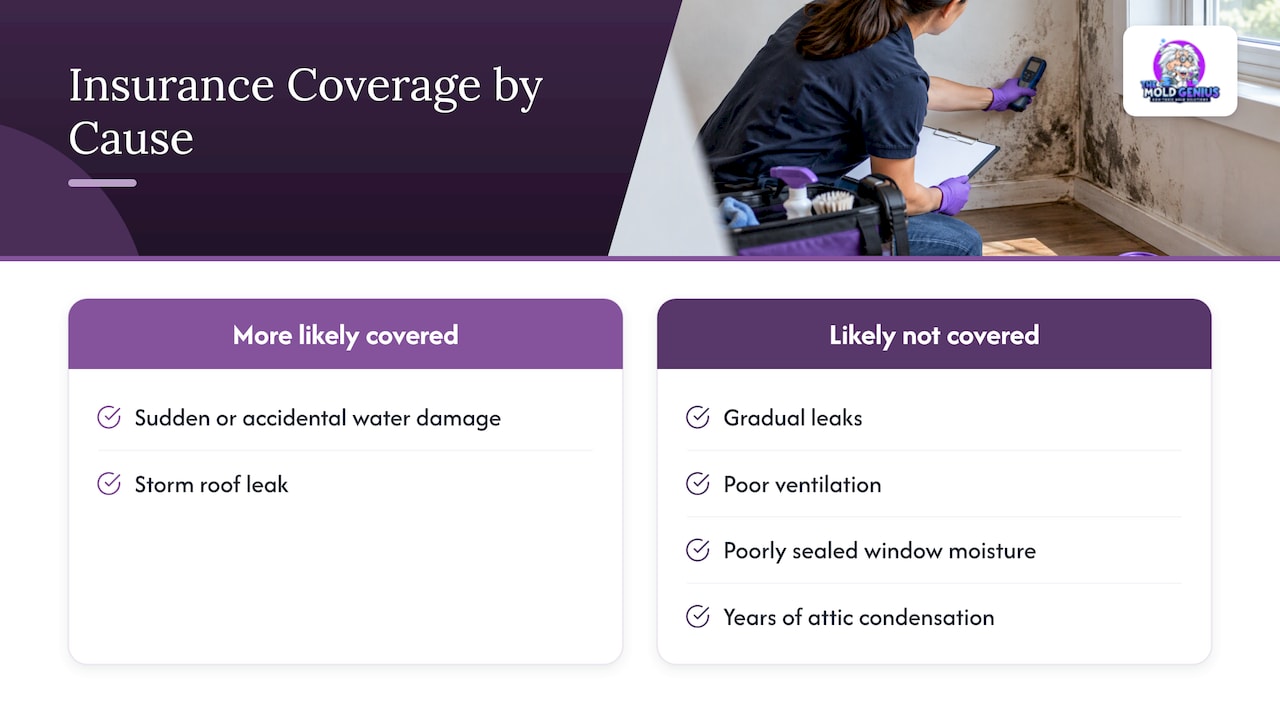
Sometimes, but it depends on why the mold grew. According to Yahoo Finance’s insurance guide, standard homeowners policies generally cover mold only when it relates to a listed covered peril, often sudden or accidental water damage. Gradual leaks, poor ventilation and moisture collecting around poorly sealed windows are examples of causes that are likely not covered.
The same guide notes that mold coverage is often capped, in some policies around $5,000 to $10,000, and gives an example policy with a $5,000 fungi and mold limit that applied only when a covered peril caused the loss. Limits and exclusions differ from policy to policy, so read your own declarations page or call your agent.
On the attic question many readers ask: attic mold from a roof leak after a storm is more likely to be tied to a covered event than attic mold from years of condensation. Document the cause early. Photos, moisture readings and a written inspection report make a claim easier to support.
We work with insurance claims and with carriers including Allstate, State Farm, USAA, Farmers and Liberty Mutual. Our mold remediation insurance coverage checklist lays out what to gather before you file.
How to read and compare mold remediation estimates
Illinois’s Mold Remediation Registration Act, 410 ILCS 105, directs the Illinois Department of Public Health to set up registration that requires third-party certification and financial responsibility. It also defines remediation broadly, to include removal, cleaning, sanitizing, demolition, treatment and preventive activities. In practical terms, that means a good estimate should describe the whole scope, not just “mold removal.” Our guide to mold remediation credentials worth verifying covers what to ask any contractor.
When estimates arrive, line them up on these points:
- Scope in writing. Which rooms, which materials, and which are removed versus cleaned.
- How the moisture source is found and fixed. A quote that treats mold and ignores water is incomplete.
- Containment and air filtration. Ask how the work area is sealed off from the rest of the house.
- What is excluded. Rebuilding, insulation replacement and plumbing or roof repair are often separate.
- Follow-up. What happens after the work, and what the company guarantees.
- Timeline and access. How long you will be out of the affected area, and whether you can stay in the house.
A low number with a vague scope often becomes a higher final bill. A clear scope with a moderate number is easier to trust.
Do you need mold testing first?
Not always. The CDC and EPA position, which the Illinois Department of Public Health also follows, is that routine sampling is rarely necessary: visible growth and the moisture source are what matter. A thorough inspection with moisture meters and thermal imaging usually tells you more about the scope of work than a lab report does.
Perspective: what we tell Downers Grove homeowners about cost
We have been doing this as a family for 25+ years, and the most expensive mold jobs we see are almost never the ones that started big. They are small problems that were wiped down, painted over, or left alone while the real cause kept feeding them.
That is why we build every job in three phases: diagnosis, removal and prevention. Diagnosis uses moisture detection and thermal imaging to find what you cannot see. Removal uses our Pure Cloud dry fogging system, which is designed to reach mold behind walls, above insulation and in tight corners, so rooms do not have to be gutted just to get at it. Prevention means fixing the root cause so the problem does not return.
Gutting is where cost balloons, because demolition and rebuilding multiply the bill. Our approach is designed to avoid that where the situation allows, and most jobs wrap up in a single day, so homeowners can return the same day. The fogging uses hospital-grade hydrogen peroxide and silver ions.
Our advice on budgeting: get the inspection first, ask for a written scope, and treat the moisture source as part of the price, not an extra. Estimates are free.
Alex
Get a Downers Grove estimate
We serve Downers Grove and the surrounding Chicagoland suburbs, from Naperville and Wheaton to Elmhurst and Arlington Heights. Every job starts with a free estimate, and the price comes after we have found where the moisture is and how far the mold has spread. See our Downers Grove mold removal services page for local details, or start at The Mold Genius to request your free estimate.

If you are selling, we also run a realtor network program for agents who need mold resolved before closing. Our guide on handling mold discovery when selling your Illinois home explains the options.
Nearby cost guides
Pricing in neighboring DuPage and Cook County suburbs follows similar patterns, because housing stock and weather are alike. If you want another local view, see our guides to Wheaton mold remediation cost and Hoffman Estates mold remediation cost.
Keeping the bill from coming back
The cheapest remediation is the one you only pay for once. After a job, the habits that matter are keeping indoor humidity controlled, running bathroom fans so they vent outdoors, fixing roof and plumbing leaks quickly, and keeping gutters and grading directing water away from the foundation. Our post-remediation mold prevention checklist turns those into a routine, and how remediation prevents future mold explains why fixing the cause is built into our process.
FAQ
How much does mold remediation cost in Downers Grove?
National ranges run from about $500 for a small bathroom job to $10,000 to $30,000 for whole-house work, according to Bob Vila. Downers Grove homes fall within those ranges, and the final number depends on hidden growth, materials and the moisture source. A free on-site estimate gives you a figure for your house.
Why do mold remediation quotes vary so much?
Quotes differ because scope differs. One contractor may price only surface cleaning while another includes removing wet drywall, fixing access problems and containing the area, as This Old House describes. Ask each company for a written scope so you compare like with like.
Will insurance cover mold in my attic?
It may, if the mold came from a covered event such as sudden water damage from a storm-related roof leak. Mold from gradual condensation or poor ventilation is likely not covered, per Yahoo Finance. Check your policy’s mold limit and talk with your agent before work begins.
Do I have to leave my house during remediation?
With our Pure Cloud dry fogging approach, most jobs finish in a single day and homeowners can return the same day. Larger or more complicated projects can take longer, and we explain the timeline in the estimate.
Sources
- Bob Vila: Mold Remediation Cost Guide
- This Old House: How Much Does Mold Remediation Cost?
- Yahoo Finance: Does homeowners insurance cover mold?
- Illinois Compiled Statutes: 410 ILCS 105, Mold Remediation Registration Act