
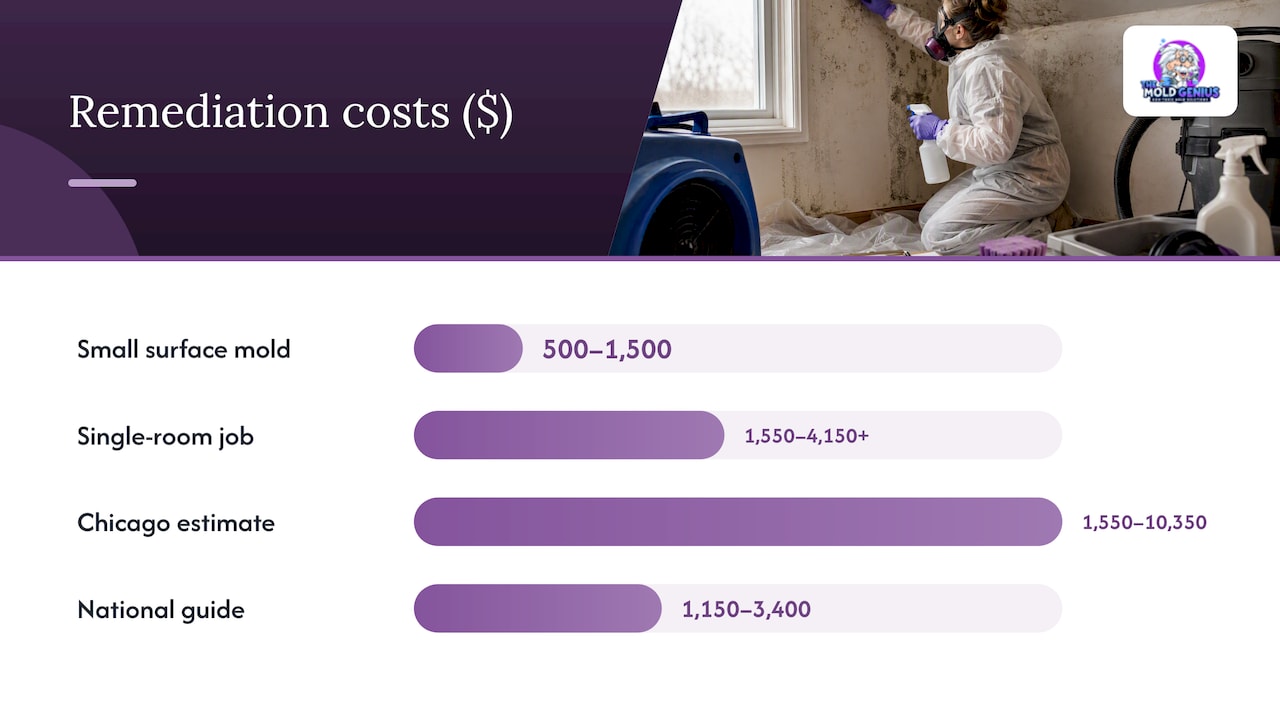
Professional mold remediation in Elmhurst, Illinois, typically costs between $1,550 and $10,350, with an average near $4,150, according to a regional estimate for the Chicago-Naperville-Elgin area published in April 2026 by ClearCost. The final price for Elmhurst mold remediation depends on the amount of surface affected, the mold's location, the type of material contaminated, and whether the moisture source has been stopped. Small surface mold jobs can range from $500 to $1,500, whereas large areas, HVAC systems, or attics can exceed $10,000.
Most Elmhurst homeowners should plan on roughly $1,500 to $10,000 for professional mold remediation, with small, contained jobs at the low end and attics, HVAC systems or whole-floor water damage pushing well past that. One regional estimate for the Chicago-Naperville-Elgin area puts the typical range at $1,550 to $10,350, with an average near $4,150. Your own number depends on how much surface is affected, where the mold is, and whether the moisture that fed it has been stopped.
Below is how those numbers break down, what a fair estimate contains, and how to compare bids without getting caught by add-ons.
What is the typical cost of mold remediation in the Chicago area?
- Chicago-area remediation is commonly estimated at $1,550 to $10,350, and small surface jobs can run $500 to $1,500. Large areas, HVAC or attics can reach $10,000 or more.
- Size, location (attic, crawlspace, behind walls), material type and water source drive price more than anything else.
- Inspection and testing are separate diagnostic costs, typically a few hundred dollars, and they are not remediation.
- Insurance usually pays only when mold follows a sudden, covered event such as a burst pipe, not long-running moisture.
- Get a written, itemized estimate that includes the moisture fix, or the mold is likely to return.
What topics are covered in this guide to Elmhurst mold remediation costs?
- What mold remediation typically costs around Elmhurst
- What drives the price up or down
- Inspection and testing are a separate cost
- What a good estimate includes
- How to compare bids without overpaying
- Will insurance pay for it?
- Our view: pay for the cause, not just the mold
- Cost by area of the home
- Get a real number for your Elmhurst home
- FAQ
- Sources
What mold remediation typically costs around Elmhurst
No one can quote your house from a keyword, and any page that claims to is guessing. What you can do is anchor on ranges.
The Chicago-Naperville-Elgin estimate from ClearCost, published April 2026, lists professional remediation at $1,550 to $10,350. It says small surface mold may cost $500 to $1,500, while large areas, HVAC systems or attics can cost $10,000 to $30,000 or more. Treat these as planning figures, not quotes, because they are modeled from national data and adjusted for regional prices.
A national consumer guide from Bob Vila lists remediation at $1,150 to $3,400, which is lower than the Chicago-area range. That gap is normal. National figures lean toward single-room jobs, while suburban Chicago homes often have finished basements, older balloon-framed walls and attics with decades of insulation.
| Situation | Planning range | What pushes it up |
|---|---|---|
| Small surface mold, one contained area | $500 to $1,500 | Hidden growth behind the surface |
| Typical single-room remediation (bathroom, part of a basement) | $1,550 to $4,150 and up | Drywall or trim that has to be removed |
| Larger basement, crawlspace or attic | Up to about $10,350 | Access, insulation, ventilation problems |
| Whole-floor, HVAC or post-flood jobs | $10,000 to $30,000 or more | Contaminated water, ductwork, rebuild |
These rows combine the two cited ranges above with common-sense scope; your estimate is the only figure that counts.
If your problem is a basement, our page on Chicagoland basement mold removal cost is titled with a starting figure of $1,500 and explains the low-demolition approach in detail.
What drives the price up or down
How much is affected
Contractors scope by the area of contaminated material, not the size of your house. The EPA says homeowners can handle cleanup themselves only for small, contained areas under about 10 square feet that are not affected by contaminated water such as sewage. Above that, the work usually needs containment, protective equipment and a plan, and that is where professional pricing starts.
Where the mold is
A wall-mounted patch of bathroom mold is easy to reach. Mold on attic roof sheathing, in a crawlspace or behind finished basement walls is not. Access, ladders, containment and the need to treat framing or move insulation all add labor. Attics are also tied to ventilation and insulation: if warm, moist air is reaching a cold roof deck, cleaning the mold without fixing the airflow only buys time.
What the mold is growing on
Nonporous surfaces such as metal or glass clean up readily. Porous materials like drywall, carpet, ceiling tile and insulation can hold growth deep inside, and traditional remediation often removes them. Removal means demolition, disposal and rebuilding, and rebuilding is often the biggest line on the final bill.
The water source
Clean water from a supply line that failed is one thing. Sewage or floodwater is another, and it changes both the safety requirements and the cost. Mold that keeps coming back usually points to an active moisture source: a foundation seep, a window well, a leaking roof, a bathroom fan venting into the attic. Fixing that source is part of the real price of the job.
What mold remediation methods are used and how do they affect cost?
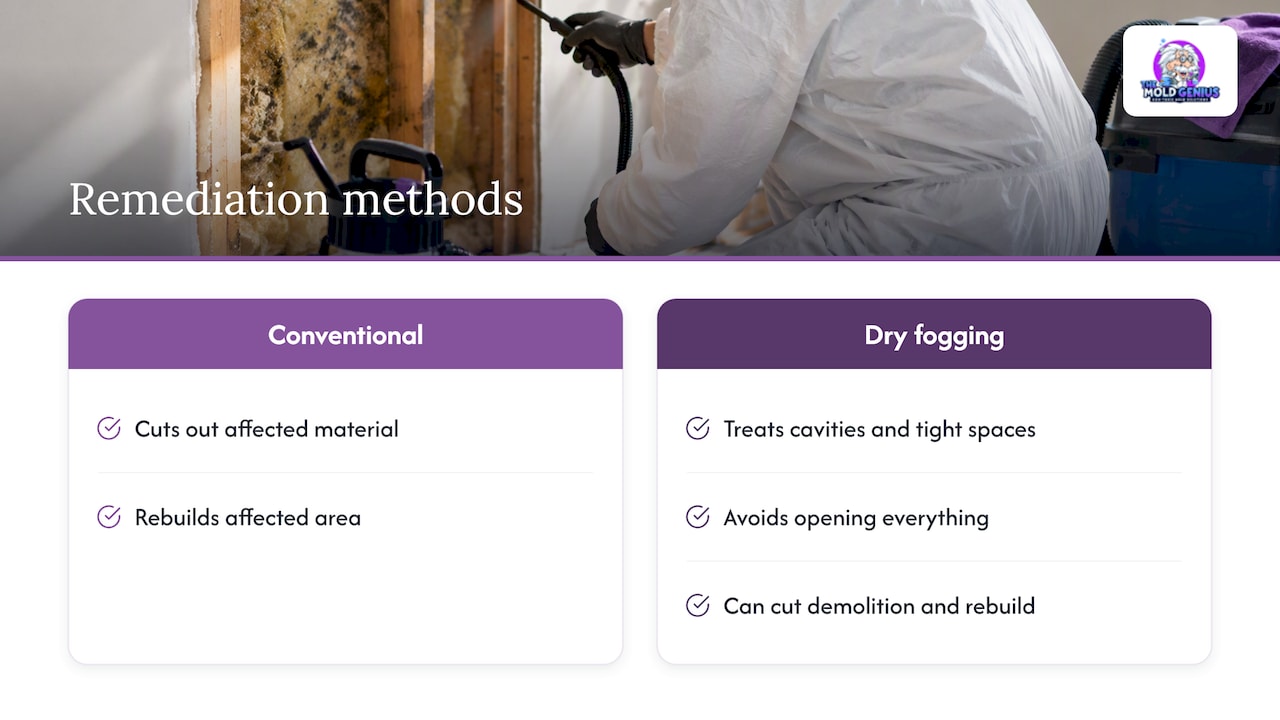
Method changes how much has to be torn out. Conventional remediation commonly cuts out affected material and rebuilds. Dry fogging systems treat mold in cavities and tight spaces without opening everything up, which can cut the demolition and rebuild portion. Ask any contractor which method they plan to use and why it fits your situation.
Inspection and testing are a separate cost
Homeowners often confuse these. Inspection and testing tell you what you have, and remediation fixes it.
Bob Vila’s guide lists inspection at roughly $300 to $1,000 and lab testing at $250 to $500. Those are diagnostic fees. If a contractor offers a free estimate, that covers scoping the job, but a formal third-party inspection with air or surface sampling is a different service.
Two practical points:
- You do not always need testing before remediation. If you can see mold and smell it, the question is usually where it is coming from and how far it goes, which moisture meters and thermal imaging answer better than a spore count.
- Testing makes more sense when the source is unclear, when someone in the home has health symptoms you want to discuss with a doctor, or when you need documentation for a real estate deal or insurance claim.
What a good estimate includes
A useful estimate is written, itemized and specific to your house. Look for each of these:
- Diagnosis and scope. Where the mold is, how much, and how it was found (moisture readings, thermal images, photos).
- The moisture source. What caused it and who is fixing it. If it is not in the quote, the mold can return.
- Containment and air handling. How the work area is sealed off from the rest of the home.
- Removal or treatment method. What is cleaned, what is removed and what is treated in place.
- Disposal and cleanup.
- Rebuild or restoration. Often excluded from a remediation quote. Ask whether drywall, insulation or flooring replacement is in or out.
- Verification. How the contractor confirms the job worked, and what happens if mold returns.
- Timeline and where you can be. Whether you need to leave the home. Our guide on whether you can stay home during mold removal covers that question.
Extras that surprise people
- Rebuild costs quoted separately from remediation
- Insulation replacement in attics
- Ductwork or HVAC cleaning
- Water damage repair that was not in the original scope
- Permits or a third-party clearance test
- Rush or after-hours fees
How to compare bids without overpaying
Price alone is a poor filter. A bid that is $1,500 lower may leave out the moisture fix, the rebuild or the verification.
- Get at least two written estimates on the same scope, and ask each contractor to name what they excluded.
- Be wary of a quote given over the phone for anything beyond a small surface patch. Mold is often bigger behind the surface.
- Ask about the cause. A contractor who cannot tell you where the water came from cannot promise it won’t return.
- Ask what the guarantee covers and get it in writing.
- Be careful with scare tactics. Not every patch of mold needs a whole-house response. The reverse is also true: a bottle of bleach is not remediation. See why bleach has limits on mold if you are tempted.
If you are weighing DIY against hiring out, our breakdown of professional mold removal versus DIY lays out when the savings are real and when they are not.
Will insurance pay for it?
Sometimes, depending on the cause. Progressive’s homeowners guide explains that standard policies usually do not cover mold unless it results from a covered peril, such as a burst pipe. If the mold has been around for weeks or longer, or comes from ongoing neglect, the policy likely will not pay.
What that means for you:
- Act fast after a water event. Photograph everything, stop the water and call your insurer before starting repairs.
- Read your policy for mold sublimits and exclusions. Many have a cap that is far below a large job’s cost.
- Ask your agent how your specific policy handles the cause you suspect. Only your insurer can say what your policy covers.
We work with major carriers including Allstate, State Farm, USAA, Farmers and Liberty Mutual, and we can document findings in a way that supports a claim. A documented moisture reading and photos of the damage make a claim easier to evaluate.
Our view: pay for the cause, not just the mold
We have spent 25+ years of combined experience in Chicagoland homes, and the pattern is consistent. The homeowners who spend the most are rarely the ones with the worst mold. They are the ones who paid for cleanup twice because the first job ignored the moisture.
That is why our process has three parts. We diagnose first with moisture detection and thermal imaging, so we find what you cannot see. We remove the mold with our Pure Cloud dry fogging system, which uses hospital-grade hydrogen peroxide and silver ions to reach behind walls, above insulation and into tight corners. Then we address prevention: ventilation, insulation, and the water source.
The practical effect on cost is that we often avoid gutting rooms. Most jobs finish in a single day and homeowners can return the same day. That does not mean every job is cheap, and we will tell you when a problem needs a roofer, plumber or waterproofing contractor first. Our comparison of basement waterproofing versus mold remediation shows how to tell which problem you actually have.
The cheapest bid is not the lowest cost. The lowest cost is the job you only pay for once.
— Alex
Cost by area of the home
Your estimate changes with where the mold is. Here is what we see in Elmhurst-area houses.
What is the cost of attic mold removal in Elmhurst?
Winter temperature swings and poor ventilation make attics mold-prone. Cost depends on the roof deck area, the insulation and whether bath fans or leaks are feeding the problem. Our Elmhurst attic mold removal page covers how we assess ventilation and insulation, not just the mold itself.
What factors influence basement mold removal costs?
Basement jobs vary the most because of finished walls, flooring and water entry. A seep through a foundation wall needs a different fix than a leaking window well. Read our basement mold remediation process for the steps.
What are the mold remediation considerations for crawlspaces, bathrooms, and garages?
Crawlspaces are about access and moisture from the soil. Bathrooms are usually about ventilation and grout, caulk or hidden leaks. Garages often involve drywall and stored belongings. Each has its own page: crawlspace, bathroom and garage.
Get a real number for your Elmhurst home
Ranges help you plan, but a site visit gives you a price. We offer free estimates, and we will walk through the diagnosis, the method and what is and is not included. See our Elmhurst mold removal services to request one. If water damage came first, our water damage repair and restoration service handles the drying and repair side as well.
If you are selling, our realtor network program helps agents get mold issues resolved before closing.
FAQ
How much does mold remediation usually cost?
For the Chicago area, one April 2026 estimate lists a range of $1,550 to $10,350, with an average near $4,150. Small surface jobs can cost less, and large attics or HVAC systems can cost far more. Only an on-site estimate gives your actual number.
Does the EPA say I can clean mold myself?
For small, contained areas under about 10 square feet that are not affected by contaminated water like sewage, yes, the EPA says homeowners can handle cleanup. Larger areas, hidden growth or water from sewage call for a professional.
Will insurance pay for black mold removal?
Usually only if the mold results from a covered, sudden event such as a burst pipe. Long-running moisture problems are typically excluded. Check your policy for mold limits and ask your insurer before work begins.
Is a mold inspection the same as remediation?
No. Inspection and testing identify the problem and cost a few hundred dollars. Bob Vila lists inspection at $300 to $1,000 and testing at $250 to $500. Remediation is the removal and treatment itself.
What are the sources for mold remediation cost and insurance information?
- Mold Remediation Cost in Chicago-Naperville-Elgin, IL (ClearCost)
- Here’s How Much Mold Inspection Typically Costs (Bob Vila)
- A Brief Guide to Mold, Moisture and Your Home (US EPA)
- Does Homeowners Insurance Cover Mold? (Progressive)