
Mold growth after water damage can begin rapidly, with spores germinating on wet surfaces within 24 to 48 hours. It manifests in various colors, including black, green, white, gray, and brown, often with fuzzy, slimy, or powdery textures on surfaces like drywall, wood, and carpet. A persistent musty odor is a crucial indicator of hidden mold, and any growth exceeding approximately 10 square feet suggests the need for professional remediation.
Water damage doesn’t end when the water recedes. Within 24 to 48 hours, mold spores already present in your home can germinate on wet surfaces and begin spreading through drywall, wood, carpet, and insulation. Knowing the real-world examples mold growth after water damage produces gives you a critical head start. You can spot it sooner, understand what you’re dealing with, and make smarter decisions about cleanup before a manageable problem becomes a structural one. This article walks you through what mold actually looks like, where it hides, and what to do about it.
Table of Contents
- Key takeaways
- 1. Examples mold growth after water damage: how to identify it
- 2. Alternaria: the most widespread mold after flooding
- 3. Chaetomium: the mold that signals a chronic leak
- 4. Stachybotrys: what black mold actually looks like
- 5. Penicillium and Aspergillus: the molds hiding in your HVAC
- 6. Mold on drywall: the most common post-flood scenario
- 7. Mold growth conditions and when to call a professional
- 8. How to prevent mold growth from getting worse
- My honest take on mold identification after water damage
- Get the mold problem solved the right way
- FAQ
Key takeaways
| Point | Details |
|---|---|
| Mold grows fast | Spores can colonize wet surfaces within 24 to 48 hours after water damage occurs. |
| Color alone isn’t enough | You cannot identify mold risk by color alone; moisture conditions and growth patterns matter more. |
| Hidden mold is common | Mold often grows behind walls, under flooring, and inside HVAC systems where you can’t see it. |
| 10 sq ft is the threshold | Any mold covering more than roughly 10 square feet warrants a call to a professional remediation service. |
| Moisture control stops recurrence | Removing mold without fixing the moisture source guarantees it will come back. |
1. Examples mold growth after water damage: how to identify it
Knowing the signs of mold after water damage is the first step toward protecting your home and your health. Mold does not always announce itself with a dramatic black patch. It shows up in ways that are easy to overlook until the problem has grown.
Colors to look for:
- Black or dark green: Often associated with Stachybotrys, commonly called black mold, on chronically wet drywall or ceiling tiles
- White or gray: Early-stage mold growth on wood, concrete, or behind wallpaper; can look like dust or salt deposits
- Green or blue-green: Penicillium or Aspergillus species, frequently found on water-damaged insulation and carpets
- Brown or olive green: Alternaria and Chaetomium, often near windows, sinks, and basement walls
- Pink or orange tinge: Less common but can appear on wet wood or grout lines in bathrooms
Textures that signal mold:
- Fuzzy or cottony growth on drywall or wood framing
- Slimy or wet-looking patches on ceiling tiles after a roof leak
- Powdery coatings on concrete block walls in basements
- Discoloration that wipes off but returns within days
Beyond what you can see, a persistent musty odor is one of the most reliable early signs of mold after water damage. Hidden mold behind surfaces can cause health problems and structural deterioration long before it becomes visible. Unexplained allergy symptoms like sneezing, itchy eyes, or a runny nose in one specific room are another signal worth taking seriously.
Pro Tip: Use your nose and a moisture meter before you use your eyes. Mold behind drywall will produce a musty smell and elevated moisture readings even when the surface looks completely dry.
2. Alternaria: the most widespread mold after flooding
Alternaria is one of the most common mold growth examples homeowners encounter after water damage. It appears as dark green or brown colonies with a velvety or suede-like texture. You will most often find it near windows, under sinks, inside shower stalls, and along the bottom of exterior walls where water intrusion has occurred.
What makes Alternaria particularly tricky is its speed. It spreads faster than most other indoor molds and can colonize porous materials like drywall paper and wood within two days of exposure to moisture. It is a known allergen and can trigger asthma attacks in sensitive individuals, so spotting it early matters.
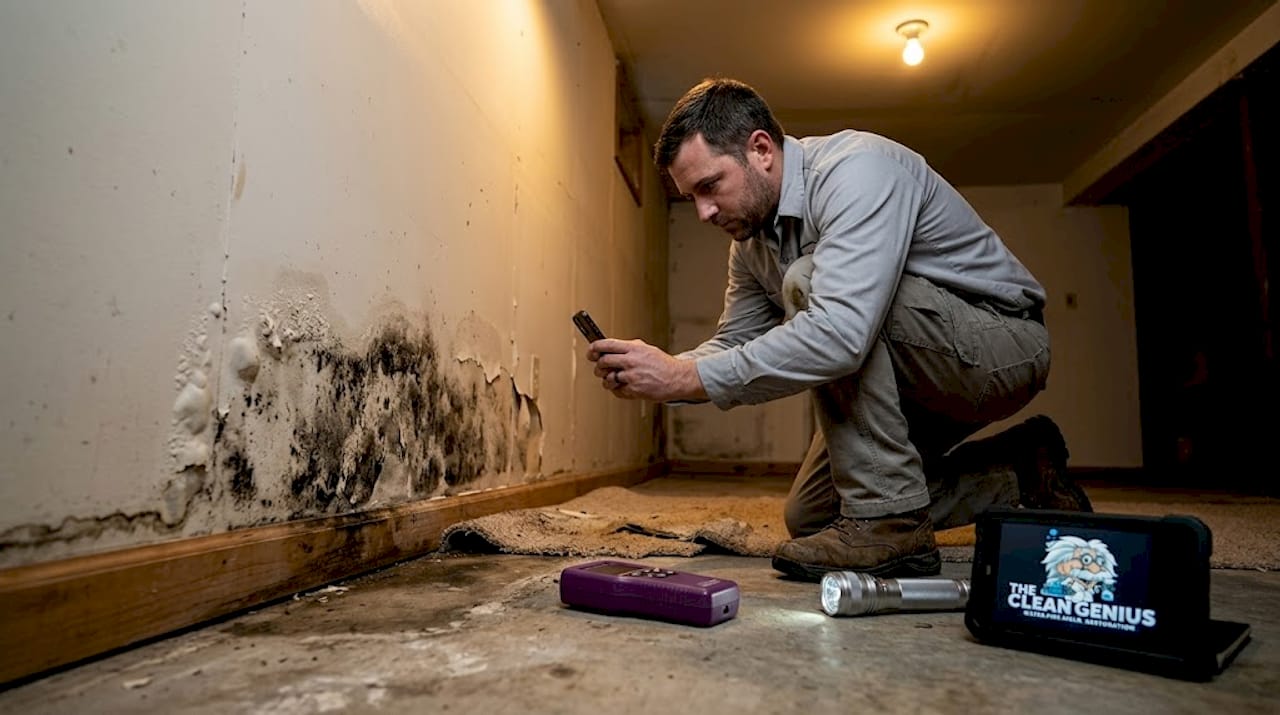
After a basement flood, Alternaria frequently appears along the base of drywall as a dark, spreading stain that looks almost like a watermark at first glance. By the time the color deepens and the texture becomes visible, it has already sent roots into the material beneath the surface.
3. Chaetomium: the mold that signals a chronic leak
Chaetomium is a mold type most homeowners have never heard of, but it is one of the clearest indicators that water damage has been ongoing rather than a single event. It starts as white or gray cottony growth and transitions to olive green or brown as it matures. You will typically find it on water-damaged drywall, cardboard, and basement walls.
Chaetomium indicates ongoing leaks rather than a one-time water event, which means if you find it, there is almost certainly a moisture source that has not been fixed. It produces mycotoxins and has been linked to neurological symptoms in cases of prolonged exposure.
If you see soft, fuzzy white growth on drywall that has turned mushy or discolored, Chaetomium is a likely culprit. The affected drywall typically cannot be saved and needs to be removed entirely.
4. Stachybotrys: what black mold actually looks like
Stachybotrys chartarum is the mold most people are thinking of when they say “black mold.” It appears as dark greenish-black colonies with a slimy or wet appearance when actively growing, and a powdery texture when it dries out. It grows on materials with high cellulose content, including drywall, ceiling tiles, and wood that has remained wet for an extended period.
The critical distinction with Stachybotrys is that it requires prolonged moisture exposure. You will not typically see it after a single overnight leak. It shows up when water damage has gone unaddressed for weeks or longer. Finding it in your home almost always means there is a hidden moisture problem that has been building for some time.
Pro Tip: Do not disturb Stachybotrys growth by scrubbing or spraying it with bleach. Disturbing it releases spores into the air. Seal off the area and call a professional.
| Mold type | Color | Texture | Common location | Moisture requirement |
|---|---|---|---|---|
| Alternaria | Dark green or brown | Velvety | Under sinks, near windows | Short-term moisture |
| Chaetomium | White to olive green | Cottony | Wet drywall, basement walls | Ongoing leak |
| Stachybotrys | Dark green-black | Slimy or powdery | Ceiling tiles, wet drywall | Prolonged saturation |
| Penicillium | Blue-green | Fuzzy | Carpets, insulation | Moderate moisture |
| Aspergillus | Green, yellow, or white | Powdery | Walls, HVAC ducts | Low to moderate |
5. Penicillium and Aspergillus: the molds hiding in your HVAC
These two mold types are often grouped together because they look similar and thrive in overlapping conditions. Both appear as powdery, fuzzy colonies in shades of green, blue-green, yellow, or white. After water damage, they frequently colonize carpets, insulation, and HVAC ductwork.
The HVAC connection is what makes them particularly concerning. Once Penicillium or Aspergillus establishes itself inside your duct system, every time your heating or cooling runs, it distributes spores throughout your entire home. Mold in air ducts can spread contamination to rooms that never had direct water exposure. This is one of the most common examples of mold growth that homeowners miss entirely because the source is invisible.
Aspergillus in particular is known to produce aflatoxins in certain conditions, making it one of the more health-relevant molds found after flooding.
6. Mold on drywall: the most common post-flood scenario
Drywall is essentially a mold buffet. The paper facing on both sides provides an ideal food source, and the gypsum core absorbs and retains moisture long after the surface feels dry to the touch. This is why porous materials wet for 48 hours typically require removal rather than cleaning.
After a flood, the base of drywall walls is almost always the first place mold appears. You will see discoloration starting at floor level, often looking like a tide line at first. Within days, fuzzy or slimy growth follows. The mold you see on the surface is only part of the story. By the time it is visible, the paper backing on the inside of the wall is already colonized.
Cutting out and replacing affected drywall is not optional in most post-flood scenarios. It is the only way to actually remove the mold rather than cover it up.
7. Mold growth conditions and when to call a professional
Understanding what conditions accelerate mold growth helps you act faster and smarter after water damage.
Mold needs three things: moisture, a food source, and the right temperature. Most homes provide the food source and temperature automatically. Moisture is the variable you can control. Indoor humidity above 60% actively promotes mold growth. Keeping humidity between 30 and 50 percent is the single most effective ongoing prevention strategy.
The EPA sets a clear threshold for professional remediation: mold covering more than 10 sq ft requires professional consultation. That is roughly a 3×3 foot patch. If you can see mold spreading across a wall section, a ceiling, or multiple surfaces, you are past the DIY threshold.
Pro Tip: Feeling the surface is not a reliable test for dryness. Use a humidity monitor and a moisture meter. Materials that feel dry to the touch can still hold enough moisture to sustain active mold growth inside.
8. How to prevent mold growth from getting worse
If you have just experienced water damage, these steps can stop mold from taking hold or spreading further.
- Fix the water source first. A leaking pipe, a failed sump pump, or a roof breach needs to be addressed before any cleanup begins. Mold will recur every time if the moisture source remains.
- Start drying immediately. Use fans, open windows when outdoor humidity allows, and run a dehumidifier continuously. The 24 to 48 hour window is real.
- Remove wet porous materials. Carpets, rugs, ceiling tiles, and insulation that cannot be dried within 48 hours should be removed and discarded. FEMA guidance on flooded items is direct on this point.
- Clean hard surfaces properly. For non-porous surfaces like tile or metal, use detergent and water rather than bleach. Bleach does not penetrate porous surfaces and does not address the root problem.
- Monitor hidden areas. Check inside cabinets, behind baseboards, and in the basement after flooding for signs of moisture and early mold growth.
- Keep humidity in check. Run a dehumidifier until your humidity monitor reads below 50 percent consistently.
- Document everything. Take photos of water damage and mold growth for insurance purposes before you clean or remove anything.
My honest take on mold identification after water damage
I have seen homeowners make the same mistake over and over: they focus on what the mold looks like instead of where the moisture is coming from. Someone spots a small white patch on a basement wall, decides it does not look like “dangerous black mold,” and wipes it off with a paper towel. Three months later, they have a serious problem behind that wall.
Visual color alone cannot reliably identify how dangerous a mold is. White mold can be just as harmful as black mold depending on the species and the exposure level. The color tells you almost nothing useful. The moisture conditions, the material it is growing on, and how long it has been there tell you everything.
The other mistake I see constantly is homeowners keeping wet materials too long because they are trying to save them. A carpet that has been soaked for three days is not worth saving. The cost of the carpet is nothing compared to the cost of remediating the subfloor and framing underneath it after mold colonizes both.
If you are unsure whether what you are seeing is mold, or if you have found mold but cannot locate the moisture source, that is exactly when to bring in a professional. Not because you cannot handle it yourself, but because the tools and methods available to professionals find what you cannot see.
— Jim
Get the mold problem solved the right way
When mold growth after water damage has gone beyond a small surface patch, or when you cannot find the source, professional remediation is the right call.

Themoldgenius uses Pure Cloud Technology, a dry fogging system with hospital-grade hydrogen peroxide and silver ions that reaches mold behind walls, above insulation, and in tight corners without tearing your home apart. Most jobs finish in a single day. Their three-phase process covers diagnosis with thermal imaging, professional mold removal, and prevention by fixing the root moisture cause. They also handle water damage restoration directly. Free estimates, insurance coordination, and same-day return for most homeowners. Call Themoldgenius before a manageable problem becomes a major one.
FAQ
How fast does mold grow after water damage?
Mold can begin growing on wet surfaces within 24 to 48 hours after water damage occurs. Drying materials within that window is the most effective way to prevent growth from starting.
What does mold look like after a flood?
Mold after flooding appears in a range of colors including black, dark green, white, gray, and brown, with textures ranging from fuzzy and cottony to slimy or powdery. It most commonly appears first along the base of walls, on ceiling tiles, and on any porous material that stayed wet.
Can mold grow inside walls after water damage?
Yes. Mold frequently grows inside walls, under flooring, and in HVAC ducts where it is not visible. A musty odor and unexplained allergy symptoms in a specific room are common signs of hidden mold growth.
When should I call a professional for mold after water damage?
The EPA recommends calling a professional when mold coverage exceeds roughly 10 square feet. You should also call a professional if you cannot identify the moisture source, if the mold is near your HVAC system, or if anyone in the home has respiratory symptoms.
Does bleach kill mold on walls?
Bleach is not recommended for mold cleanup on porous surfaces like drywall or wood because it does not penetrate deep enough to kill mold at the root. Detergent and water work better for hard surfaces, and porous materials with significant mold growth typically need to be removed entirely.