
Most Hoffman Estates homeowners should expect a professional mold job to land in the low thousands of dollars. Industry analysis for the Chicago market puts most residential jobs between $2,000 and $7,800, with a mid-range near $3,100. Small, contained patches can come in under that. Whole-house problems after a sewer backup or a long leak can go far above it. Where your job falls depends on the size of the affected area, where the mold is, what the water source was, and how much building material has to be replaced.
This guide breaks down those drivers, what is usually billed on top of removal, and how to read a written estimate so you can compare quotes fairly.
TL;DR
- Chicago-area residential mold jobs most often cost $2,000 to $7,800, with a mid-range around $3,100 (2026 industry analysis).
- Nationally, remediation runs roughly $10 to $25 per square foot, and small jobs sit at the high end because of minimum labor fees.
- The moisture source, the location (attic, basement, crawlspace, behind walls) and how much drywall or insulation must be replaced move the price most.
- Inspection, testing and rebuilding can be separate line items, so ask what the quote includes.
- Get a written scope and at least three estimates. If the leak is not fixed, the mold comes back and you pay twice.
Table of Contents
- What mold remediation typically costs in Hoffman Estates
- What drives the price up or down
- Costs that may sit outside the removal price
- Can you do it yourself to save money?
- How to read a mold remediation estimate
- Perspective: why the method changes the bill
- Insurance and selling a home with mold
- Get a Hoffman Estates estimate from The Mold Genius
- FAQ
- Sources
What mold remediation typically costs in Hoffman Estates
No published price list is specific to Hoffman Estates, so the useful benchmarks are Chicago-metro and national figures. Here is how they line up.
| Scenario | Typical range | Source |
|---|---|---|
| Most residential jobs, Chicago market | $2,000 to $7,800, mid-range about $3,100 | Restore Advisor, 2026 |
| Per square foot, national | $10 to $25 per sq ft | This Old House, 2026 |
| Extensive whole-house remediation | $10,000 to $30,000 | This Old House, 2026 |
| Separate mold inspection | $450 to $800 | Fixr, 2025 |
Two things to notice. First, the per-square-foot rate is not a flat multiplier. Smaller projects often land at the top of the range because every job carries minimum labor and setup costs. A 40-square-foot patch will not cost a fifth of a 200-square-foot one.
Second, Chicago-area labor runs higher than the national average. The same Chicago analysis notes that construction and extraction workers earn about 130% of the U.S. average (May 2025 data), so national averages can understate what you will see locally.
For reference, we do not publish fixed prices at The Mold Genius, because an honest number needs a look at your home. We offer free estimates, and the sections below explain what we and any other contractor will be pricing.
What drives the price up or down
The moisture source
The single biggest variable in the Chicago market is whether the water was clean or contaminated, according to the Chicago cost analysis. A slow roof leak or a condensation problem is a different job from a sewer backup. Contaminated water means more protective equipment, more material removal and more disposal, and the cost climbs with each.
In Hoffman Estates, with its mix of basements, finished lower levels and older attics, water most often arrives through foundation seepage, a failed sump, a plumbing leak or roof and ventilation problems. If you are not sure where yours came from, reading up on ceiling water stain causes can help you trace a stain to its origin before you call anyone.
Location in the house
Where the mold sits changes access, containment and what has to be removed. Major cost factors include the location of the mold, total square footage, the extent of structural damage and the labor for containment and removal. In practice:
- Attics: temperature swings and poor ventilation drive growth on roof sheathing and insulation. Treating mold without fixing airflow and insulation invites a repeat. See our breakdown of attic mold removal cost.
- Basements: finished walls, carpet and stored belongings add scope. Our page on basement mold removal cost goes deeper on what changes the number.
- Crawlspaces: tight access slows work, and moisture control often matters as much as the cleaning. Our guide to crawlspace mold risks explains why.
- Bathrooms and garages: usually smaller in scope, but drywall behind tile or a damp slab can enlarge the job.
Size of the affected area
The more square footage, the higher the total, though the rate per foot often falls on larger areas. Hidden growth is the wild card. A visible 2-foot patch on a ceiling can sit above a much larger area of damp insulation or framing. That is why a diagnosis step with moisture detection and thermal imaging matters before anyone gives you a firm figure.
Labor, materials and the method
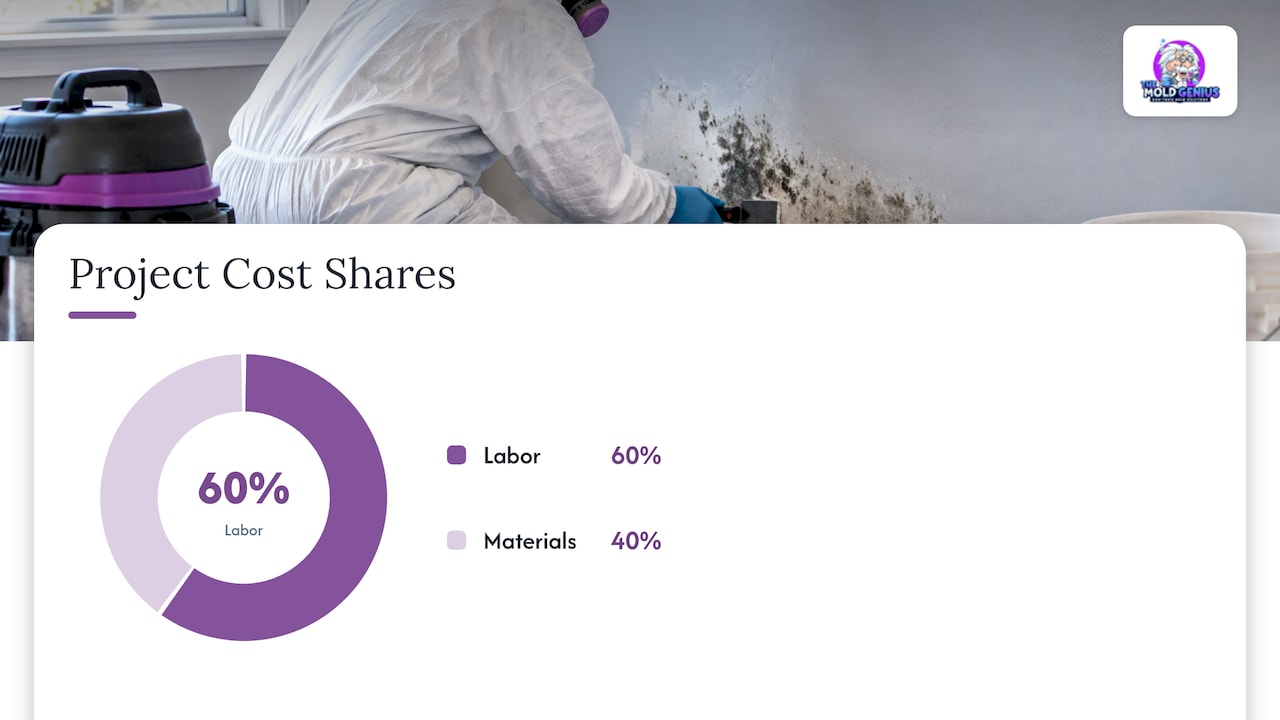
Labor makes up about 60% of a typical project and materials the other 40%. Method matters too. Traditional remediation often means demolition, so you pay for drywall, insulation and trim to come out and go back in. Some companies use specialized methods like dry fogging, which changes how much of the room has to be disrupted.
Costs that may sit outside the removal price
A quote that looks cheap can leave out things you will need. Ask whether each of these is included:
- Inspection and testing. Mold inspections cost $450 to $800 when billed alone, and some companies waive or include the fee if you hire them for the remediation.
- Fixing the moisture problem. A remediation plan should include steps to correct the water or moisture problem, or the mold may return. The ANSI/IICRC S520 standard’s preview says correcting the underlying cause is ordinarily the property owner’s responsibility unless it is separately contracted. A plumber, a gutter fix or a sump pump can be a separate bill.
- Rebuilding. Replacing drywall, insulation, flooring or trim after removal is often priced separately from the mold work itself.
- Water damage repair. If a leak or flood caused the mold, drying and restoration may come on top. We handle that under water damage repair and restoration, so it can be scoped together.
Can you do it yourself to save money?
Sometimes. The EPA says homeowners can typically handle cleanup themselves when the affected area is less than 10 square feet, roughly a 3-foot by 3-foot patch. Above that, or when the mold is hidden, recurring, or tied to sewage or a large water event, a professional is the safer call.
The EPA also notes the longer mold grows, the more damage it can cause, so delay is its own cost. If you are weighing it, our guides on professional removal versus DIY and when bleach works lay out the limits. Anyone with asthma, allergies or a weakened immune system should talk with their doctor before cleaning mold at all.
How to read a mold remediation estimate
A good estimate is a scope, not just a number. The EPA’s remediation guidance describes assessing the size of the problem and the damaged material types, then planning for moisture correction, protective equipment, containment, careful removal and communication with occupants. It also says the plan may need revising if new facts turn up, which is why a good contractor explains how change orders work before the job starts.
Louisiana State University’s AgCenter guidance says a written contract should include:
- a diagram or survey identifying the rooms, sections or square footage
- the expected duration
- an itemized materials list and who supplies renovation materials
- how debris is handled and removed
- warranties or guarantees
- cleanup procedures and products
- a cost breakdown and a total price cap
The same guidance recommends getting at least three estimates and checking training or certification and references before you sign. Compare scopes line by line. Two quotes that differ by $2,000 often differ in what they include, not in how good the work is.
Licensing and credentials in Illinois
One industry guide reports that Illinois does not require a specific mold remediation license, though reputable contractors are expected to carry IICRC S520-based training and general liability insurance. Ask for proof of both, and ask whether the contractor will put the guarantee in writing.
Perspective: why the method changes the bill
We have spent years in Chicagoland attics, basements and crawlspaces, and the pattern is consistent. The expensive jobs are rarely expensive because the mold is hard to kill. They are expensive because of the demolition, the rebuilding and the days a family spends out of its own house.
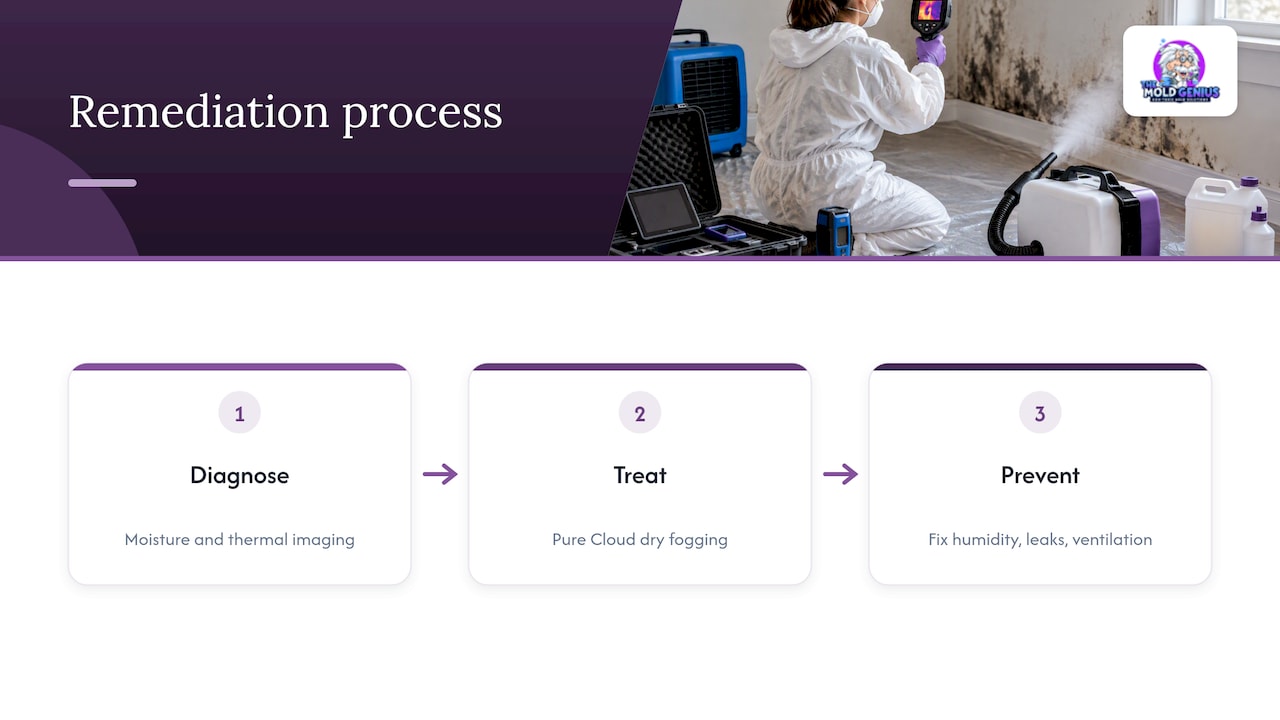
That is why we built our process around diagnosis first. We use moisture detection and thermal imaging to find what you cannot see, so the scope matches the real problem instead of a guess. Then we treat with Pure Cloud dry fogging, which uses hospital-grade hydrogen peroxide and silver ions and reaches behind walls, above insulation and into tight corners. For most jobs that means no gutting of rooms and no multi-day displacement. Most jobs wrap up in a single day and homeowners can return the same day.
The third phase is the one homeowners skip when they price-shop: prevention. If the humidity, the leak or the attic ventilation is not fixed, any treatment is temporary. We would rather tell you the root cause plainly than sell you a second cleanup next year. Our post-remediation prevention checklist is what we hand to homeowners after a job.
— Alex
Insurance and selling a home with mold
Whether insurance pays depends on the cause. Policies commonly respond to sudden, covered water events differently than to long-term seepage or neglected maintenance, and your carrier makes the call. We work with insurers including Allstate, State Farm, USAA, Farmers and Liberty Mutual, and our guide on what an insurance claim needs for mold remediation explains the paperwork to gather. Photograph the damage and keep your invoices.
If you plan to sell, mold in a basement is something to resolve early rather than at the closing table, because it can stall an inspection or a negotiation. We run a realtor network program for agents who need mold issues fixed before closing. For the disclosure rules that apply to your sale, ask your real estate agent or an Illinois real estate attorney.
Get a Hoffman Estates estimate from The Mold Genius
If you have mold in Hoffman Estates and want a scope you can compare against other quotes, we offer free estimates. We diagnose first, explain what we found, and give you a clear scope for removal and prevention. Our Hoffman Estates mold removal services page covers the area, and our mold removal and remediation page explains the process.

We are family-owned, with 25+ years of combined experience and more than 400 Google reviews, and our work is guaranteed. Tell us what you are seeing and we will take it from there.
FAQ
How much does mold remediation cost in Hoffman Estates?
Most Chicago-area residential jobs fall between $2,000 and $7,800, with a mid-range around $3,100, based on 2026 industry analysis. Extensive whole-house work can reach $10,000 to $30,000. A free on-site estimate is the only way to get a number for your home.
Why do small mold jobs cost more per square foot?
Contractors carry minimum labor and setup costs on every job, whatever its size. That is why smaller projects often fall at the higher end of the $10 to $25 per square foot range.
Is a mold inspection included in the price?
Not always. Separate inspections run $450 to $800, and some companies include or waive the fee when you hire them for remediation. Ask before you book.
Can I remove mold myself?
The EPA says homeowners can typically handle patches under 10 square feet. Larger, hidden or recurring mold, or growth after sewage or major flooding, calls for a professional. Our guide on why mold remediation is not a DIY job explains the risks.
Sources
- How Much Does Mold Remediation Cost? (2026 Guide), This Old House
- Mold Remediation Chicago IL: Costs & Sewer Backup Risk, Restore Advisor
- Mold Remediation Cost, Fixr
- How Much Does Mold Remediation Cost?, Forbes Home
- A Brief Guide to Mold, Moisture and Your Home, US EPA
- Mold Remediation in Schools and Commercial Buildings Guide, Chapter 3, US EPA
- ANSI/IICRC S520 (2015) preview
- Hiring a Mold Remediation Contractor, LSU AgCenter
- Mold Remediation Cost in Illinois, MoldGuide