
You’ve decided to sell your home, and the last thing you want is a buyer’s inspector finding mold three days before closing. A mold pre sale inspection is a proactive assessment you commission before listing your property, designed to identify visible mold, hidden moisture problems, and air quality issues before they become someone else’s leverage against you. Most sellers assume mold inspections are something buyers do. That assumption costs deals. This guide walks you through what the inspection actually involves, how to prepare for one, what the results mean, and how to use the whole process to your advantage.
Table of Contents
- Key takeaways
- What a mold pre sale inspection includes
- How to prepare for a mold inspection
- Why pre sale mold inspections benefit sellers
- What happens after the inspection results come in
- My honest take on pre sale mold inspections
- Ready to act on your inspection results?
- FAQ
Key takeaways
| Point | Details |
|---|---|
| Proactive beats reactive | Ordering a pre sale mold examination before listing gives you control over the narrative and the timeline. |
| Preparation affects accuracy | Closing windows and turning off HVAC systems 48 hours before inspection stabilizes air conditions for valid samples. |
| Inspection and testing differ | Visual inspection finds visible mold; lab-tested air and surface samples document spore counts and species for buyers and lenders. |
| Results shape your next steps | Clean results build buyer confidence; problems found early give you time to remediate on your own terms. |
| Documentation protects you | Written inspection reports and remediation records reduce legal risk and support full disclosure requirements. |
What a mold pre sale inspection includes
A mold pre sale inspection is not just a quick look around for black spots on the ceiling. A thorough pre sale mold examination combines several methods to catch both visible and hidden problems.
Here is what a professional inspector typically covers:
- Visual assessment. The inspector walks through all accessible areas, including attic, basement, crawlspace, bathrooms, and around windows, looking for discoloration, water staining, and visible mold colonies.
- Moisture detection. Moisture meters measure water content in walls, floors, and ceilings. Elevated readings point to conditions where mold is likely growing even if it is not yet visible.
- Thermal imaging. Infrared cameras detect temperature differences in surfaces, revealing hidden moisture behind drywall or under flooring without cutting anything open.
- Air sampling. The inspector collects air samples from multiple rooms and sends them to a lab for analysis. This measures spore counts and identifies mold species present in your home.
- Surface sampling. If visible growth is found, swab or tape-lift samples are collected and sent for lab analysis to confirm the species.
- Outdoor baseline sampling. A sample is collected outside your home at the same time as indoor samples. Without an outdoor baseline, indoor spore counts alone can be misleading because some mold spores are naturally present in outside air.
It helps to understand the difference between inspection and testing. Inspection is visual and moisture-focused; testing adds lab analysis for species identification and spore counts. Buyers and lenders often require documented test results, not just a visual walkthrough.
| Method | What it detects | Lab analysis needed? |
|---|---|---|
| Visual inspection | Visible mold and water damage | No |
| Moisture meter | Hidden moisture in materials | No |
| Thermal imaging | Temperature anomalies from moisture | No |
| Air sampling | Airborne spore counts and species | Yes |
| Surface sampling | Species on visible growth | Yes |
Inspection appointments typically run two to six hours depending on home size, with lab results available within 24 to 48 hours. Budget-wise, inspection costs range from roughly $300 to $900 depending on the scope of testing and the size of the property.

Pro Tip: Ask your inspector whether outdoor baseline sampling is included in the quote. Some inspectors skip it to save time, but without that comparison, the air sample results are scientifically harder to defend if a buyer challenges them.
How to prepare for a mold inspection
Preparation is not about making your home look good for the inspector. It is about stabilizing indoor air conditions so the samples accurately reflect what is actually in your home. Proper preparation steps include controlling air movement and avoiding anything that would artificially alter spore concentrations.
Follow these steps before your inspection:
- Close all windows and doors 48 hours before the inspection. This allows indoor air to reach a stable, representative state. Opening windows the morning of inspection flushes out spores that would otherwise be captured in samples.
- Turn off humidifiers and dehumidifiers. Both devices actively change moisture levels and can skew air quality readings.
- Turn off air purifiers. HEPA filters pull spores from the air, which would produce artificially low counts in your samples.
- Shut down the HVAC system shortly before the inspector arrives. Running the system circulates air and disrupts localized spore concentrations.
- Do not clean or disinfect suspected mold areas. Scrubbing a surface before sampling destroys the evidence the inspector needs to document.
- Schedule on a dry day. Outdoor baseline samples collected on a rainy day produce unreliable results because rain suppresses outdoor spore counts.
- Clear access to all areas. Move boxes away from basement walls, pull items out of crawlspace entrances, and make sure the attic hatch is accessible. Inspectors cannot assess what they cannot reach.
Pro Tip: Let your inspector know about any past water intrusion events, even if they were repaired. A leak from two years ago that was patched quickly can still have residual mold growth behind the wall. That context helps the inspector prioritize where to look.
Why pre sale mold inspections benefit sellers
The conventional thinking is that mold inspections protect buyers. That is only half the picture. When you order a pre sale mold examination before listing, you shift from a reactive position to a proactive one.
Here is what that shift actually looks like in practice:
- You control the timeline. If mold is found during a buyer’s inspection, you are on their schedule. If you find it first, you decide when and how to address it.
- You reduce buyer anxiety. A clean inspection report is a marketing asset. Buyers who see documented proof of a mold-free home are less likely to request price reductions or contingencies.
- You manage legal risk. Most states require sellers to disclose known material defects. A pre sale inspection creates a documented record of what you knew and when, which is far better than having a buyer discover a problem you could have found yourself.
- You negotiate from strength. If remediation is needed, you can get it done before listing and price the home accordingly, rather than scrambling to offer credits during a tense negotiation.
- You build buyer trust. Providing inspection documentation upfront signals transparency. That matters more than most sellers realize, especially in a market where buyers are cautious.
Understanding how mold affects your home’s value makes the cost of a pre sale inspection look very small compared to what a surprise discovery during escrow can cost you.
A mold problem found by a buyer’s inspector is a negotiating weapon. The same problem found by your inspector is a project with a solution.
What happens after the inspection results come in
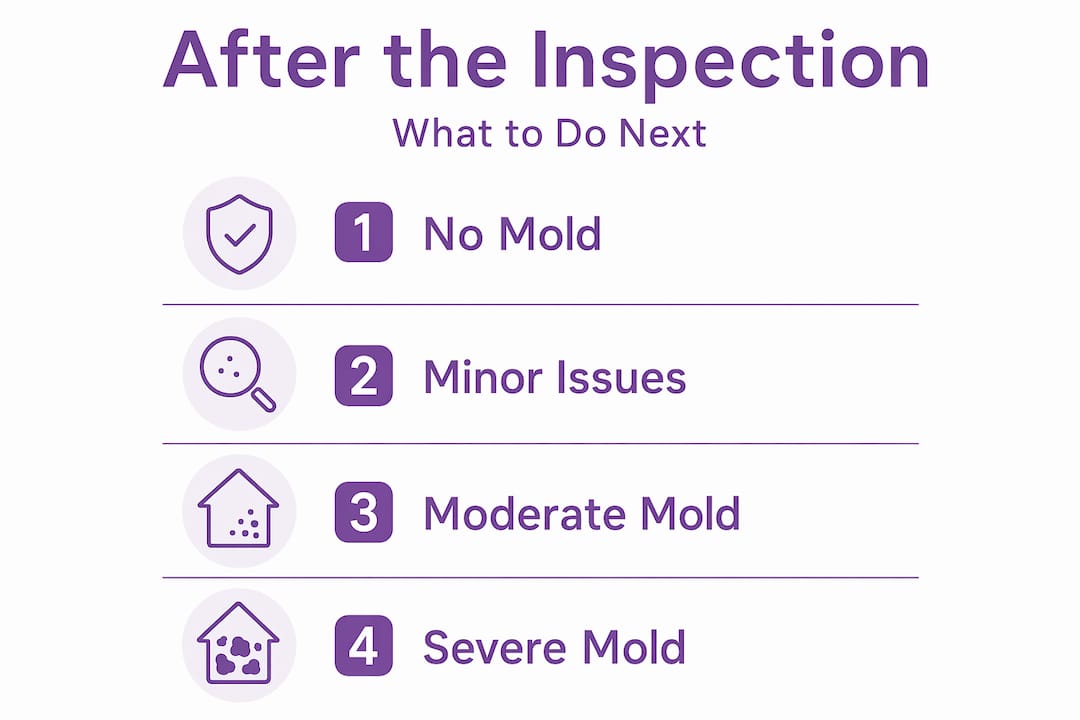
The mold inspection process produces one of four general outcomes, and each one calls for a different response.
No mold detected. This is the best case. You receive a clean report, you attach it to your listing disclosures, and you move forward with confidence. Buyers and their agents see the documentation and have one less reason to push for concessions.
Minor issues found. Small amounts of surface mold in bathrooms or around window frames often indicate a ventilation or humidity problem rather than a structural one. Cleaning the affected surfaces with appropriate products and improving airflow usually resolves it. Document what you did and when.
Moderate mold growth. This typically means there is a moisture source feeding the mold, such as a slow pipe leak, inadequate crawlspace vapor barrier, or poor attic ventilation. You need to fix the source first. Then remediate the mold. Skipping the source fix and just treating the mold is a waste of money because it will return.
Severe mold contamination. Extensive mold, particularly in attic spaces or crawlspaces, requires professional remediation. Buyers financing with FHA or VA loans face stricter property condition requirements, and lenders may require a clearance test before approving the loan.
| Outcome | Recommended action | Disclosure required? |
|---|---|---|
| No mold detected | Attach report to disclosures | Report the clean result |
| Minor surface mold | Clean, improve ventilation, document | Yes |
| Moderate growth | Fix moisture source, remediate, retest | Yes |
| Severe contamination | Professional remediation, clearance test | Yes |
Pro Tip: After any remediation, order a post-remediation clearance test before relisting. This independent confirmation that mold levels are back to normal is worth more to a buyer than your word alone. It also protects you legally.
When choosing a remediation company, ask the right questions before signing anything. Knowing what to ask a mold removal company before hiring them can save you from paying twice for the same problem.
My honest take on pre sale mold inspections
I have seen what happens when sellers skip this step. A deal falls apart two weeks before closing because a buyer’s inspector found mold in the attic. The seller had no idea it was there. The buyer panics, demands a $15,000 price reduction, and the seller either accepts it or risks losing the deal entirely. That is not a negotiation. That is a hostage situation.
What I have learned from working through hundreds of mold situations is that the sellers who come out ahead are the ones who treated their home like a product before putting it on the market. They did not wait for someone else to find the problems. They found the problems themselves, fixed them, and documented everything.
The other thing most sellers miss is the distinction between inspection and testing. You can have a visual inspection and feel confident, but if there is hidden mold behind a wall or in an HVAC duct, a visual check will not catch it. Air sampling with a proper outdoor baseline comparison is what gives you a defensible, documented picture of your home’s actual air quality.
My take is simple. The cost of a pre sale mold examination is almost always less than the cost of a single round of buyer negotiations after mold is discovered. Transparency is not just the ethical choice. It is the financially smart one.
— Jim
Ready to act on your inspection results?
If your pre sale inspection turned up mold, or if you want to get ahead of potential problems before you list, Themoldgenius is ready to help.

Themoldgenius uses Pure Cloud Technology, a dry fogging system with hospital-grade hydrogen peroxide and silver ions, to reach mold in places traditional methods miss. Behind walls, above insulation, in tight corners. No gutting rooms. Most jobs are done in a single day, and you can return home the same day. Their team handles mold removal and remediation in attics, basements, bathrooms, crawlspaces, and garages across the Chicagoland area. They also work directly with realtors who need mold issues resolved before closing. Free estimates are available, so there is no reason to guess at the scope or cost. Contact Themoldgenius at themoldgenius.com to get started.
FAQ
What is a mold pre sale inspection?
A mold pre sale inspection is a proactive assessment ordered by the seller before listing a property. It identifies visible mold, hidden moisture conditions, and airborne spore levels using visual checks, moisture meters, and lab-analyzed air samples.
How much does a mold inspection cost for sellers?
Mold inspection costs typically range from $300 to $900 depending on home size and whether air and surface sampling are included in addition to a visual walkthrough.
How long does a mold inspection take?
Most mold inspection appointments take two to six hours, with lab results returned within 24 to 48 hours. Scheduling is often available same-day or next-day.
Do sellers have to disclose mold found in an inspection?
Yes. Once you are aware of a mold problem, most states require you to disclose it as a material defect. A pre sale inspection with documentation actually protects you by showing you acted in good faith and addressed the issue.
What is the difference between mold inspection and mold testing?
Mold inspection is visual and focuses on identifying moisture and visible growth. Mold testing adds lab analysis to identify specific species and measure spore concentrations, which buyers and lenders often require as documentation before closing.