
Professional mold remediation in the Chicago area, including Palatine, typically costs between $2,000 and $7,800 for most residential jobs, though national averages are around $2,300. Contractors commonly price these jobs by contaminated square footage, usually $10 to $25 per square foot. The exact cost for mold remediation depends on the amount of surface affected, how hard it is to reach, and whether the water source has been fixed.
Most Palatine homeowners should plan for a professional mold remediation job to land between about $1,200 and $3,750 nationally, with Chicago-area jobs reported higher, roughly $2,000 to $7,800. Your exact number depends on how much surface is affected, how hard it is to reach, and whether the water source has been fixed. We don’t publish flat prices at The Mold Genius because the right figure comes from looking at your home, so this guide shows you how the numbers are built and how to read any quote you receive.
What is the typical cost of mold remediation in Palatine and Chicagoland?
- National typical range for professional remediation is $1,200 to $3,750, averaging about $2,300. Chicago-area pages report $2,000 to $7,800 for most residential jobs.
- Contractors usually price by contaminated square footage, commonly $10 to $25 per square foot, plus fixed costs such as containment and disposal.
- Attics, crawlspaces and finished basements cost more because access is harder and hidden growth expands the scope.
- A good estimate names the affected areas, itemizes labor and materials, and explains how success is verified and how the moisture source will be handled.
- Your insurance may cover mold only in limited ways, so read your policy before the work starts.
Table of Contents
- What mold remediation typically costs near Palatine
- How contractors price the job
- What pushes your price up or down
- Do you need mold testing first?
- What a written estimate should include
- How to compare two or three quotes fairly
- Perspective
- Insurance and mold in Illinois
- Get a Palatine estimate from The Mold Genius
- FAQ
- Sources
What mold remediation typically costs near Palatine
No single published price exists for Palatine specifically, so the useful approach is to start with national and Chicago-area ranges and then adjust for your house.
| Source scope | Reported range | Notes |
|---|---|---|
| National, most homeowners | $1,200 to $3,750 | Average about $2,300 |
| Chicago residential | $2,000 to $7,800 | Mid-range about $3,100 |
| Chicago finished basement | $2,000 to $9,100 | Limited access and, in many cases, more complex protocols for contaminated water |
| Small areas | $500 to $1,500 | Example totals from one guide |
| Extensive whole-house work | $10,000 to $30,000 | Example totals from the same guide |
These are third-party estimates, not our quotes. Treat them as a planning frame. A Palatine ranch with a damp corner of the basement sits near the bottom of the scale. A two-story with roof-leak mold across an attic and a wet finished basement sits much higher.
How contractors price the job
The square-foot rate
Most residential quotes start with the area of contaminated surface. One 2026 guide puts the usual rate at $10 to $25 per square foot, rising to about $15 to $30 when access is complex or HVAC work is involved, and dropping to $8 to $12 for light surface mold on accessible non-porous materials.
Fixed costs on top
The same guide notes that the rate is a starting point, not the final invoice. Containment setup and teardown, equipment days, disposal and minimum charges add fixed costs. That means a small job often works out to a higher price per square foot than the headline rate. If someone quotes you $15 per square foot for a 20-square-foot patch and the total is $900, that is not a red flag by itself. It is the fixed costs showing up.
Size categories and containment
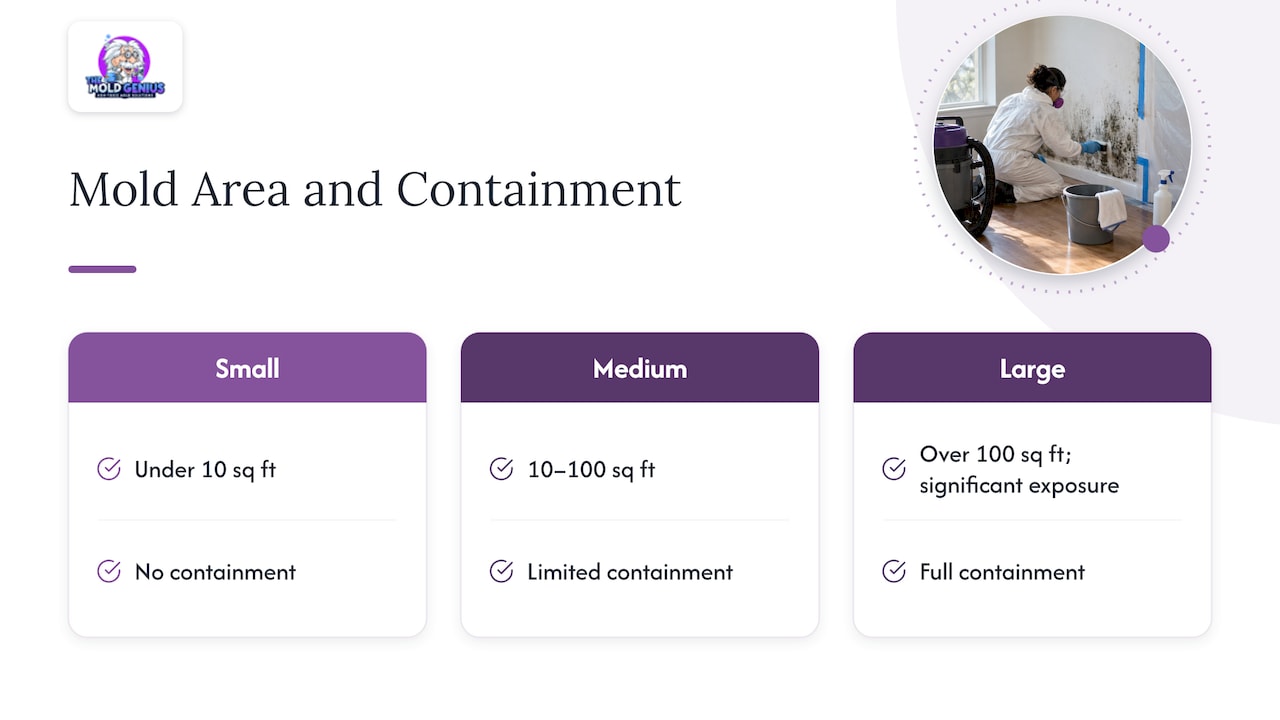
The EPA sorts clean-water mold areas into small (under 10 square feet), medium (10 to 100) and large (over 100 square feet or significant exposure potential), with no, limited and full containment respectively. Bigger areas need more setup, and setup is a real part of the price.
What pushes your price up or down
Size and depth
Costs generally rise with larger affected areas and deeper damage, especially when mold has reached porous materials that must be removed and replaced, according to This Old House. Drywall and insulation are the usual culprits.
Location and access
The harder the mold is to reach, the more the job costs. Access difficulty adds time, so two jobs with the same amount of mold can price differently if one is in an open basement wall and the other is under a low-pitch roof deck. Hidden mold also raises cost because the abatement is more challenging.
In our area, that plays out room by room:
- Attics: temperature swings and poor ventilation drive growth, so the scope often includes ventilation and insulation, not only the mold. See our attic mold removal service, including the Palatine attic page.
- Basements: finished basements cost more than unfinished ones because of limited access, and contaminated-water events add complexity. Our basement mold removal page covers how we approach it.
- Crawlspaces: tight quarters and moisture exposure shape the work. Here is how crawlspace mold is treated.
- Bathrooms and garages: usually smaller in scope, but a hidden leak behind a wall can change that quickly.
Mold type and water source
Some molds call for specialists, protective equipment and extra precautions, which can raise the price. And when the cause is sewage backup, the job can sit at the top of the basement range. The same Chicago guide adds that sewer backup is excluded under standard HO-3 policies unless you bought an endorsement.
Do you need mold testing first?
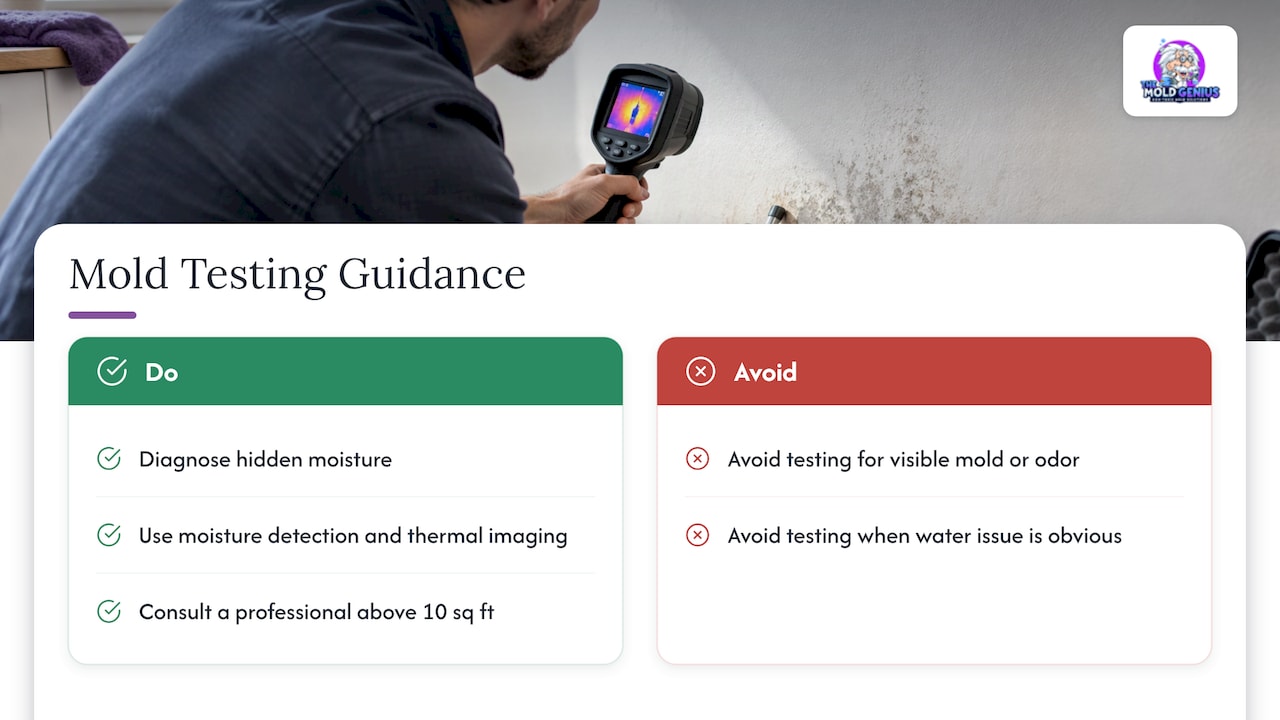
Often not. The Illinois Department of Public Health says that if you can see or smell mold, testing is usually unnecessary, can be expensive and is difficult to interpret. Building science research agrees that when the water problem is obvious, testing to guide cleanup is pointless.
What you do want is a diagnosis of where moisture is hiding. We use moisture detection and thermal imaging to find what you can’t see, which tells us how far the problem really goes before anyone quotes a number.
As a size guide, IDPH advises consulting a professional when more than 10 square feet is contaminated. If you are in that territory, our guide on getting on-site bids before hiring a remediator walks through the process.
What a written estimate should include
Ask for the estimate in writing. A complete one has six parts:
- A project description that names the affected areas specifically.
- A scope of work itemized by labor category.
- Material costs broken out.
- The verification protocol, meaning moisture readings or clearance samples.
- Timeline and access requirements.
- The total price and payment terms.
Two more items matter just as much in Illinois. First, the moisture source. IDPH is clear that fixing the moisture source is essential so mold does not regrow. Second, reconstruction. Removing drywall is one line item. Replacing it is another, and some quotes leave it out. Ask which one you are looking at.
For a closer look at what remediation work includes and how it limits regrowth, what remediation involves is a helpful companion read.
How to compare two or three quotes fairly
A $1,800 quote and a $4,500 quote are not comparable until they cover the same work. Line them up on these points, which InspectandTest recommends:
- Affected square footage to be removed or treated
- The containment plan
- Whether post-remediation verification is included
- Whether reconstruction is in scope
- What the warranty covers
Then add the question most people forget: who fixes the cause? Chronic roof leaks, foundation moisture, plumbing failures and sustained high humidity are the common sources, and skipping the repair means the growth comes back. If one bidder treats the mold and shrugs at the leak, the cheaper price is not cheaper. Our article on why mold returns after cleaning explains the typical root causes.
Perspective
Most cost surprises come from one of two places: mold nobody could see when the quote was written, and a moisture problem nobody fixed.
That is why our process starts with diagnosis. Moisture detection and thermal imaging show us what is behind the wall or above the insulation before we commit to a scope. Then we remove the mold with our Pure Cloud system, a dry fogging process using hospital-grade hydrogen peroxide and silver ions that reaches behind walls, above insulation and into tight corners. The idea is to treat mold where it lives without gutting rooms.
For many homes that means the job wraps up in a single day and the family returns the same day. Less demolition and fewer days of displacement are meant to keep the total bill and the disruption lower than a tear-out approach.
The third phase is prevention. We look for the cause, whether that is ventilation, insulation or a water source, so you aren’t paying for the same problem twice. Our work is backed by a guarantee, and we give free estimates so you can see the scope in writing before you decide.
Alex
Insurance and mold in Illinois
Coverage varies by policy, so the policy itself is the authority. As an example of what the language can look like, one sample Illinois policy form lists a $5,000 limit for fungi, wet or dry rot, or bacteria. Your limit may differ, and coverage often hinges on whether the mold came from a sudden covered event, such as a burst pipe, rather than long-term seepage.
Practical steps:
- Pull your declarations page and look for fungi or mold limits and any water backup endorsement.
- Document the damage with photos before any work begins.
- Call your carrier before signing a remediation contract.
We work with claims from carriers including Allstate, State Farm, USAA, Farmers and Liberty Mutual. Our insurance coverage checklist lists what to gather. Questions about tax treatment, such as whether remediation is deductible, belong with a tax professional, since it depends on your situation.
Get a Palatine estimate from The Mold Genius
If you have visible mold, a musty smell, or a leak you suspect has fed hidden growth, we offer free estimates across Palatine and the surrounding suburbs. We are a family-owned team with 25+ years of combined experience and 400+ Google reviews. Our diagnosis, Pure Cloud removal and prevention steps are designed to resolve most jobs in a day.

Start on our mold removal page or go straight to the room you are worried about: attic, basement, crawlspace, bathroom or garage. If water caused the problem, our water damage repair and restoration service deals with the source too.
FAQ
How expensive is mold remediation in a house?
Nationally, most jobs run $1,200 to $3,750, and Chicago-area reports run $2,000 to $7,800. Whole-house cases can climb far higher. The size, location and moisture source decide where you land, and a free on-site estimate gives you a figure for your home.
Will insurance pay for mold in the attic?
It depends on your policy and the cause. Many policies cap mold coverage and respond mainly when a sudden covered event caused the water. Read your fungi or mold limit, and call your carrier before work starts. Our insurance checklist helps you prepare.
Can I write off mold remediation on my taxes?
That depends on your circumstances, and we can’t give tax advice. Keep invoices, photos and any insurance paperwork, and ask a tax professional whether anything applies to you.
Do I need a mold test before I hire someone?
Usually not when mold is visible or the water problem is obvious. IDPH says testing is usually unnecessary in that case. A moisture and thermal imaging inspection tells you more about scope.
Why do two quotes differ so much?
Usually the scopes differ. Square footage, containment, verification, reconstruction and the moisture repair may be included in one and left out of the other. Compare them line by line before judging on price.
Sources
- How Much Does Mold Remediation Cost? (This Old House)
- Mold Remediation Chicago IL: Costs and Sewer Backup Risk
- Mold Remediation Cost Per Square Foot
- EPA mold remediation table
- Mold Remediation Cost Guide (Bob Vila)
- How Much Does Mold Remediation Cost? (Acorn Finance)
- IDPH: Reducing Your Exposure to Mold
- Building Science RR-0209: Mold Testing
- Mold Estimate guide (InspectandTest)
- Black Mold Removal Cost (InspectandTest)
- Sample Illinois policy form
- Mold remediation and removal overview