
A mold air sample is a diagnostic tool that uses a calibrated pump to draw a measured volume of air through a spore trap cassette, capturing airborne mold spores on an adhesive surface. These cassettes are then analyzed by an accredited laboratory, which identifies specific mold species and quantifies spore concentrations, often pulling between 75 and 150 liters of air during a 5 to 10 minute sampling window. This process provides a precise count of spores per cubic meter of air, offering homeowners a reliable assessment of their indoor air quality. The results are most meaningful when indoor spore levels are compared against an outdoor baseline sample to determine potential issues.
If you’ve ever wondered whether your home’s air is safe to breathe, a mold air sample is one of the most reliable tools you have. Most homeowners assume that if they can’t see mold or smell anything musty, they’re in the clear. That assumption can be dangerously wrong. Mold spores are microscopic, constantly circulating through your indoor air, and some of the most problematic species grow completely out of sight. Understanding what is a mold air sample, how it works, and what results mean can make the difference between taking the right action and ignoring a real health risk.
Table of Contents
- Key Takeaways
- What is a mold air sample and how it works
- Why mold air samples matter for your home
- How to sample mold air: what to expect
- Reading your lab results
- Challenges and limitations of mold air sampling
- My take on what homeowners get wrong about mold testing
- What to do when your air sample results raise concerns
- FAQ
Key Takeaways
| Point | Details |
|---|---|
| Air sampling detects invisible spores | Mold spores are airborne and microscopic, so visual checks alone won’t tell you what’s really in your air. |
| Lab analysis confirms species and counts | A certified lab identifies specific mold types and spore concentrations to guide remediation decisions. |
| Indoor vs. outdoor comparison matters | Results only mean something when indoor spore levels are compared against an outdoor baseline sample. |
| Professional sampling beats DIY kits | DIY kits provide basic presence data but lack the expert analysis needed to act on results safely. |
| Results require professional interpretation | Spore counts and species data need qualified review before you can plan any remediation steps. |
What is a mold air sample and how it works
A mold air sample is exactly what it sounds like. A calibrated pump draws a measured volume of air through a collection device, typically a spore trap cassette, which captures airborne mold spores on an adhesive surface inside. Those cassettes are then sent to an accredited laboratory where technicians examine the contents under a microscope to identify and count what was captured.
The technical specs matter here. Sampling pumps run 5 to 10 minutes, pulling between 75 and 150 liters of air through the cassette during that window. That controlled volume is what makes the results quantifiable. You’re not just getting a “yes mold exists” answer. You’re getting a specific count of spores per cubic meter of air, along with identification of which species were present.
Here’s how the process breaks down:
- Spore trap cassettes capture particles on a sticky internal surface as air passes through
- Calibrated pumps maintain a consistent airflow rate so volume is accurately measured
- Lab microscopy (or molecular PCR analysis for higher accuracy) identifies mold genera and species
- An outdoor control sample is collected simultaneously to establish a baseline for comparison
- A written report summarizes spore counts, species identified, and how indoor levels compare to outdoor levels
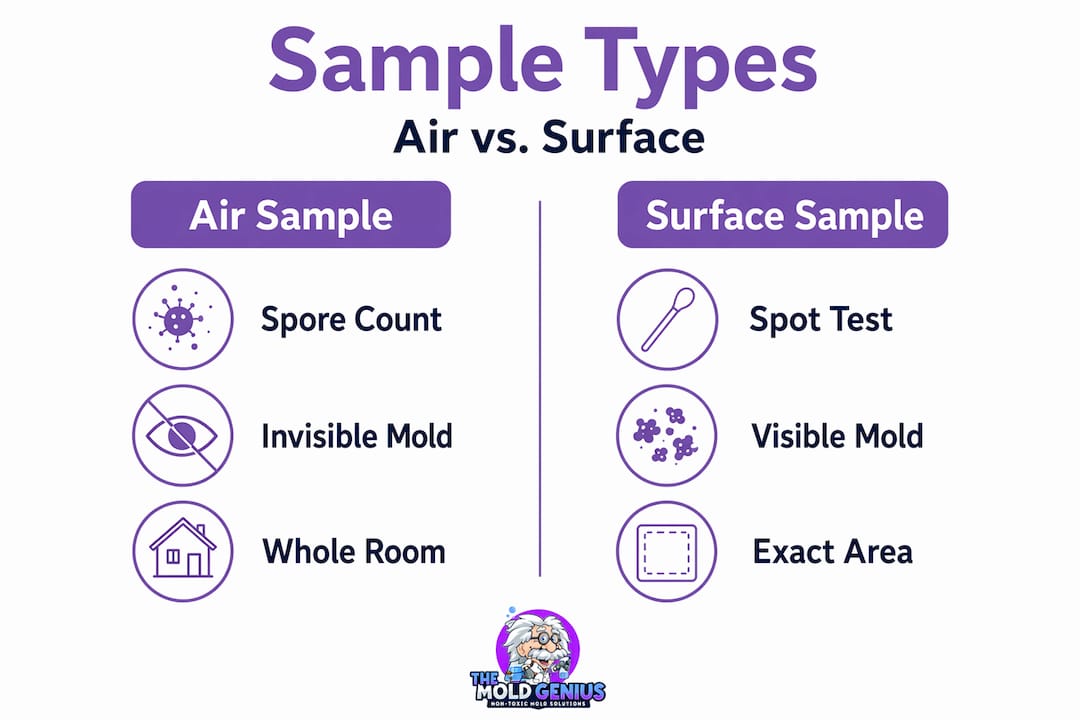
This differs from surface sampling, which swabs a specific visible spot to identify what’s growing there, or dust sampling, which collects settled dust to assess long-term accumulation. Air sampling is the method that reflects what you’re actually breathing right now.
Pro Tip: Ask your inspector whether the lab they use is AIHA-accredited. Accreditation matters because it verifies the lab follows standardized protocols, which directly affects how much you can trust the numbers in your report.
Why mold air samples matter for your home
The core value of a mold air quality test is context. A single spore count number by itself tells you almost nothing. What makes it meaningful is comparing it to the outdoor baseline collected at the same time. Indoor air should have similar or lower spore counts than the outdoor air around your home. When indoor levels are significantly higher, or when species appear indoors that weren’t present outdoors, that signals an active indoor mold source.
Here’s why that distinction is so important.
| Factor | What it tells you |
|---|---|
| Elevated indoor count vs. outdoor | Active mold growth somewhere inside the home |
| Unusual species found only indoors | Localized source, often hidden behind walls or under flooring |
| Low count but symptomatic residents | May indicate intermittent release or need for additional testing methods |
| Outdoor-matching count indoors | Likely no significant active indoor source |
Smell and sight are unreliable guides on their own. Many mold species grow in areas with no visible surface and produce no odor until colonies are substantial. Only lab analysis from professional sampling can confirm the presence of toxic species like Stachybotrys chartarum (black mold) or Aspergillus strains that produce mycotoxins. No homeowner can make that call by looking at a dark spot on a wall.
The importance of mold air samples also comes down to health protection. Some occupants experience respiratory symptoms, fatigue, or chronic sinus issues without knowing why. Air sampling creates a documented picture of what’s actually circulating in your living space, giving doctors and remediation professionals the data they need to make informed decisions.
Pro Tip: Always request that your inspector collect at least one outdoor control sample during the same visit. Without that comparison point, your indoor results have no meaningful reference.
How to sample mold air: what to expect
When sampling mold air, homeowners can expect to learn about the process and associated costs. This section will detail what the process actually looks like and what it will cost, moving beyond just knowing you need testing.
Professional vs. DIY
DIY mold test kits cost between $30 and $80 and can indicate whether mold spores are present. What they cannot do is tell you how much, which species, or whether the levels are abnormal for your area. A professional inspection with air sampling and lab analysis costs between $300 and $700, including lab fees of roughly $25 to $50 per sample. For most homeowners dealing with real concerns, that investment is worth it.
What a professional inspection looks like
- Initial walkthrough. The inspector does a visual check and looks for moisture sources, water staining, and problem areas before placing any equipment.
- Moisture mapping. Thermal imaging and moisture meters locate hidden dampness behind walls or under flooring where mold often originates.
- Sampler placement. Cassettes are positioned at breathing zone height, typically 3 to 5 feet off the ground, in multiple rooms and problem areas.
- Timed sampling runs. The pump runs for the calibrated period while the home is undisturbed to avoid kicking up settled dust.
- Outdoor control sample. A matching sample is taken outside to create the baseline comparison.
- Lab submission. Cassettes are packaged and sent to an accredited lab, with results typically returning within 3 to 5 business days.
- Report review. A qualified inspector walks you through findings and recommends next steps.
A certified mold test should always include all of these components, not just the air cassette collection. Any inspection that skips moisture mapping or outdoor control samples is incomplete.
When does air sampling for mold make sense? Consider it when:
- You or a family member has unexplained respiratory symptoms or allergic reactions at home
- You’ve had recent water damage, flooding, or a plumbing leak
- You’re buying or selling a home and want documentation
- You’ve noticed visible mold in one area and want to know if spores have spread to other rooms
- You’ve completed remediation and want to verify it was successful
Reading your lab results
Lab reports can look intimidating, but the core elements are straightforward once you know what to focus on.
Every report lists spore types, spore counts per cubic meter, and a comparison between indoor and outdoor samples. Reliable mold type identification requires microscopic or molecular lab techniques, and the quality of that analysis depends entirely on the lab’s accreditation.
Key things to look for:
- Cladosporium and Penicillium/Aspergillus are the most common mold genera found in air samples. Elevated levels of these may not indicate a crisis, but they signal moisture issues worth addressing.
- Stachybotrys (black mold) spores are dense and heavy and rarely become airborne in large numbers, which means a low count doesn’t rule it out. A surface sample may be needed to confirm or rule out its presence.
- Any species found significantly indoors but not outdoors is a red flag, regardless of the count.
- Total spore counts above 1,500 spores per cubic meter indoors when outdoor levels are much lower typically warrant professional follow-up.
Counts alone don’t tell the full story. A home with 1,000 Penicillium spores per cubic meter indoors when outdoor levels are 900 has a very different situation than a home where the outdoor count is 100. This is why no federal or state-enforced standards exist for residential mold testing. Interpretation requires professional judgment, not just a number.
Challenges and limitations of mold air sampling
Air sampling is a powerful tool, but it has real limitations that every homeowner should understand before relying on results alone.
- Sampler placement directly affects results. Placing cassettes too low disturbs dust and creates false positives. Placing them too high misses the breathing zone where exposure actually happens.
- Spores aren’t always airborne. Mold growing inside wall cavities or deep in HVAC ductwork may release spores only intermittently. A single sampling run on a calm day might completely miss an active source.
- Timing matters. Activity in the home before sampling, recent cleaning, or open windows can all skew results significantly.
- Hidden mold needs more than air sampling. Air sampling alone may miss mold inside walls or HVAC systems; dust-based DNA testing or moisture mapping are often needed to locate concealed sources.
- Air sampling doesn’t measure exposure. Health experts recommend combining clinical assessment with environmental testing because a normal air sample doesn’t mean occupants haven’t been exposed over time.
The takeaway: air sampling is most valuable as part of a multi-method assessment, not as a standalone answer.
My take on what homeowners get wrong about mold testing
I’ve been in homes where the air sample came back clean and the family was still getting sick. I’ve also been in homes where the results looked alarming and the actual source was a single small colony that was easy to address. What I’ve learned over 25 years in this field is that mold air sampling data is a tool, not a verdict.
The biggest mistake I see homeowners make is treating a clean test result as proof that everything is fine. If your symptoms are real and persistent, one air sample run on one Tuesday afternoon doesn’t close the case. Mold in wall cavities, in attic sheathing, or in a crawlspace may be releasing spores only when HVAC systems kick on or temperatures shift. A single snapshot can miss that entirely.
I’ve also seen the opposite problem. Homeowners get a scary-looking report, see the word Aspergillus in bold, and immediately assume the worst. Some Aspergillus species are genuinely problematic. Others are nearly ubiquitous in outdoor air and mean nothing out of context. Without someone who knows how to read that report sitting across from you and explaining what matters, numbers on a page can send you into unnecessary panic or false reassurance.
My honest advice: use air sampling as one part of a larger conversation, not the whole conversation. Pair it with moisture mapping. Understand what your inspector is telling you. And if your results are concerning, work with a certified mold remediation company that can translate data into a real plan. The goal isn’t just to get a number. It’s to understand what’s happening in your home and fix it.
— Jim
What to do when your air sample results raise concerns
Getting a positive or elevated mold air sample result is not the end of the story. It’s the starting point for getting your home’s air quality back under control. At Themoldgenius, the process starts with a thorough diagnosis that includes moisture detection and thermal imaging to find exactly where mold is growing, not just where spores happen to be floating. From there, the Pure Cloud Technology system treats affected areas with hospital-grade hydrogen peroxide and silver ions, reaching behind walls and into tight spaces without tearing your home apart.
Most jobs are done in a single day, and you can return home the same day. Whether you’re dealing with basement mold removal after flooding or a more widespread concern throughout the home, Themoldgenius handles the full process from detection through remediation to prevention. Free estimates are available, and they work with most major insurance carriers. If your air sample has given you results you’re not sure how to act on, that’s exactly the situation their team is built for. Reach out through their mold removal services page to get started.
FAQ
What does a mold air sample actually test for?
A mold air sample captures airborne spores from a measured volume of air, which a certified lab then identifies by species and counts per cubic meter. Results show you which mold types are present and whether indoor levels are elevated compared to outdoor baseline air.
How accurate are DIY mold test kits compared to professional air sampling?
DIY kits can indicate whether mold spores are present but provide no species identification or quantification. Professional air sampling with accredited lab analysis is significantly more reliable and gives you the data needed to make informed remediation decisions.
Can mold air sampling detect mold inside walls?
Not always. Mold growing inside wall cavities may not release spores consistently into the air, so a standard air sample can come back clean even when hidden mold is present. Moisture mapping and dust DNA testing are often needed to find concealed sources.
How much does professional mold air sampling cost?
Professional mold inspections with air sampling and lab analysis typically cost between $300 and $700, with individual lab fees running $25 to $50 per sample. The total depends on how many rooms are sampled and whether comprehensive moisture assessment is included.
When should I get a mold air quality test done?
You should consider a mold air quality test after water damage or a plumbing leak, when household members have unexplained respiratory symptoms, before or after a real estate transaction, or to verify that a previous remediation was successful.