
Mold remediation in Wheaton typically ranges from $500 for small, isolated patches up to $12,000 or more for structural contamination, according to local directories. Nationally, professional mold removal costs generally fall between $1,200 and $3,750, or $10 to $25 per square foot. The final price depends heavily on the affected area's size, its accessibility, and whether the underlying water issue has been resolved. Homeowners insurance usually covers mold only when it results from sudden, accidental water damage, often with benefit caps.
Most Wheaton homeowners pay somewhere between a few hundred dollars for a small, isolated patch and five figures for mold that has spread through a structure. National guides put the typical professional job at $1,200 to $3,750, with $10 to $25 per square foot as the usual rule of thumb. A local directory lists Wheaton jobs from about $500 up to $12,000 or more for structural contamination. Where your house lands depends on how much area is affected, how hard it is to reach, and whether the water that caused it has been stopped.
This guide explains those numbers, shows what moves a quote up or down, and tells you what a fair written estimate should contain.
What is the typical cost of mold remediation in Wheaton?
- Expect roughly $10 to $25 per square foot nationally for mold remediation. Small areas typically cost $500 to $1,500, while whole-house cases can range from $10,000 to $30,000. Costs vary by location, with attics, basements, and HVAC systems priced differently, HVAC often being the most expensive. Labor is a significant factor, often more than half the bill. Homeowners insurance may cover costs if mold follows sudden, accidental water damage, but policies often cap benefits. Always get a written scope of work, proof of insurance, and credentials. The Mold Genius offers free estimates in Wheaton.
What information is covered in this mold remediation cost guide?
- What mold remediation typically costs
- Cost by location: attic, basement, HVAC
- What makes a quote go up or down
- Why the testing question affects your budget
- Does homeowners insurance pay for mold?
- What a good estimate should include
- Our perspective: the cheapest quote is rarely the cheapest job
- Get a Wheaton estimate
- How to keep the cost from repeating
- FAQ
- Sources
What mold remediation typically costs
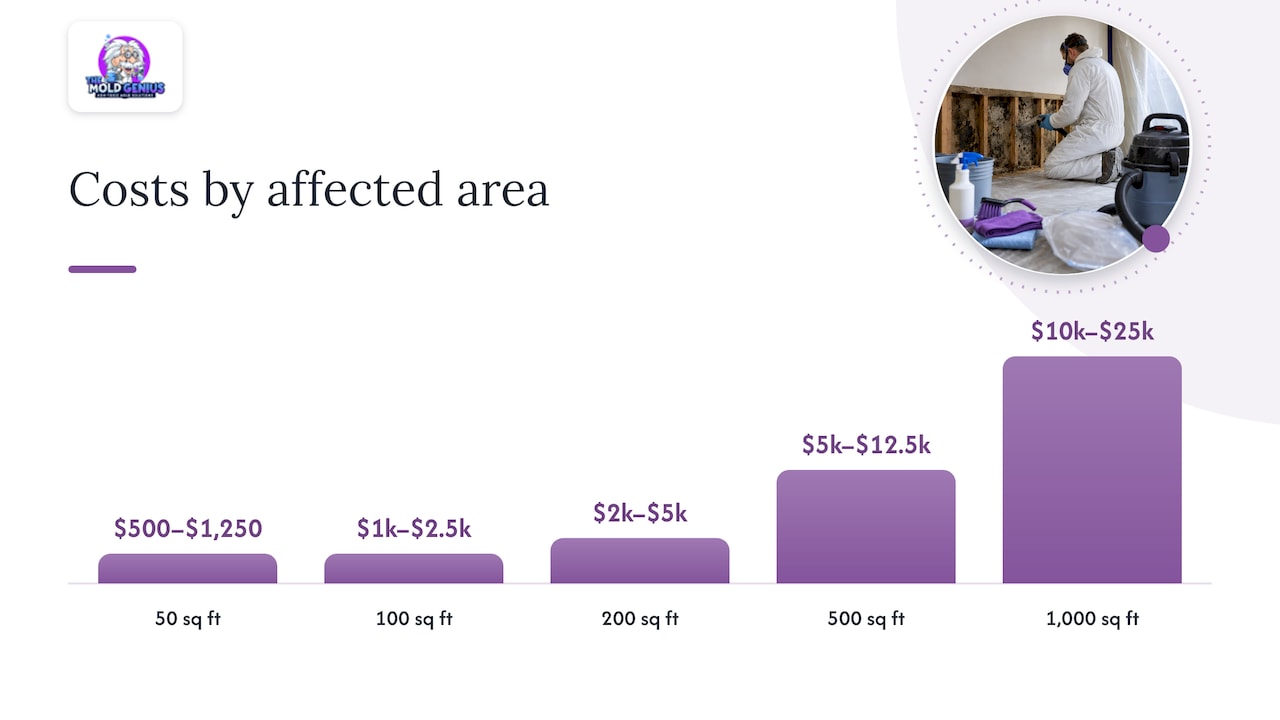
The most useful way to read pricing is by size of the affected area. This table uses the national ranges published by This Old House. Small jobs sit at the high end per square foot because contractors have minimum labor and setup fees that do not shrink with the size of the patch.
| Affected area | Typical cost range |
|---|---|
| 50 sq ft | $500 to $1,250 |
| 100 sq ft | $1,000 to $2,500 |
| 200 sq ft | $2,000 to $5,000 |
| 500 sq ft | $5,000 to $12,500 |
| 1,000 sq ft | $10,000 to $25,000 |
Two things are worth keeping in mind when you read a table like this.
First, “affected area” is the area the contractor can confirm, not what you can see. Mold on the face of a drywall panel often continues behind it, above insulation or inside a wall cavity. A quote based only on the visible stain can grow once someone looks behind the surface.
Second, these are national averages. Chicagoland labor rates, older housing stock, and the finished basements common in DuPage County suburbs can all push a job above or below the middle of the range. The Wheaton figure of $500 to $12,000 or more from a local directory is a wide band for the same reason: it covers everything from a corner of a bathroom ceiling to a contaminated crawlspace and framing.
We do not publish flat prices at The Mold Genius, because we do not think an honest number is possible before we see the space. We do give free estimates, and we tell you what the number is built from.
Cost by location: attic, basement, HVAC
Where the mold sits changes the work more than almost anything else. National averages by location, again from This Old House:
| Location | Average mold removal cost |
|---|---|
| Attic | $1,000 to $4,000 |
| Basement | $500 to $3,000 |
| HVAC system | $3,000 to $10,000 |
Attics
A small, easy-to-reach patch can cost as little as $1,000. Extensive mold in a cramped attic can reach $4,000, and if the growth is in or behind insulation, the insulation usually has to come out, which adds cost. In Wheaton, attic mold is rarely just a mold problem. Winter temperature swings, warm air leaking up from living space and poor ventilation put moisture on cold roof sheathing. If you only clean the sheathing and do not fix airflow and insulation, the mold tends to return.
That is why our attic work includes an assessment of ventilation and insulation, not only the treatment. You can see how that works on our Wheaton attic mold removal page.
Basements
Basements are humid, particularly in summer, and they range from easy to very difficult depending on access and finishes. National averages run from $500 to $3,000. Cost climbs when mold has reached drywall, carpet, framing or stored belongings, and when the moisture source, such as a foundation crack, a window well or a sump failure, still needs attention. Our guide to Chicagoland basement mold removal costs goes further into what shapes a basement quote, and our basement mold remediation process shows the steps.
HVAC systems
Duct and air handler contamination is the expensive end, at $3,000 to $10,000 on average, because the system spreads spores through the house and has to be cleaned or partly replaced. If you see mold on registers or smell mustiness only when the system runs, get it assessed before you pay for surface cleaning in the rooms.
Crawlspaces, bathrooms and garages
The sources we reviewed give no dependable national averages for these, so we will not invent them. In practice, bathrooms are usually the smallest jobs when the leak is already fixed. Crawlspaces are harder because of access, vapor barriers and moisture in the soil. Our pages on bathroom, crawlspace and garage mold explain the approach for each, and a free estimate gives you a number for your specific space.
What makes a quote go up or down
The main drivers are the square footage affected, accessibility, the materials involved, the extent of damage and labor. Labor often accounts for more than half of the total, and the rest goes to materials and equipment such as air handlers.
In plain terms, here is how those play out in a house:
- Size of the contaminated area. More square feet means more labor, containment and cleanup, though the per-foot rate usually falls on large jobs.
- Access. A low crawlspace, a tight attic eave or a wall that has to be opened takes more hours than an open basement wall.
- Porous materials. Mold in drywall, insulation and carpet usually means removal and replacement, not cleaning. Wood framing can often be treated and kept.
- Containment and air control. Sealing off the work zone and filtering the air protects the rest of the house and takes setup time.
- The moisture source. If a leak, condensation or grading problem is still active, the job is not finished when the mold is gone. Fixing it adds cost but is what prevents a second bill.
- Rebuild. Remediation is not reconstruction. New drywall, paint, flooring and insulation are usually separate from the mold line item, so ask whether a quote includes them.
Where our approach changes the math
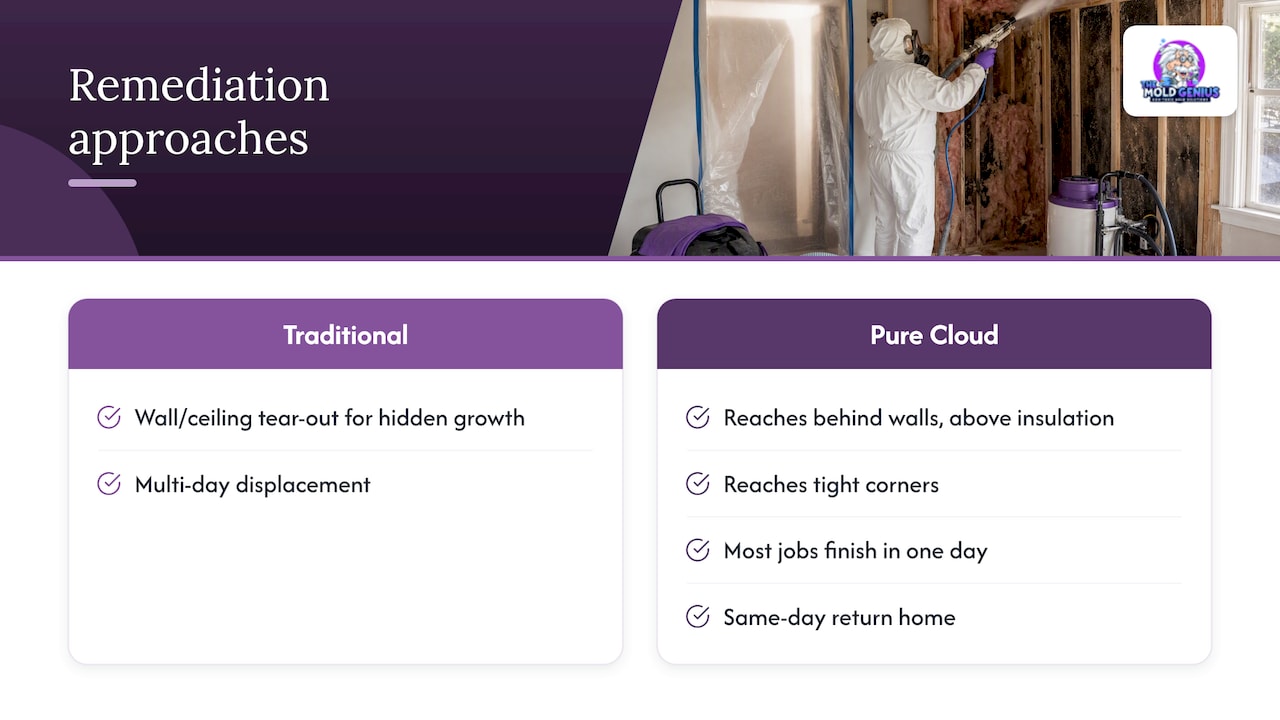
Traditional remediation often means tearing out wall or ceiling material to reach hidden growth. We use Pure Cloud Technology, a dry fogging system with hospital-grade hydrogen peroxide and silver ions that reaches mold behind walls, above insulation and in tight corners. Because it avoids gutting rooms, most jobs wrap up in a single day and you can come home the same day. For many homeowners, less demolition and fewer days out of the house are part of the real cost savings, even when the treatment line on the bill looks familiar. Whether it fits your situation depends on what we find during diagnosis, which we do with moisture detection and thermal imaging.
Why the testing question affects your budget
Many homeowners assume they must pay for lab sampling first. The EPA’s guidance for homeowners says sampling is not usually recommended: results can be hard to interpret, and cleanup and moisture repair are needed whatever the mold type.
That does not make inspection pointless. Finding where the moisture is coming from, and how far the growth extends, is what keeps a quote accurate. A visual inspection with moisture meters and thermal imaging does that. If you want to understand when sampling does help, our articles on why professional mold testing matters and a home air quality mold testing checklist lay out the cases.
One practical point: if a separate inspector writes the protocol and a different company does the work, you get an independent check on the scope. The HUD-hosted cleanup guide suggests asking for references, proof of insurance and an independent inspector, so budget for that if the job is large or tied to a sale or a claim.
Does homeowners insurance pay for mold?
Sometimes. The Illinois Department of Insurance explains that coverage depends on the policy and the cause. Sudden, accidental water damage, such as a burst pipe, is typically covered, while mold from neglect, humidity or flooding is usually excluded. Some companies offer limited coverage or require a buy-back endorsement for mold.
The same page advises checking whether a policy has a monetary cap on mold benefits, since some limit remediation or testing to fixed, low amounts. So read your declarations page, then call your agent before work starts, not after.
We work with major carriers, including Allstate, State Farm, USAA, Farmers and Liberty Mutual, and we know what documentation adjusters look for: moisture readings, photographs, a scope of work and the cause of loss. Our guide to what an insurance-approved mold remediation claim needs walks through it. If the mold followed a leak or flood, our water damage repair and restoration service handles the drying and the repair together with the mold.
What a good estimate should include
A useful estimate is written, itemized and specific. The HUD-hosted guide says an estimate should include a detailed scope of work and a plan to protect residents, belongings and workers. In practice, ask for:
- The areas to be treated, with measurements, and what is out of scope.
- Which materials will be removed and which will be treated and kept.
- How the work zone will be contained and how the air will be filtered.
- How the moisture source will be identified and who fixes it.
- How the contractor will confirm that the job worked, and whether there is a guarantee.
- Whether rebuilding is included or priced separately.
- Proof of liability insurance.
Be cautious of a flat price quoted over the phone with no visit, a quote that is only “mold treatment” with no scope, or pressure to sign the same day.
Credentials in Illinois
Illinois has long had no statewide mold remediation license, which is why credentials were left to homeowners to verify. The state has since enacted the Mold Remediation Registration Act, described on the Illinois Department of Public Health’s registration page. Requirements and timing can change, so check that page for the current status before you hire anyone.
Either way, look for third-party training. The EPA’s guidance says to hire a professional affiliated with or certified by NEHA, AIHA, IICRC or ACAC for cleanup after a disaster. We list the three credentials we think matter most in our guide to mold remediation certifications.
Our perspective: the cheapest quote is rarely the cheapest job
We get calls from homeowners who have already paid once. The first company cleaned what was visible, left the moisture problem in place, and the mold came back within a season. That second bill is the real cost to watch for.
Here is how we think about price. The number on a quote matters less than three things behind it. Did someone find the cause of the moisture, with instruments and not guesswork? Does the treatment reach the mold you cannot see, or only the surface you can? And is the fix to the cause part of the scope, so the job stays done?
That is why our process has three phases: diagnosis, removal and prevention. Diagnosis uses moisture detection and thermal imaging. Removal uses the Pure Cloud system, which avoids gutting rooms and lets most families be back home the same day. Prevention fixes the root cause, whether that is ventilation, insulation, a leak or drainage. We back the work with a guarantee and over 400 Google reviews from Chicagoland homeowners.
If a lower quote leaves out one of those phases, compare the scopes, not the totals.
— Alex
Get a Wheaton estimate
If you have found mold, or you suspect it behind a wall or in an attic, our team can look at it and give you a free written estimate. See our Wheaton mold removal services or start at themoldgenius.com to request a visit. If you are selling, our realtor network program helps agents resolve mold before closing.
How to keep the cost from repeating
Speed and moisture control are the cheapest tools you have. Illinois guidance says to dry water-damaged areas and items as soon as possible, preferably within 24 to 48 hours, to help prevent mold growth. That applies to a washing machine overflow or a sump failure as much as a flood.
After remediation, the EPA frames a finished cleanup as one where the moisture problem is fixed, visible mold and odors are gone, and people can reoccupy the space without symptoms. It also notes there is no easy single answer on when it is done. This is why we measure moisture afterward, not only look. Our post-remediation mold prevention checklist covers humidity control, ventilation and what to monitor, and how water damage leads to mold explains the timeline.
A note on doing it yourself: the Illinois Department of Insurance says people who are pregnant, have asthma or other respiratory problems, or have a weakened immune system probably should not clean mold themselves. If anyone in your household is in that group, hire the job out and have them stay away from the area. If someone has symptoms, talk to their doctor.
Frequently Asked Questions about Mold Remediation Costs in Wheaton
How much does mold remediation usually cost?
National guides put the typical job at $1,200 to $3,750, at about $10 to $25 per square foot. Small areas run $500 to $1,500, and extensive whole-house work can reach $10,000 to $30,000. A free on-site estimate is the only way to get a figure for your own house.
Is mold remediation in Wheaton more expensive than elsewhere?
Not by a fixed amount we can point to. A local directory lists Wheaton jobs from about $500 to $12,000 or more, which is a similar spread to national figures. What moves your price is the size, access and moisture source, not the zip code alone.
Does insurance cover mold remediation?
It can, when the mold results from sudden, accidental water damage such as a burst pipe. Mold from humidity, neglect or flooding is usually excluded, and some policies cap mold benefits. Check your policy and call your agent before work begins.
Do I need mold testing before remediation?
Not always. The EPA says sampling is not usually recommended because cleanup and moisture repair are needed regardless of mold type. Testing can still help for a sale, a claim, or hidden mold you suspect but cannot find.
How do I know remediation worked?
The moisture problem should be fixed, visible mold and musty odors gone, and the space usable without symptoms, according to EPA guidance. Ask your contractor how they verify this and whether the work is guaranteed.
What are the sources for mold remediation cost information?
- How Much Does Mold Remediation Cost? (2026 Guide), This Old House
- Mold Remediation and Removal in Wheaton, Illinois, LookMold
- Homeowner’s and Renter’s Guide to Mold Cleanup After Disasters, EPA
- Creating A Healthy Home: Field Guide for Clean-Up, HUD USER
- Flood, Illinois Department of Insurance
- Mold Remediation Registration Information, Illinois Department of Public Health
- Illinois Post-Flood Quick Guide, Illinois DNR
- A Brief Guide to Mold, Moisture, and Your Home, EPA