
A high water table causes mold because groundwater continuously pushes moisture through a home's foundation walls and slab, keeping building materials damp enough for mold to colonize. The Mold Genius states that effective remediation requires relieving hydrostatic pressure with drainage, sealing the foundation with a waterproofing membrane, and controlling indoor humidity. A critical diagnostic sign is a sump pump cycling during dry weather, indicating groundwater, not surface water, is the source. Maintaining indoor relative humidity below 60% is essential, as this is the threshold for mold establishment on most building materials.
A high water table causes mold because groundwater pushes moisture through your foundation walls and slab continuously, keeping building materials damp long enough for mold to colonize them. The fix isn’t a coat of waterproof paint. It’s relieving the pressure with drainage, sealing the assembly with a real waterproofing membrane, and controlling indoor humidity so mold never gets the conditions it needs.
Three things you can do right now:
- Check for efflorescence (white, chalky deposits on basement walls or the base of concrete block). Its presence confirms liquid-state water is moving through your masonry, not just condensing on the surface.
- Watch your sump pump. If it’s cycling during a stretch of dry weather, groundwater is the source, not recent rain.
- Set a dehumidifier to keep indoor relative humidity below 60% — the threshold above which mold establishes itself on most building materials.
DIY steps help, but they don’t fix the source. If you’re seeing widespread dampness, recurring mold, or a sump that never stops, you’re past the point where a dehumidifier alone solves anything.
Pro Tip: The single most useful diagnostic sign is a sump pump running in dry weather. That tells you the water table itself is the driver, not a leaky gutter or a one-time rain event. Everything else follows from that distinction.
Table of Contents
- What does a “high water table” actually mean for your home?
- How a high water table physically forces moisture into your home
- How can you tell if a high water table is causing your moisture problem?
- What actually fixes groundwater-driven moisture and prevents mold
- Why surface sealants fail and what the code actually requires
- When should you call a professional?
- Key Takeaways
- The part most homeowners get wrong
- Themoldgenius can diagnose and fix the source, not just the symptoms
- Useful sources and further reading
What does a “high water table” actually mean for your home?
The water table is the upper boundary of the zone in soil where all the pores and cracks are saturated with groundwater. “High” in practical terms means that boundary sits close to your foundation, typically within about 5 feet of the bottom of your footing. When it’s that close, hydrostatic head needs to be addressed in foundation design and drainage, not just managed with surface treatments.
Several conditions push the water table up on a given property:
- Prolonged rain or seasonal snowmelt saturates the soil faster than it can drain.
- Clay-heavy soil holds water rather than letting it percolate down, so the saturated zone stays near the surface longer.
- Low lot elevation means your property collects runoff from neighbors and the street.
- Proximity to rivers, lakes, or coastal areas ties your groundwater level directly to surface water levels.
- Poor grading around the foundation directs water toward the house instead of away from it.
A high water table is fundamentally different from surface flooding or a single bad storm. Surface flooding is temporary. A high water table is a persistent condition that exerts constant pressure on your foundation, season after season. Homeowners near the Chicago area’s river corridors and low-lying suburbs often deal with this year-round, not just in spring.
A quick risk check: if your lot sits lower than the street, your soil drains slowly after rain, and you’re within a mile of a body of water, your water table is likely higher than average for your region.
How a high water table physically forces moisture into your home
Understanding the physics here matters because it explains why the cheap fix never works.
Hydrostatic pressure
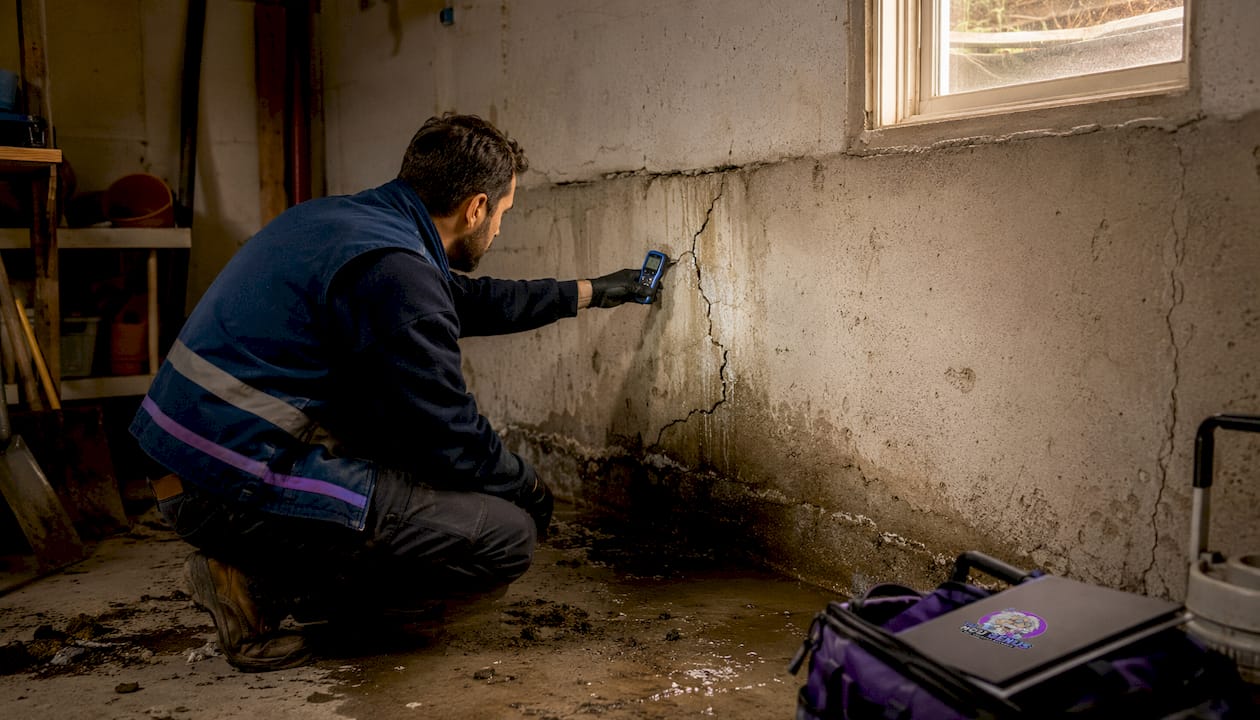
Water is heavy. Every foot of water depth adds about 0.43 psi of pressure against whatever is containing it. A basement wall with 5 feet of saturated soil pressing against it must resist roughly 31,000 pounds of lateral force across a 40-foot wall. The upward pressure on a 1,200 sq ft slab under the same conditions approaches 374,000 pounds. That force doesn’t care about paint. It finds cracks, cold joints, and pores, and it pushes water through them.
Capillary action
Even without visible cracks, concrete and masonry are porous. Water wicks upward through microscopic pores in the footing and slab and laterally through block walls. This capillary suction is what creates the ring of dampness you see at the base of many basement walls, especially at cold joints between the footing and the wall. It’s slow, steady, and invisible until the moisture reaches the surface.
Vapor and condensation
Once water is continuously present inside wall assemblies and under slabs, it raises indoor relative humidity. Warm, humid indoor air then contacts cooler foundation surfaces and condenses. Finished basement walls with fiberglass insulation and paper-faced drywall are particularly vulnerable: moisture vapor passes through the permeable materials and reaches the cool foundation surface, but there’s almost no drying potential behind the wall. That microclimate stays damp through the entire cooling season, and paper-covered gypsum is exactly the nutrient source mold needs.
| Mechanism | How it enters | Diagnostic signature |
|---|---|---|
| Hydrostatic pressure | Through cracks, joints, pores under force | Water rising through floor cracks; widespread wall seepage |
| Capillary action | Wicking through porous concrete/masonry | Damp ring at base of walls; efflorescence on block |
| Vapor/condensation | Diffusion through permeable finishes | Mold on back of drywall; musty odor without visible water |
How can you tell if a high water table is causing your moisture problem?
The key diagnostic question is: does the moisture appear during or after rain, or does it persist even in dry weather? Groundwater-driven problems don’t take breaks.
Signs you can check yourself
- Efflorescence on walls or floor. White, powdery deposits mean liquid water has been moving through the masonry and depositing dissolved salts as it evaporates. It’s a reliable field indicator of active groundwater intrusion, not condensation.
- Damp ring at the base of walls. Especially at the cold joint where the wall meets the footing.
- Sump pump cycling in dry weather. Check the float cycle over a 24-hour period when it hasn’t rained in several days.
- Floor or wall dampness that doesn’t track with rain events. If it’s wet in August after two dry weeks, it’s groundwater.
- Musty odor without visible mold. Mold growing behind finished walls or under flooring often produces odor before it’s visible.
Pro Tip: Before calling anyone, do a simple humidity check with an inexpensive hygrometer. If your basement consistently reads above 70% RH in summer without a dehumidifier running, you have a persistent moisture source, not just seasonal condensation.
What professionals look for
A thorough professional assessment goes well beyond a visual walkthrough. Inspectors use moisture meters to measure moisture content inside wall assemblies and slabs, and thermal imaging cameras to identify temperature differentials that reveal hidden wet areas behind finished surfaces. For properties with suspected groundwater issues, geotechnical professionals may install piezometer wells or monitoring wells to measure the actual depth of the water table at the site over time.
When you’re seeing structural movement (cracks that are widening, doors that won’t close), mold covering more than 10 sq ft, or a sump that runs continuously, you’re past DIY territory. A professional assessment at that point isn’t optional.
What actually fixes groundwater-driven moisture and prevents mold
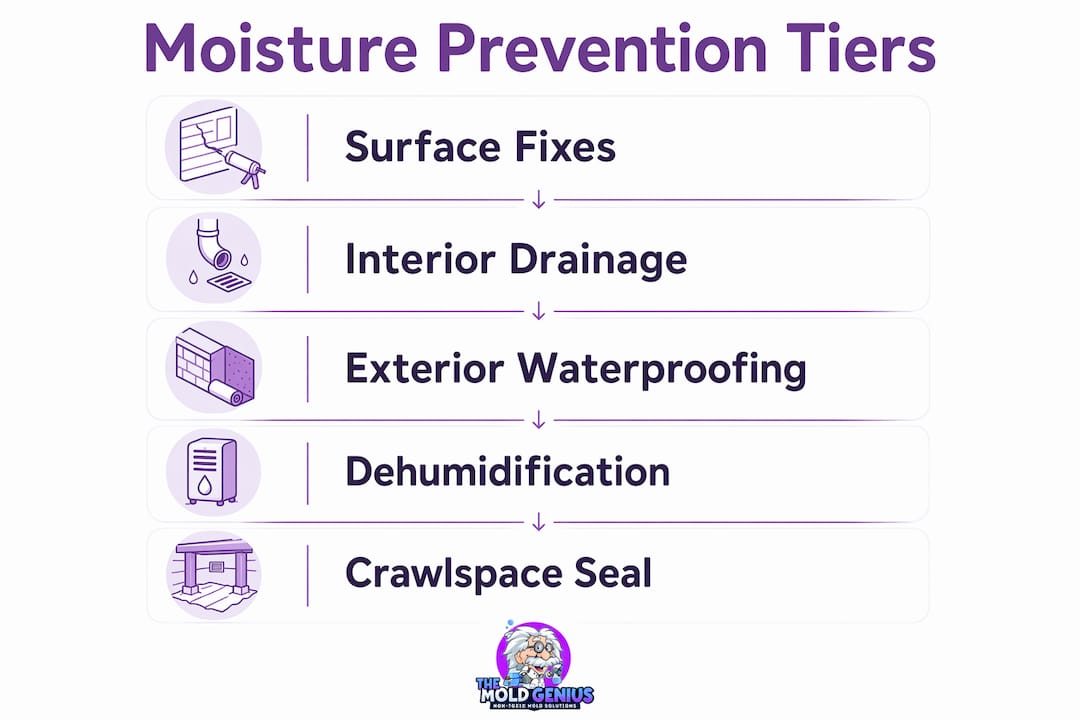
Solutions need to match the severity of the problem. Surface fixes work when surface runoff is the main contributor. Persistent groundwater requires subsurface drainage and real waterproofing.
Tier 1: Surface and grading fixes (low cost, do these first)
- Regrade soil so it slopes away from the foundation at least 6 inches over 10 feet.
- Clean and extend downspouts so they discharge at least 6 feet from the foundation. A 1-inch rainfall on a sizable roof produces a large volume of runoff water that must be diverted away from the foundation to reduce intrusion risk. That all has to go somewhere.
- Check window wells for proper drainage and covers.
These steps can meaningfully reduce intrusion when surface runoff is the dominant contributor. They won’t solve a true high water table problem on their own.
Tier 2: Interior drainage and sump systems (moderate cost)
An interior perimeter drain (often called a French drain or drain tile) installed at the footing level collects water that enters the wall-floor joint and routes it to a sump pit. A properly sized sump pump with a battery backup then removes it. This is a management system. It doesn’t stop water from entering the wall assembly, but it intercepts it before it spreads across the floor.
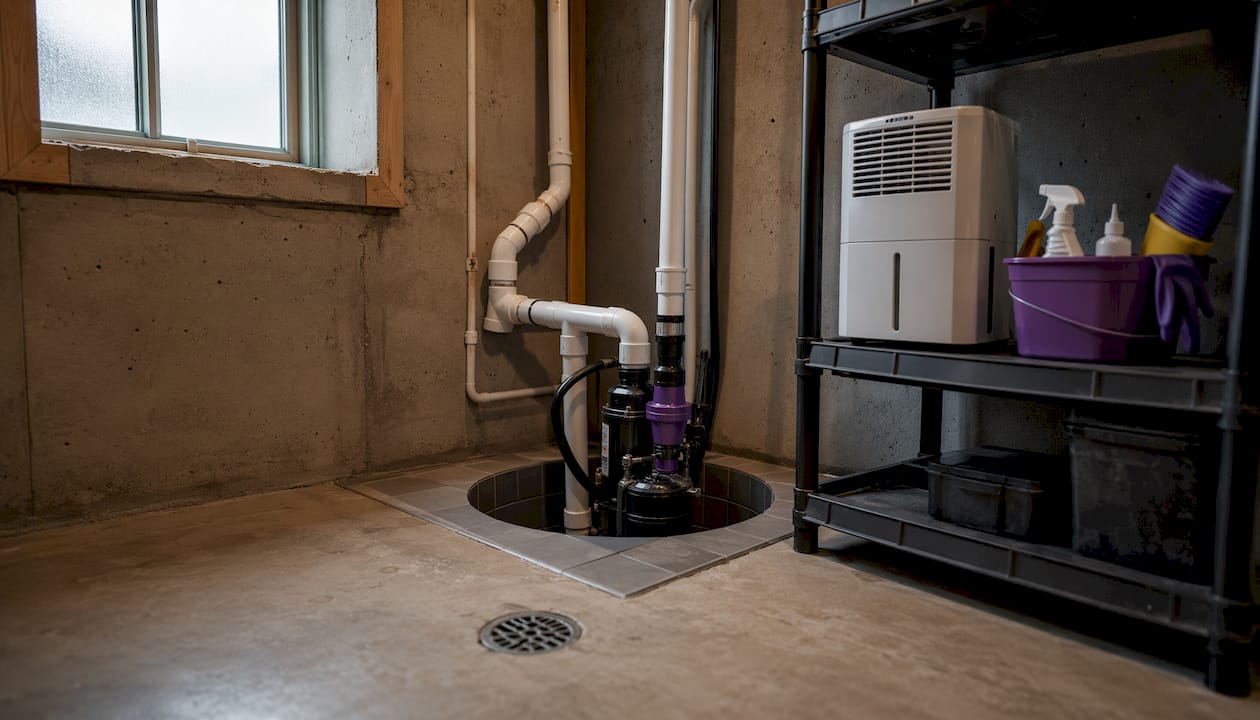
Keep indoor relative humidity below 60% with a continuous-run dehumidifier as part of this system. Drying water-damaged areas within 24–48 hours prevents mold from establishing even when some moisture intrudes temporarily.
Tier 3: Exterior excavation and membrane waterproofing (higher cost, most durable)
Excavating to the footing, applying a continuous waterproofing membrane, and installing exterior perimeter drain tile is the most durable solution for high hydrostatic pressure. It addresses the source rather than managing the symptom. For properties where the water table sits within 5 feet of the footing, this is often the only approach that provides long-term protection.
Crawlspace-specific options
Crawlspaces over moist soil are a direct pathway for groundwater vapor into the home. Crawlspace encapsulation with a heavy-duty vapor barrier (20-mil minimum) sealed to the walls and a conditioned or actively dehumidified space is the current building-science standard. An unconditioned crawlspace with a thin poly sheet on the floor is not encapsulation. It’s a partial measure that still allows vapor to enter the living space above.
| Solution | Typical cost range | Best for |
|---|---|---|
| Regrading + downspout extensions | — | Surface runoff contributors |
| Interior drain + sump pump | — | Moderate groundwater intrusion |
| Crawlspace encapsulation | — | Vapor and low-level groundwater |
| Exterior excavation + membrane | — | Severe hydrostatic pressure |
Pro Tip: When evaluating contractor proposals, look for the words “perimeter drain” and “waterproofing membrane” together. A proposal that mentions only “coating” or “sealer” is not addressing hydrostatic pressure. Ask specifically whether the solution relieves pressure or just resists it.
Checklist for evaluating any contractor proposal:
- Does it include a drainage component (interior or exterior perimeter drain)?
- Does it specify a waterproofing membrane (not dampproofing or coating)?
- Does it address the sump pump and backup power?
- Does it reference IRC waterproofing requirements for your foundation type?
- Does it include a written warranty on the drainage system?
Why surface sealants fail and what the code actually requires
This is where most homeowners waste money. A bucket of waterproof paint costs $50. An exterior membrane system costs $15,000. The price difference feels like a reason to try the paint first. The problem is that sealants can blister, delaminate, or be bypassed by new cracks because they do not relieve hydrostatic head. They’re designed to resist incidental moisture, not sustained pressure.
The International Residential Code makes this distinction explicit. IRC Chapter 4 differentiates dampproofing from waterproofing and requires waterproofing where a high water table or severe soil-water conditions are present. Dampproofing is a coating or treatment that resists moisture vapor and incidental contact. Waterproofing is a continuous membrane system combined with drainage that resists hydrostatic pressure. They are not interchangeable, and the code treats them differently for good reason.
When a contractor proposes a coating for a basement that has active water intrusion, ask them directly: “Is this rated to resist hydrostatic pressure?” The honest answer, almost always, is no.
Pro Tip: In any contractor proposal, the phrase “dampproofing” is a red flag when hydrostatic pressure is the documented problem. The proposal should specify a waterproofing membrane plus a drainage system. Those two elements together are what the IRC requires and what actually works.
When should you call a professional?
Some moisture problems are manageable with grading and a dehumidifier. Others require a licensed contractor or a structural engineer. Here’s how to tell the difference.
Red flags that require professional assessment:
- Cracks in foundation walls that are widening or have horizontal displacement.
- Mold growth covering more than 10 sq ft, or mold that has returned after cleaning.
- Sump pump running continuously in dry weather over multiple days.
- Efflorescence covering large sections of wall, not just isolated spots.
- Floor heaving or slab cracking that wasn’t there before.
- Water entering through the floor, not just the walls.
What a professional inspection includes:
A thorough mold inspection for a groundwater-related problem covers moisture mapping with a calibrated meter, thermal imaging to find hidden wet areas, evaluation of the perimeter drain (if one exists), sub-slab assessment, and a written diagnosis with a system-based recommendation. A good inspector doesn’t just tell you where the mold is. They tell you why the moisture is there and what it will take to stop it.
Typical remediation sequence:
- Diagnosis and moisture mapping (usually one day).
- Source control: grading, downspout corrections, exterior drainage where accessible.
- Interior drainage installation and sump pump upgrade if needed (1–3 days for most homes).
- Exterior excavation and membrane waterproofing where required (3–14+ days depending on scope).
- Dehumidification system installation and humidity verification.
- Mold remediation of affected materials once moisture is controlled.
- Post-remediation verification testing.
For minor jobs (interior drain, sump, and dehumidification), expect 1–3 days of work and costs in the low-to-moderate range. For major exterior excavation and membrane systems, timelines stretch to 1–3 weeks and costs move into the high range. Structural repairs add to both.
Key Takeaways
A high water table causes mold by forcing groundwater through foundation walls and slabs via hydrostatic pressure and capillary action, creating the persistent dampness mold needs to grow.
| Point | Details |
|---|---|
| Hydrostatic pressure is the root cause | Groundwater exerts continuous force through walls and slabs; coatings cannot resist it. |
| Efflorescence is your early warning | White salt deposits on masonry confirm liquid-state water movement, not just condensation. |
| Drainage before waterproofing | A perimeter drain relieves pressure so a membrane can work; one without the other is incomplete. |
| Humidity control is non-negotiable | Keep indoor RH below 60% and dry any intrusion within 24–48 hours to prevent mold establishment. |
| Themoldgenius handles the full sequence | Diagnosis, drainage coordination, and Pure Cloud remediation for Chicagoland homeowners. |
The part most homeowners get wrong
The most common mistake isn’t skipping the sump pump or ignoring the efflorescence. It’s treating a groundwater problem as a mold problem. Homeowners call for mold removal, get the visible growth cleaned up, and then wonder why it’s back in six months. It’s back because the moisture source never changed.
The second mistake is the coating trap. A waterproof paint feels like a solution because it’s visible, affordable, and immediate. But pressure doesn’t negotiate. It finds the next weak point: a hairline crack, a cold joint, a pipe penetration. The coating blisters, the water comes back, and now you’ve also trapped moisture inside the wall assembly where it can’t dry.
What successful jobs actually look like: the moisture source gets identified first, drainage gets installed or improved, the waterproofing membrane goes on, and then the mold gets treated. In that order. Skipping to remediation without fixing the source is like mopping a floor while the faucet is still running. The basement mold root cause diagnosis step isn’t optional. It’s the whole job.
One more thing worth saying: interior drainage systems are genuinely useful, but they’re a management tool, not a substitute for exterior waterproofing when the pressure is severe. Experienced practitioners treat interior drainage as a complement to exterior work, not a replacement for it. If a contractor tells you an interior French drain alone solves a high water table problem, ask them what happens to the moisture that’s still inside the wall assembly.
Themoldgenius can diagnose and fix the source, not just the symptoms
If your basement or crawlspace keeps coming back wet and you’re not sure whether it’s groundwater, condensation, or something else, the answer starts with a proper diagnosis, not a guess.

Themoldgenius serves the Chicagoland area with a three-phase process built for exactly this problem: moisture detection and thermal imaging to find what you can’t see, basement mold removal and crawlspace remediation using Pure Cloud dry fogging technology, and prevention work that addresses the root cause so the mold doesn’t return. Most jobs wrap up in a single day, and homeowners return the same day. For water damage situations where groundwater has already caused structural damage, the team also handles water damage repair and restoration directly.
Free estimates are available. If you’re seeing efflorescence, a sump that won’t quit, or mold that keeps coming back, contact Themoldgenius to schedule an inspection and get a system-based proposal, not just a cleanup.
Useful sources and further reading
These are the primary references used throughout this article. They’re worth bookmarking if you’re preparing for a contractor conversation or want to verify code requirements.
| Source | What it covers |
|---|---|
| UMN Extension: Moisture in Basements | Practical causes and solutions for basement moisture; includes capillary action and drainage guidance |
| EPA Moisture Control Guidance | Federal guidance on moisture sources, transport mechanisms, and mold prevention in buildings |
| NCBI: Damp Buildings and Health | Research-backed overview of how dampness drives microbial growth and health effects |
| Missouri DNR: Basement and Yard Water Problems | Hydrostatic pressure calculations and drainage solutions for homeowners |
| Building Science Corporation: Basements | Building-science perspective on drainage, waterproofing membranes, and why coatings fail |
| IRC Chapter 4: Foundations | The code distinction between dampproofing and waterproofing; what’s required when hydrostatic pressure is present |
| Foundation Authority: High Water Table Construction | Foundation design thresholds and engineered solutions for high water table sites |
This article is general information for homeowners and does not constitute professional engineering, legal, or medical advice. Confirm current code requirements and site conditions with a licensed contractor, structural engineer, or your local building department before beginning any foundation or waterproofing work.