
Black mold removal in Elmhurst, IL, typically costs between $500 and $6,000, with an average job near $2,000, according to Illinois planning figures from ExpectedCosts. For areas under 10 square feet, the cost ranges from $500 to $1,500, while larger areas over 30 square feet can cost $3,500 to $10,000. The final price depends on the mold's square footage, location, accessibility, and whether the underlying water source has been addressed. The Illinois Department of Public Health notes that testing for mold is generally not recommended, as visible growth is enough to warrant remediation.
Most Illinois mold remediation projects land between $500 and $6,000, with a typical job near $2,000, according to Illinois planning figures from ExpectedCosts. Those are planning numbers, not quotes. In an Elmhurst home, the final price depends mostly on how many square feet of mold you have, where it is growing, how hard it is to reach, and whether the water source that fed it has been fixed. This guide explains each of those drivers, shows what to expect by project size, and lists what to look for in an estimate before you sign.
What is the typical cost of black mold removal in Elmhurst, IL?
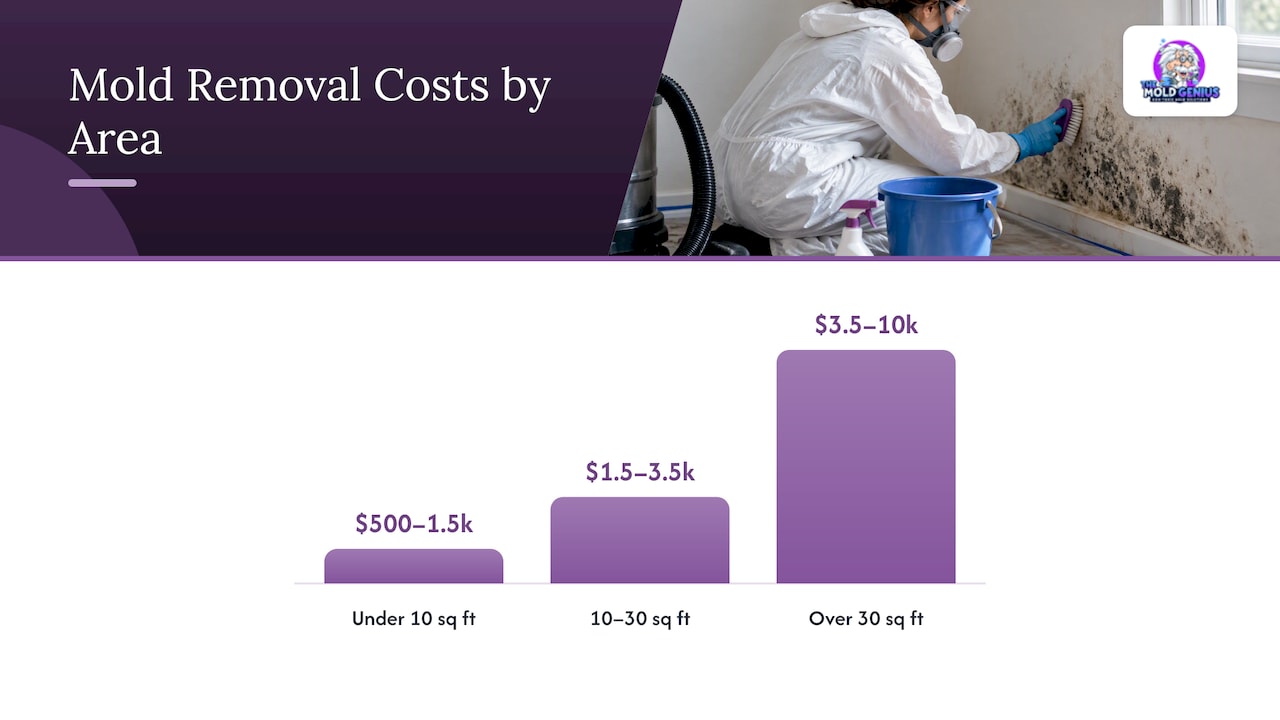
- Illinois planning ranges run about $500 to $1,500 for under 10 square feet, $1,500 to $3,500 for 10 to 30 square feet, and $3,500 to $10,000 above 30 square feet.
- Size is only the starting point. Location in the house, access, containment needs and moisture repairs move the number.
- Standard homeowners policies often exclude slow leaks and may cap mold coverage, so check your policy before the work, not after.
- Cleaning mold without fixing the moisture will most likely let it return, so a quote that ignores the water source is incomplete.
- We give free estimates in Elmhurst and across Chicagoland, and we do not publish flat prices because every house is different.
Table of Contents
- What “black mold” means for your quote
- Black mold removal cost by size of the affected area
- What moves the price up or down
- Does homeowners insurance cover black mold?
- How to read a black mold estimate
- Why DIY is a risky way to save money
- Perspective: why we price differently
- Get a free estimate for your Elmhurst home
- Ways to keep the final cost down
- FAQ
- Sources
What “black mold” means for your quote
Homeowners use “black mold” for any dark, blotchy growth on drywall, wood, grout or insulation. Color alone does not tell you what you have, and it does not change the basic job much. Contractors price the work by how much surface is affected, what material it is growing on, and how it must be contained and removed.
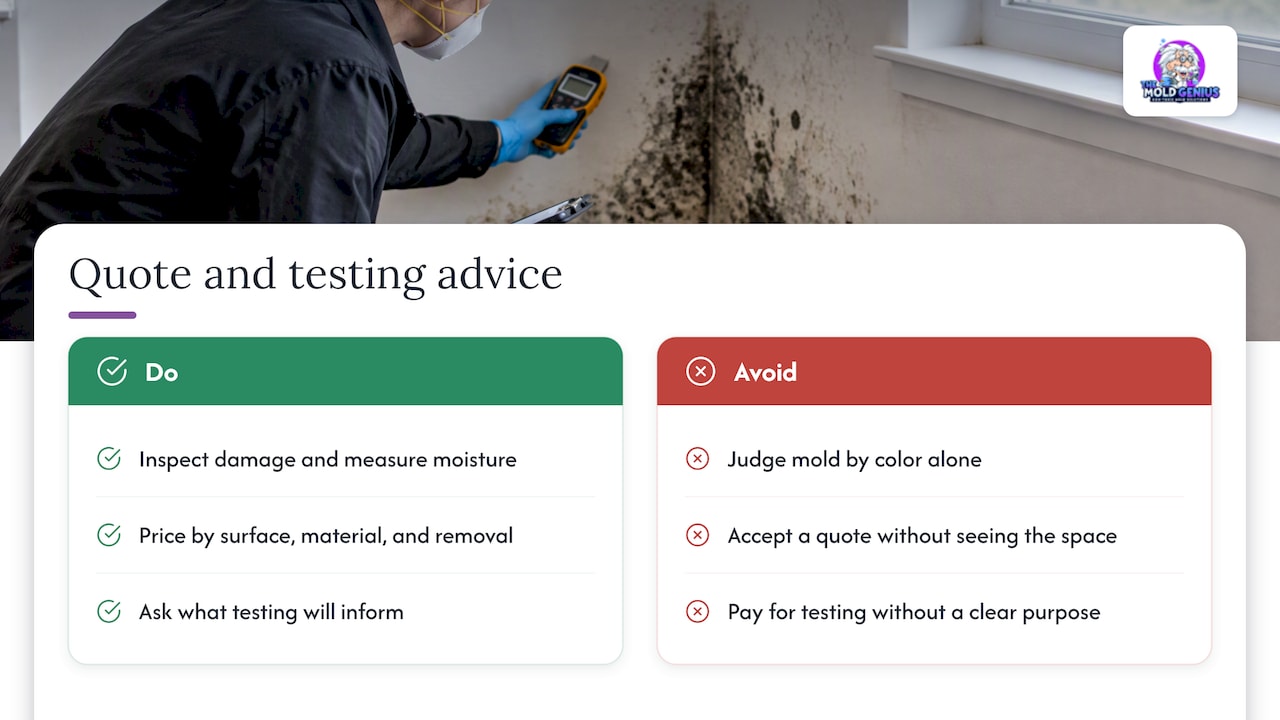
That is also why you should be wary of anyone who quotes a special “black mold” price over the phone without seeing the space. A fair estimate comes from looking at the actual damage and measuring moisture.
The Illinois Department of Public Health notes that it does not recommend testing for mold, because there are no established regulatory standards for acceptable levels and visible mold is enough reason to start cleaning and repairs. In practice, that means you should not have to pay for lab work just to justify a removal when you can already see the growth. If a contractor adds testing, ask what decision it will inform.
Black mold removal cost by size of the affected area
Square footage is the first number any estimator writes down. These Illinois figures give you a realistic frame:
| Affected area | Typical Illinois planning range |
|---|---|
| Under 10 square feet | $500 to $1,500 |
| 10 to 30 square feet | $1,500 to $3,500 |
| Over 30 square feet | $3,500 to $10,000 |
The ranges come from ExpectedCosts’ Illinois guide. Treat them as a sanity check on a quote, not a promise of a price.
The size breaks also line up with how the EPA thinks about mold. Its guidance for schools and commercial buildings classifies an affected area as small under 10 square feet, medium from 10 to 100 square feet, and large above 100 square feet or when exposure of occupants or workers could be significant. Containment and protective equipment change with each category. Bigger areas need more barriers, more protective gear and more labor, which is where the price climbs.
The EPA’s homeowner guide also says that for growth covering more than 10 square feet, you should consult that remediation guidance rather than treating the job as a routine cleanup (EPA, A Brief Guide to Mold, Moisture, and Your Home).
Can you provide a worked example of black mold removal cost in Elmhurst?
Imagine a finished basement in an Elmhurst bungalow where a slow leak behind a wall left dark growth across about 25 square feet of drywall and baseboard. On the Illinois ranges, that sits in the $1,500 to $3,500 band. Now change one thing: the growth also reaches the floor joists above the ceiling. Access gets harder, containment gets bigger, and you could move toward the next band even if the visible patch has not grown. Your quote should explain that kind of jump in plain terms.
What moves the price up or down
Where the mold is
Location changes labor and containment more than most people expect.
- Basements: the most common problem in older Chicagoland homes, because of seepage, humidity and drainage. Finished walls hide growth, which can increase the demolition scope.
- Attics: temperature swings and poor ventilation drive growth on roof sheathing and insulation. Work is hot, tight and slow. If you are in Elmhurst, see our Elmhurst attic mold removal page.
- Crawlspaces and garages: low clearance, soil moisture and stored items add time.
- Bathrooms: usually smaller areas, but fan and plumbing problems can mean hidden growth behind tile or drywall.
How much has to be taken apart
Traditional remediation often means cutting out drywall, pulling insulation and rebuilding afterward. Every sheet removed is labor on both sides: demolition and reconstruction. A method that treats mold behind walls and above insulation without gutting a room can cut that second bill considerably. That is the reason we use Pure Cloud dry fogging, which we cover below.
Containment and protection
Containment keeps spores from spreading to clean rooms while work is underway. More containment means more materials and setup time. If you want to understand what you are paying for, read how mold containment works.
The moisture source
This is the line item people skip and later regret. The EPA says that cleaning up mold without fixing the water problem will most likely cause the problem to return (EPA mold guide). A leaking pipe, a failed sump pump, a bad window well or a roof leak has to be handled by someone, whether it is us, a plumber or a roofer. Ask who owns that repair and whether it is in the number. For more on this, read why mold returns after cleaning.
Displacement
If remediation makes part of your home unlivable, especially when mold is in bedrooms, bathrooms or the HVAC system, you may need to stay elsewhere, as This Old House points out. A hotel for several days is a real cost that never shows up on the contractor’s invoice. Whether you can stay depends on more than the square footage, which we explain in Stay Home During Mold Removal?.
Does homeowners insurance cover black mold?
Sometimes, and rarely in full. The Illinois Department of Insurance explains that standard homeowners policies do not cover water damage from seepage, humidity, drainage problems or floods. They may cover sudden and accidental water damage, and sometimes sewer backup or sump pump failure if you carry that coverage (Illinois Department of Insurance).
The same page notes that Illinois insurers may put sublimits on mold remediation, sometimes capping coverage at amounts such as $5,000, or offer buy-back endorsements that restore or raise the limit.
What that means for an Elmhurst homeowner:
- Find out what caused the water. A burst pipe is treated differently from years of humidity.
- Read your policy for a mold sublimit and any sewer backup or sump pump endorsement.
- Call your insurer before work starts and document the damage with photos.
- Get an itemized estimate, because adjusters want to see scope and moisture repair separated.
We work with major carriers including Allstate, State Farm, USAA, Farmers and Liberty Mutual, and we can help you organize documentation. Our mold insurance coverage checklist and our guide to what an insurance-approved remediation claim needs walk through the steps. Coverage decisions belong to your insurer, so confirm with your agent.
How to read a black mold estimate
A good estimate lets you compare two contractors line by line. Look for:
- Measured scope: square footage per room, the materials affected, and how that was measured.
- Diagnosis: moisture readings or thermal imaging that show where the water is, not just where the stain is.
- Method and containment: what will be removed, what will be treated in place, and what barriers go up.
- Moisture fix: who repairs the source, or a clear note that it is excluded.
- Rebuild: whether drywall, insulation and finishes are included or left to you.
- Timeline and re-entry: how long the job takes and when you can use the space.
- Guarantee: what is covered, for how long, and in writing.
Check the contractor, not just the price
Illinois does not currently require state licensing for mold remediation contractors. The Illinois Department of Insurance advises homeowners to ask for proof of insurance, company operating procedures and professional references (Illinois Department of Insurance). The Illinois Department of Public Health says the Mold Remediation Registration Act has been enacted, but registration requirements are not yet in effect because rulemaking is pending (IDPH registration page). Until that changes, the vetting is on you. Ask for a certificate of insurance and call two references.
What are the red flags to watch for in a mold removal estimate?
- A firm price quoted sight unseen.
- Pressure to sign the same day.
- A quote with no mention of moisture or why the mold grew.
- Paid lab testing that does not change the plan.
- A vague line such as “mold treatment” with no scope.
Why DIY is a risky way to save money
It is tempting to scrub a small patch yourself, and for a few square feet of surface mold on a hard surface, many people do. The EPA advises that people with health concerns such as asthma or weakened immune systems should consult a health professional before attempting any DIY cleanup (EPA mold guide). If someone in your home has those conditions, talk to your doctor first.
The larger financial risk is cleaning what you can see while the source stays wet. Then you pay twice. Our pages on professional removal versus DIY and why remediation is not a DIY job explain where the line sits.
Perspective: why we price differently
We are a family-owned company, and we have watched homeowners get quotes that look cheap and then grow. The usual cause is demolition. When a contractor’s only tool is cutting out and replacing, the bill follows the amount of wall they have to open.
We built our process around three phases: diagnosis with moisture detection and thermal imaging, removal with Pure Cloud, and prevention. Pure Cloud is a dry fogging system that uses hospital-grade hydrogen peroxide and silver ions. It reaches mold behind walls, above insulation and in tight corners without gutting rooms. Most jobs finish in a single day and homeowners can return the same day.
We do not publish a flat price list, and we would be skeptical of any company that does. A 10 square foot patch from a leaking window and 10 square feet from a bad roof vent can need very different work. Our advice is to get the free estimate, ask for the moisture source in writing, and compare scope rather than totals.
— Alex
Get a free estimate for your Elmhurst home
If you can see dark growth, smell mustiness after rain, or have had a leak, the cheapest step is to have someone measure the problem. We offer free estimates for Elmhurst and nearby DuPage and Cook County communities, and we cover attics, basements, bathrooms, crawlspaces and garages.

Start with the page that matches the problem: basement mold removal for damp lower levels, attic mold removal for roof and ventilation issues, or water damage repair in Elmhurst when the leak itself is the problem. Not sure where it started? Reach us through The Mold Genius and we will start with diagnosis.
Ways to keep the final cost down
You cannot control how much mold you have, but you can control how fast you act and how clearly the job is defined.
- Act early. The price bands above climb with area. A patch caught at 8 square feet costs less than the same patch at 35.
- Stop the water first. Shut off a leaking line, run a dehumidifier, and fix the gutter or grading problem that feeds the wall.
- Photograph everything. Dated photos help an insurance conversation and help the estimator see how the damage progressed.
- Ask for options. A method that treats in place may cost less than full demolition when the materials are structurally sound.
- Bundle related work. If the attic also needs better ventilation or insulation, addressing both in one visit can save a second mobilization.
- Keep the area clear. Moving stored boxes before the crew arrives saves labor hours.
If you are planning a basement job specifically, our basement mold remediation process page shows the steps in order, so you know what each line of the estimate is for.
FAQ
How much does black mold removal cost in Elmhurst, IL?
Illinois planning figures put most projects between $500 and $6,000, with a typical job near $2,000 (ExpectedCosts). Your price depends on square footage, location, access and moisture repairs. We give free estimates after looking at the space.
Can you still live in a house with black mold?
Sometimes, but it depends on where the mold is and who lives there. If mold is in bedrooms, bathrooms or the HVAC system, you may need to stay elsewhere during the work. People with asthma or a weakened immune system should talk to a health professional about their own situation.
Does homeowners insurance pay for mold removal in Illinois?
Possibly, if the water damage was sudden and accidental, but many policies exclude seepage and humidity and may cap mold coverage. Illinois insurers can set sublimits such as $5,000 (Illinois Department of Insurance). Call your insurer before work begins.
Do I need a mold test before removal?
Not necessarily. The Illinois Department of Public Health does not recommend routine mold testing, and visible mold is reason enough to begin cleaning and repairs (IDPH). Ask any contractor what a paid test would change about the plan.
Will the mold come back after removal?
It will most likely return if the water problem is not fixed, according to the EPA. That is why our process includes diagnosis and prevention along with removal.
Sources
- Mold Remediation Costs in Illinois, ExpectedCosts
- A Brief Guide to Mold, Moisture, and Your Home, EPA
- Mold Remediation in Schools and Commercial Buildings, EPA
- Mold FAQ, Illinois Department of Public Health
- Mold Remediation Registration, Illinois Department of Public Health
- Flood, Illinois Department of Insurance
- How Much Does Mold Remediation Cost? This Old House