
Mold problems in new construction homes are primarily caused by moisture trapped during the building process, not by age or neglect. Wet building materials, rushed timelines, and modern airtight construction without proper ventilation create conditions for mold. Notably, about 68% of new homes in humid climates show moisture issues at handover, indicating a significant prevalence of the problem. This trapped moisture often leads to mold growth behind drywall, in basements, or attics, even before homeowners turn the key.
Mold problems in new construction homes are caused primarily by moisture trapped during the building process, not by age or neglect. About 68% of new homes in humid climates show moisture issues at handover. That number should stop any new homeowner cold. The industry term for this category of failure is “construction moisture intrusion,” and it covers everything from wet lumber sealed inside walls to condensation forming behind airtight drywall. New does not mean mold-free. It means the conditions for mold may have been locked in before you ever turned the key.
1. What causes mold problems in new construction homes?
Moisture is the root cause of mold in newly built houses, and construction creates moisture at every stage. Wet building materials like concrete, drywall compound, and lumber emit moisture during curing for weeks after installation. When builders enclose those materials too quickly, that moisture has nowhere to go.
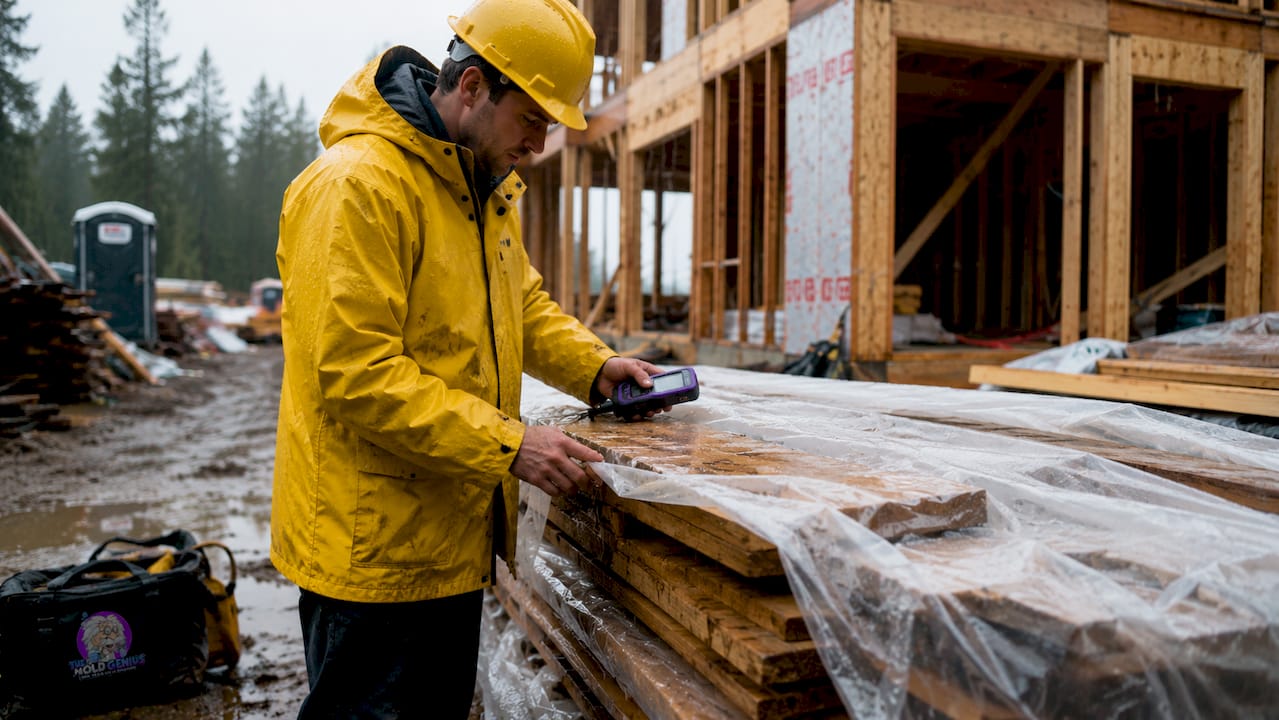
Pressure to meet deadlines makes this worse. Builders rushing timelines skip essential drying windows, sealing in moisture that feeds mold colonies behind finished walls. Rain exposure during framing is another common culprit. Lumber left wet for even a short time can harbor mold before insulation goes in.
Modern airtight construction traps indoor moisture that older, leakier homes would have vented naturally. Without mechanical ventilation systems like heat recovery ventilators (HRVs), that moisture accumulates until mold takes hold.
Common construction defects that drive mold issues in new homes include:
- Improper flashing around windows and doors, allowing water infiltration behind the wall assembly
- Missing or reversed vapor barriers, which trap moisture on the wrong side of insulation
- Poor site grading, directing rainwater toward the foundation instead of away from it
- Inadequate attic ventilation, causing condensation on roof sheathing
- Unsealed penetrations around pipes and wires, creating pathways for humid air
Pro Tip: Ask your builder for a moisture inspection report before drywall goes up. Once the walls are closed, hidden moisture problems become expensive to find and fix.
2. Where mold typically appears in new homes
Mold in newly built houses rarely shows up where you can see it first. The most common locations are behind drywall, inside wall cavities, and on framing lumber that was enclosed before it fully dried. By the time you notice a problem, the colony is often well established.
Flashing defects around windows and doors are a frequent entry point for water that feeds hidden mold. Basements and crawlspaces are high-risk zones because concrete slabs continue releasing moisture for months after pouring. Attics are another trouble spot, where poor ventilation creates temperature swings that generate condensation on roof sheathing.
The warning signs homeowners should watch for are listed below, along with what each one typically indicates.
| Warning Sign | What It Suggests |
|---|---|
| Musty odor in a closed room | Active mold growth, often hidden behind walls or under flooring |
| Staining on drywall or ceilings | Water intrusion from above or behind the surface |
| Swollen or warped trim | Prolonged moisture exposure in the framing behind it |
| Caulk failure around windows | Flashing or sealant defect allowing water entry |
| Condensation on interior windows | Excess indoor humidity, often from poor ventilation |
Repeated staining, musty odors, and swollen trim are red flags that require prompt investigation, not a wait-and-see approach. Builders sometimes tell new homeowners these signs are “normal settling.” They are not. Document every symptom with photos and dates.
3. How to prevent mold in new construction homes
Mold prevention in new builds requires a layered approach, not a single product or fix. Proper flashing, drainage planes, vapor barriers, and ventilation must all work together. Failing any one layer creates an opening for moisture to accumulate.
Follow these steps to protect your new home from mold before and after move-in:
- Verify drying time before enclosure. Confirm with your builder that framing lumber and concrete have reached acceptable moisture content before drywall installation. A moisture meter reading above 19% in wood is a risk threshold.
- Inspect vapor barriers and flashing. Walk the site before drywall goes up and check that vapor barriers are installed on the correct side of the wall assembly for your climate zone.
- Install an HRV or ERV system. Mechanical ventilation systems like HRVs are critical in airtight homes to manage humidity from cooking, bathing, and breathing. Run them continuously, not just when you notice stuffiness.
- Keep indoor humidity between 30% and 50%. Use a digital hygrometer to monitor levels. Anything above 60% creates conditions where mold can establish itself within days.
- Commission an independent moisture inspection. Hire a third-party inspector before closing. Builders have financial incentives to move quickly. An independent inspector does not. Learn how home inspectors find mold before problems become structural.
- Use mold-resistant materials where appropriate. Mold-resistant drywall slows mold growth but does not prevent it if moisture levels stay high. Treat it as one layer of defense, not the whole strategy.
- Grade the site correctly. The ground around your foundation should slope away from the house at a minimum of 6 inches over the first 10 feet. Flat or inward-sloping grades direct rainwater toward your slab.
Pro Tip: Run your bathroom exhaust fans for at least 20 minutes after every shower during the first year. New homes off-gas significant moisture from curing materials, and bathrooms amplify that load.
Good indoor air quality practices also reduce the moisture load your ventilation system has to handle. Cooking with lids on pots, venting dryers to the outside, and avoiding large amounts of indoor plants all make a measurable difference in a tight home.
4. What to expect from mold remediation in a new home
Professional mold remediation is the correct response when mold is confirmed in a new construction home. Remediation differs from simple mold removal. Mold removal addresses visible surface mold. Remediation addresses the source, the affected materials, and the conditions that allowed mold to grow. You need remediation, not just a surface clean.
Mold can start growing within 24–48 hours on wet materials, which means a slow response after discovering mold in a new home compounds the damage quickly. Acting within the first week of discovery limits both the spread and the cost.
Key steps in a professional remediation process include:
- Moisture detection and thermal imaging to locate hidden mold behind walls and above insulation without destructive opening
- Containment to prevent spores from spreading to unaffected areas during treatment
- Treatment of affected materials using EPA-registered antimicrobials or dry fogging systems that penetrate cavities traditional methods cannot reach
- Root cause correction to fix the moisture source, whether that is a flashing defect, grading issue, or ventilation failure
- Post-remediation verification through air sampling or surface testing to confirm mold counts have returned to normal levels
Severe cases of mold in new homes can cost over $50,000 in remediation, dehumidification, and material replacement. That figure reflects what happens when moisture problems go unaddressed for months. Early detection and fast action cut that cost significantly. Protecting your home’s equity depends on treating mold as a structural issue, not a cosmetic one.
What are the key takeaways about mold problems in new construction homes?
Mold problems in new construction homes stem from construction moisture failures, and early detection combined with layered prevention is the most cost-effective response.
| Point | Details |
|---|---|
| New homes are not mold-free | 68% of new homes in humid climates show moisture issues at handover. |
| Mold grows fast | Mold colonizes wet materials within 24–48 hours, making speed critical after any water event. |
| Prevention requires multiple layers | Flashing, vapor barriers, ventilation, and drying time must all work together. |
| Remediation beats removal | Addressing the moisture source prevents recurrence; surface cleaning alone does not. |
| Costs escalate quickly | Severe cases exceed $50,000. Early action is the most effective cost control. |
What 25 years of mold work taught me about new construction
New homeowners are the most surprised clients I see. They paid top dollar for a brand-new house and they cannot understand why there is mold growing behind a wall that was finished six months ago. The frustration is real, and it is completely valid.
Here is what I have learned after years of walking through new builds with a moisture meter: builders are not always cutting corners out of negligence. Many are working under contract deadlines that make proper drying times financially painful. The result is the same either way. Wet lumber gets sealed inside a wall, the home gets handed over, and the new owner spends the next year wondering why it smells musty.
The biggest mistake I see homeowners make is accepting the builder’s explanation that moisture is “normal” in a new home. Some moisture off-gassing is normal. Staining on drywall, swollen trim, and a persistent musty smell are not. Those are symptoms of a problem that will not resolve on its own.
My honest advice: get an independent inspection before your builder warranty expires. Most new construction warranties run one year for workmanship. That window closes fast. If you find mold or moisture damage inside that window, you have legal standing to demand a fix. After it closes, the cost is yours. Use the mold growth conditions checklist as a starting point for your own walkthrough before you call anyone.
Act early. The difference between a one-day remediation job and a $50,000 gut renovation is almost always how long the moisture sat before someone addressed it.
— Jim
Themoldgenius can help you resolve mold in your new home
Discovering mold in a home you just built is one of the most frustrating situations a homeowner can face. Themoldgenius has spent 25+ years helping Chicagoland homeowners resolve exactly this kind of problem, and their process is built for situations where traditional remediation falls short.

Their Pure Cloud Technology uses hospital-grade hydrogen peroxide and silver ions delivered as a dry fog, reaching mold behind walls, above insulation, and in tight cavities without tearing out finished materials. Most jobs wrap up in a single day with same-day return. Their three-phase process covers diagnosis with thermal imaging, treatment, and root cause correction so the problem does not come back. For professional mold removal and remediation in a new construction home, contact Themoldgenius for a free estimate.
FAQ
Can a brand-new home really have mold?
Yes. New homes can develop mold before or shortly after move-in due to wet building materials, rain exposure during framing, and poor ventilation. About 68% of new homes in humid climates show moisture issues at handover.
How quickly does mold grow in a new home?
Mold can begin colonizing wet materials within 24–48 hours. Any water event during or after construction requires fast drying to prevent mold from establishing itself.
Does mold-resistant drywall prevent mold in new homes?
No. Mold-resistant drywall slows mold growth but does not stop it when moisture levels remain high. It works only as part of a complete moisture control strategy.
What are the first signs of mold in a new construction home?
Musty odors, staining on drywall or ceilings, swollen trim, and caulk failure around windows are the most common early signs. Document each one with photos and report them to your builder before your warranty expires.
Is the builder responsible for mold in a new home?
Builder responsibility depends on your warranty terms and local building codes. Most new construction warranties cover workmanship defects for one year. Mold caused by construction moisture failures typically falls within that coverage window if reported promptly.